
Jim “Junior” Gilliam Mr. Versatility
Last week I submitted a post on Joe Black indicating it was one of my two favorite articles that I have ever written. The other was on Jim Gilliam that I profiled on Think Blue LA on April 25, 2016. AC was/is a huge Jim Gilliam fan and suggested I pull this one out of the mothballs so AC this one is for you, again. As a youngster growing up
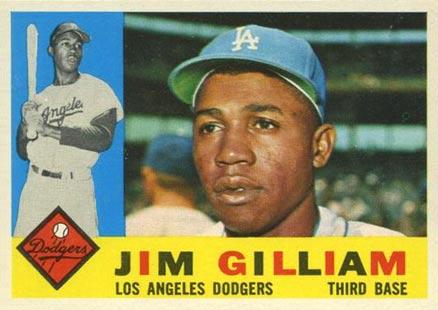
Last week I submitted a post on Joe Black indicating it was one of my two favorite articles that I have ever written. The other was on Jim Gilliam that I profiled on Think Blue LA on April 25, 2016. AC was/is a huge Jim Gilliam fan and suggested I pull this one out of the mothballs so AC this one is for you, again.
As a youngster growing up on the east coast of Canada in the 1950’s I fell in love with the Brooklyn Dodgers. There was just so much to love – Duke, Campy, Jackie, Newk, the two Carl’s, Gil, Pee Wee, and the list goes on. Don Drysdale was just starting to come into his own before the move to Los Angeles and Sandy Koufax had not yet blossomed. However, there were other lesser-known players that I always appreciated for the roles they played in the success of the Brooklyn Dodgers – Clem Labine, Jim Hughes, Billy Cox, Preacher Roe, Sandy Amoros, George “Shotgun” Shuba, Jim Gilliam and others.
One of the lesser lights that particularly still stands out in my memory of those years with the Brooklyn Dodgers and later as a member of the Los Angeles Dodgers was “Mr. Versatility” and I think the prototypical utility player before the role was so defined and embraced by MLB. He did so I believe because he was a team player and confident in his abilities.
Jim “Junior” Gilliam was, in my opinion, the first real Dodger utility player and most certainly so in my lifelong career as a Dodger fan which now spans 67 years. Some will argue that Gilliam was not a utility player because he played his first two years with the Dodgers at second base. However, even in his second year, he began to branch out to other positions. Gilliam was indeed a utility player able to play several positions competently over the course of his career and with the confidence of his manager.
As a black player, Jim Gilliam’s path to major league baseball was not much easier than that of Jackie Robinson’s although Robinson had blazed a trail for him. However, his determination to not only get there but to excel as a major league player was not unlike that of his black teammates – Jackie Robinson, Roy Campanella, Don Newcombe, and Joe Black.
Gilliam was born in Nashville, Tennessee on October 27, 1928, and attended Pearl High School in Nashville. His early life was not easy as his father died when he was only two and his mother had to do housework to provide for him, her only child. She was able to buy him his first baseball glove when he was 14. Within two years he was earning a return on that investment by playing for the Crawfords, a local team, and getting paid to do so.
In 1946 just three years after getting his first glove Jim Gilliam got a tryout with the Baltimore Elite Giants of the Negro National League. The tryout became a defining moment in his baseball career. Only 17 years of age at the time he made the team but perhaps, more importantly, Baltimore’s manager, George “Tubby” Scales, noticing that Gilliam had trouble hitting curveballs from a right-handed pitcher simply told him to go to the other side of the plate and a switch-hitter was born. Additionally, Scales addressed the youngster as “Junior” and he became known as “Junior” Gilliam.
By 1950 he had been selected as an all-star three times to compete in the East-West Games. By now he was getting noticed by major league teams and a Chicago Cubs report stated he was “the best young prospect in the [then] Negro American League.” The scouting report advised Gilliam was “a clean-cut youngster with an accurate snap throw, a good eye, a hustler with the knack for punching the ball to all fields.”
Gilliam’s contract was purchased by the Cubs but for whatever reason, it was decided he wouldn’t make it with the Cubs. One suggestion was that he wouldn’t be able to hit AAA pitching. Another was that the Cubs had a better prospect so there was no place for Gilliam to play. However, his future roommate with the Dodgers, Joe Black, felt that the reason was that he hadn’t played integrated ball and being socially shy the Cubs believed he could not adapt to major league baseball.
Fortunately, Gilliam was signed by the Dodgers in 1951 and by 1952 – at age 23 – he became the International League’s MVP. Playing for the Montreal Royals he hit .303 while leading the league with 133 runs scored along with 41 doubles and driving in 109 runs.
The Dodgers were looking for a leadoff hitter and it was his plate discipline that paved his path to Ebbets Field. With the AAA Royals in 1952, Gilliam walked 100 times while striking out only 18 times.
By the end of his rookie season with the Dodgers in 1953, he had started 146 games, been on base in 130 of them, and scored 125 runs along with a. 278 batting average, a .383 OBP and a .415 slugging percentage. He led the league with 17 triples and 710 plate appearances. Gilliam walked 100 times in 1953 setting a new walks record for rookies. At the end of the season, he was selected as the National League Rookie of the Year.
Jim Gilliam played 14 years with the Dodgers, the last two in 1965 and 1966 as a player-coach. He retired after the 1966 season and continued to coach with the Dodgers through manager Walter Alston’s reign which ended following the 1976 season. Tommy Lasorda and Jim Gilliam were the two leading contenders to replace Alston. Lasorda got the call and asked Gilliam to remain with the team as a coach. That was to be Gilliam’s only managerial interview.
He never evolved into a star player, at least statistically, and some say it is because he played baseball the year around playing winter ball in Latin America between MLB seasons. However, he did evolve into the quintessential but yet undefined utility player. During his career, all with the Dodgers, he played 1,046 games at second base, 761 at third base, 203 in left field, 29 in right field, five in center field and two at first base. Offensively he accumulated 1,889 hits while walking 1,036 times and striking out 416 times finishing his career with a .265 batting average and an OBP of .360. He hit .266 from the left side and .261 as a right-handed hitter. By comparison, a modern-day super-utility player, Ben Zobrist, has a career batting average of .265 and an OBP of .355.
Gilliam was part of trade rumor speculation practically every season he played with the Dodgers. He started every season after his first one not being the leading candidate for any starting position, but for the 12 seasons, until he became a player-coach, he averaged 146 games played. In true Jamey Wright fashion, he had to win a spot each and every year after his rookie year. He was actually released by the Dodgers in both 1964 and 1965 and resigned as a free agent.
The 5’10” -175 lb switch-hitter had a baseball acumen that did not go unnoticed by his manager and fellow players. His greatest supporter was manager Walter Alston who perhaps above all others saw the need to keep Gilliam in the line up at some position because of his reliability, versatility, and durability.
First baseman Ron Fairly explained Alston’s fondness for Gilliam: “He never missed a sign; all the years he played for Alston, Walt would say the one player who never missed a sign was Jim Gilliam,” Fairly stated.
In 1961 Alston added: “He gets on base. He can punch the ball on the hit and run. He steals and never throws to the wrong base. He knows how to get a walk. He has all the little things that go to make up a good ball club. I don’t think he’s ever been late a day in his life.”
In 1962 Dodger shortstop Maury Wills stole 104 bases and was caught only 13 times. Little did we know that Wills was not working alone; he had Jim Gilliam batting behind him aiding and abetting in his thievery with a skill not gifted to many.
“I try to help him,” said Gilliam. “Lots of times there are pitches I could swing at, but I see Maury out of the corner of my eye and take the pitch if I think he’s going to get the base. Or else I’ll take a strike, even two strikes to give him a chance to steal it. If it looks like he could be caught, I’ll hit at the pitch. Maybe I’ll punch it through and Maury will be able to make it to third. Or else I’ll foul it off and he’s not out.”
“Not a man in baseball can do it better,” said coach Leo Durocher, “because Jim’s a real mechanic with that bat. He’s the best two-strike hitter in baseball.”
Bill James created a measure designed to be a proxy for Baseball IQ, a stat he called “Player Performance Index,” a combination of specific batting, running and defensive statistics meant to pull out “percentage players.” Gilliam ranks third all-time for that measure, behind only Cincinnati Reds second baseman Joe Morgan and Philadelphia Athletics second baseman Max Bishop.
Jim Gilliam’s life ended all too soon at the age of 49. On September 15, 1978, he drove manager Tommy Lasorda to Dodger Stadium and then returned home. He suffered a cerebral hemorrhage at home. He later died on October 8th one day after the Dodgers won the National League title.
Los Angeles Times sports columnist Jim Murray penned a tribute to Jim “Junior” Gilliam and began his tribute with these words: “I guess my all-time favorite athlete was Jim Gilliam. He always thought he was lucky to be a Dodger. I thought it was the other way around.” Jim Gilliam’s number “19” was retired on October 10, 1978. Among the ten Dodgers to have had their number retired he is the only one not to have been elected to the Baseball Hall of Fame. If there was a Hall of Fame for utility players, James William Gilliam would be a solid choice to be the first inductee
More from Dodger Talk

Enjoy it While You Can!
It was both surprising and not surprising to me that the Dodgers signed Kyle Tucker. That they can make it work is a tribute to the true genius of Mark Walter and Andrew Friedman. Enjoy it while you can, because it will end soon. In the upcoming CBA and talks among owners, MLB…

Dodgers Food Trailer
I did this interview a couple of weeks ago with Chef Mike, who runs the Dodgers Food Trailer for the Great Lakes Loons. They are there for every home and road regular season and playoff game. They prepare three meals a day for approximately 50 people (players and coaches). Since games end late most evenings, they do not prepare breakfast. Many of their hotels have a complimentary breakfast anyway. However,…
Meet LAD 2026 Draft Picks 1-12
3 picks were High School players (2 SS and 1 OF). There was a college OF, college catcher, college SS, and 10 college pitchers. Of all the talk for a need for a catcher, the only catcher the Dodgers selected was Luke Bard, son of LAD bullpen coach Josh Bard. Bard was a 4th year senior from Houston Christian University. He is not a prospect, so the Dodgers are still…

Interview with Paul Beachy – Team Bus Driver For The Great Lakes Loons (LA Dodgers Minor League Team)
It’s been a few days since I did this interview. We have evidently been working my son-in-law (the video guy) like a rented mule at US Water Systems. However, I am taking him to London with me in a few days, so maybe Watford will buy him a pint as a tip, but he’s a dang Red Sox fan, so there is that! I thought that it would be interesting…
Discussion (36)
Disagree, not disagreeable
Needless to say I am in Zach McKinstry’s corner as I have been since his days as a Loon. For a 33rd round selection he has simply forced the team to pay attention to him. I understand what his role will be going ahead and he has prepared himself for it. He might not be a Kike or CT3 but I would not underestimate him. My hope is that he gets to play MLB somewhere but barring injuries I expect it might not be with the Dodgers. In any event, being added to the 40-man roster gives him a better payday.
Lots of activity…
Yankees DFA Greg Bird and Ellsbury.
Jose De Leon headed to Cincy.
Rays designated Matt Duffy.
Jharel Cotton was DFA’d by the A’s today to make room on the 40 man for other guys.
AC, you and I have spoken about Kluber a few times. Do you think there is any way that the Indians would part with Clevinger? If so, what do you think they would ask for him as opposed to what they might ask for Kluber?
DODGERS SELECT RHP WHITE, IF/OF MCKINSTRY AND OF PETERS TO 40-MAN ROSTER
LOS ANGELES – The Los Angeles Dodgers today added right-handed pitcher Mitchell White, infielder/outfielder Zach McKinstry and outfielder DJ Peters to the 40-man roster. The roster is at 40.
White, 24, was originally drafted in the second round of the 2016 First-Year Player Draft out of Santa Clara University. In four seasons with the Dodgers, he has posted a 14-15 mark with a 3.97 ERA (130 ER/294.2 IP) and 311 strikeouts against 102 walks. Last season, he split the season between Double-A Tulsa and Triple-A Oklahoma City, going a combined 4-6 in 23 games (20 starts) with a 5.09 ERA (53 ER/93.2 IP) and 105 strikeouts.
McKinstry, 24, spent the majority of the 2019 season with Double-A Tulsa and was named to the Texas League Mid-Season All-Star after hitting .279 (95-for-341) with 16 doubles, four triples, 12 homers and 52 RBI in 95 games for the Drillers. He was promoted to Triple-A on August 3 and finished the campaign with Oklahoma City, slashing.382/.421/.753 with eight doubles, two triples, seven homers and 26 RBI in 26 games for the Oklahoma City Dodgers. In four combined seasons with the organization, he is a .270 (331-for-1226) hitter with 61 doubles, 14 triples, 30 homers and 149 RBI. The Ohio native has moved all over the diamond in his Dodger career, playing 153 games at second base, 102 at third base, 78 at shortstop and 16 in the outfield. The left-handed hitter was originally drafted in the 33rd round of the 2016 First-Year Player Draft out of Central Michigan University.
Peters, 23, joins the Dodgers 40-man roster after splitting the 2019 season with Double-A Tulsa and Triple-A Oklahoma City. In 68 games for the Drillers, he batted .241 (60-for-249) with 10 doubles, 11 homers and 42 RBI while batting .260 (54-for-208) with 10 doubles, 12 homers and 39 RBI in 57 games for Oklahoma City. In his Dodger career, he has appeared in all three outfield spots, recording 25 games in left field, 94 games in right field and 311 in center field. The Southern California native was originally drafted in the fourth round of the 2016 First-Year Player Draft out of Western Nevada Community College (Nv.). In four seasons with the organization, he has hit a combined .269 (461-for-1714) with 92 homers and 271 RBI.
1955 World Series, game 7, top of 6th inning. Dodgers had scored their second run of the game, and the bases were loaded, two outs, with second baseman Don Zimmer scheduled to hit. Walt Alston pinch hits for Zimmer, sending George “Shotgun” Shuba to the plate, but he grounds out to end the Dodgers half of the inning. In the bottom of the 6th inning the versatile Gilliam moves from LF, where he started the game, to second base, and the left hand throwing Sandy Amoros goes into game in LF. Every Dodgers fan knows the rest of the story.
Jim Gilliam will never be lost in our memory banks. Hopefully Kike can follow the trail he blazed. Something that they have in common besides their versatility and passion for the game is they were/are usually seen with a smile on their faces.
This one is for you Mark.
Open on www.thinkbluela.comhttps://www.thinkbluela.com/2015/01/meet-kike-hernandez/Great article on a remarkable player DC! Thank you!
Sorry Mark, but Kike doesn’t hold a candle to Gilliam. Gilliam was far and away the more complete player.
I really enjoy these articles on Dodgers from the past. Thanks!
Great read DC!! Keep it up
Very talented player for the Dodgers. His walks to strikeout ratio was awesome. Thank you DC for a wonderful tribute to Jr. Gilliam.
I still have hope that Kike will be the consummate swiss-army knife. He started at age 22 and still is not yet 28. Zobrist really came into his own at age 28. Junior was good right out of the box. The reality of the situation is that the Dodgers will likely lose Kike. Someone will offer him Starter Money after 2020 or the Dodgers will trade him this offseason. Junior was amazing but most of his games were at 2B and 3B. He played 222 games in the OF and the rest at 2B and 3B. Not to disparage Junior, but Kike is a very good defender at every position. I think we sometimes forget how versatile he is. Would it surprise you to learn that Kike has more HR than Junior?
Maybe I am stealing Junior’s thunder, but Kike is a favorite of mine… he just has not quite yet achieved the degree of success I had hoped for.
Those were the days. Very good column on Jim Gilliam.
Great work DC… Junior played the game the way it should be played… Full bore…
Great tribute by Jim Murray, IMO the greatest sports columnist SoCal has ever seen…
And then there was Plaschke!!!
Thank you, DC. #19 is proudly smiling from above.