
The Fall of Baseball Cards
This is the second part in the two-part article on baseball cards penned back in 2012. I had collected baseball cards as a youngster in the fifties. Unfortunately, I gave my collection to a good friend in 1957 when my family moved from the small town of Lunenburg in Nova Scotia to the city of Edmonton, Alberta. At that point, my life was over – or so I thought, and
This is the second part in the two-part article on baseball cards penned back in 2012.
I had collected baseball cards as a youngster in the fifties. Unfortunately, I gave my collection to a good friend in 1957 when my family moved from the small town of Lunenburg in Nova Scotia to the city of Edmonton, Alberta. At that point, my life was over – or so I thought, and I wanted my best friend to have my cards. Even more unfortunately, they were lost in a fire that later badly damaged my friend’s home.
As a teenager in Edmonton I didn’t acquire any cards. In fact, I don’t recall seeing them in the stores of the city. In any event, I expect my money was more important for other things at that point.
After a hiatus of twenty-eight years, I began collecting cards again in 1985. I purchased a 1981 boxed Fleer set from a card shop in Los Angeles. For the next ten years our son Jamie and myself went on a bit of a collecting binge (but I can stop at any time, mind you). During that time I easily acquired about 30,000 cards, mostly in boxed sets at very reasonable costs. Jamie also purchased many cards, probably in the 20,000 range.
At the same time, we collected individual cards – mostly of players that were playing with star quality and players we tried to predict would become stars. Hence, with Ben MacDonald, Andy Benes, Alex Fernandez cards, I proved that even then success was difficult to predict. I did, however, collect quite a few Tony Gwynn cards and Jamie quite a few Kirby Puckett cards during this span, but most of my focus was on collecting Dodger cards.
Jamie and I were elated when Kirby Puckett and Tony Gwynn were inducted into the Hall of Fame in 2001 and 2007 respectively. Having bought many of their cards over the years, it almost felt as though we helped them get there.
After about ten years in hot pursuit of cards of our choice, things changed. There now seemed to be an indefinite number of companies producing cards – Topps, Bowman, Fleer, Donruss, Score, Sportflics, Leaf, O-Pee-Chee, Upper Deck, Studio, and it became difficult to acquire all of those sets.
To complicate matters, it became difficult to even find boxed sets after 1995. Cards shows in our area had disappeared, card shops closed up, eBay was just getting off the ground and was not yet an option for buying cards, and entirely new marketing schemes took over. Card companies began releasing two or three completely different series every year and made them available only in packs of ten (or so) for $2.95 or more per pack. Each series contained special cards that were almost impossible to acquire in order to complete that set. Their goal, of course, was to get you to buy more packs of cards in your effort to get those elusive special cards and you ended up with a lot of doubles or triples that you did not need – and you were still missing that special card; a scheme if ever there were one… and a scam.
The cost of collecting a set of cards in that manner and the frustration of so many companies producing cards caused us to change our collecting habits. We began collecting only individual cards when we could find them, and I continued to pursue Dodger cards. We thought that our concerns were peculiar to us because of where we lived in rural Nova Scotia. Little did we know that the path that we were forced into was a path that was being followed by thousands of card collectors around the world.
How did this all come about? A number of things happened. After World War II Topps was the only company still producing cards. Topps enjoyed decades with no real rivals, until a legal decision at the beginning of the 1980’s opened the doors for other would be manufacturers to enter the fray. Fleer, Donruss and other companies started production thinking a baseball card boom was in the making. At the height of their popularity in the early 1990’s, card manufacturers produced an estimated 81 billion baseball cards a year. “That’s about 325 cards for every man, woman, and child in the United States,” notes Dave Jamieson in his book, “Mint Condition: How Baseball Cards Became an American Obsession”
The boom turned out to be a bust as card companies were bought out or went bankrupt. Last year, Major League Baseball decided they were only going to renew their contract with Topps, so we are back where we started with Topps a sole distributor of baseball cards. Well, not quite, as Panini and Upper Deck have an arrangement with the Major League Baseball Players Association giving them the right to make MLBPA-approved baseball cards, but without team logos or nicknames on their products. Who would want baseball cards without “Dodgers” or “LA” or the Dodger logo on display?
What caused the glut on the market that killed the industry as an investment industry as some had envisioned? A court decision, yes, but there were other factors. In 1979, James Beckett published the first comprehensive book of its kind entitled Beckett Baseball Card Price Guide (which now comes out annually and even has a monthly on-line subscription) that put a published price on individual cards, thus changing how people, young and old, looked at cards. This publication may have had an influence on the belief that baseball cards could be an investment opportunity such as precious metals and, as such, should be produced in large volume.
As Dave Jamieson wrote in Mint Condition –
“It was greed on the part of card makers because they rolled out so much product that it diluted the power of the cards and killed the golden goose. It was greed on the part of the baseball union, because they sold a lot of rights – and made a lot of royalties on those rights – until they had too many card makers. Then you had greed on the part of dealers, surly guys who didn’t care to talk to the nine-year-olds who came into their shops, and were there just to sell cards. Finally, collectors were swallowing up everything thinking it was going to turn to gold.”
Another suspect in the fall of the baseball card was the baseball strike of 1994-95. The strike opened the door for other sports to fill the void in interest and in purchasing cards. Young collectors turned to Pokémon and Yu-Gi-Ho cards in droves. For me the reason for the decline is that card collecting no longer was a hobby. It had priced itself right out of the range of the very clientele that had supported it’s growth for more than a century – kids. The newer cards became more and more fancy, more glossy and, of course, more expensive – especially autographed cards.
Can the golden days of baseball card collecting be recovered? Probably not; but Dave Jamieson has the best idea yet:
“…restore it to what it once was. They should convince everyone, children and adults alike, that baseball cards are exactly what they were before the boom times of the 1980’s and ‘90’s – cheap play things suitable for tacking to the wall, flicking on the playground, or stuffing into a shoe box.”
More from Dodger Talk
The Game Has Changed and Not For the Better
Earlier in the week I had a dialogue with MT and Bluto regarding the lack of confidence I have in RVS as a competent MLB Team Batting Coach. I have no doubts that his methodology can and does work for some, but each batter is different and needs a different approach. At least…
Meet Me In St. Louis
The St. Louis Cardinals have always been an iconic organization in MLB and arguably the most successful NL via winning more WS than any other NL team, trailing only the NYY. The Cardinals have won 11 WS in 19 appearances. They also hold the ire of Dodger fans as St. Louis has beaten the LAD in four postseason series (1985 NLCS, 2004, NLDS, 2013 NLCS, and 2014 NLDS) against a
Dodger Killers
With the passing in the last week or so of Bob Gibson, Whitey Ford, and now Joe Morgan, I got to thinking about players who always seem to be at their best against the Dodgers. It has always seemed to me like some players just have another team s number. Take for example, Willie McCovey. His BA against the Dodgers in 297 games was .241. He hit 45 HR s and had
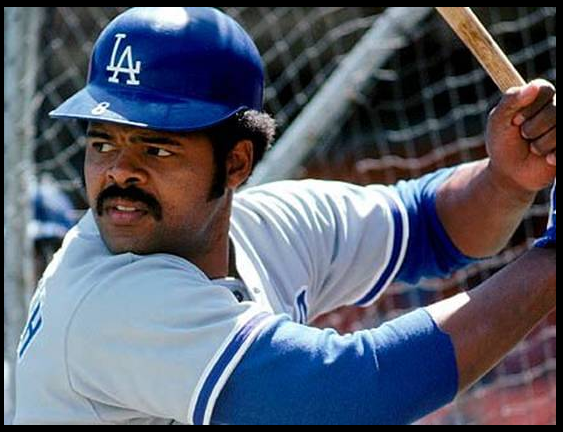
Reggie Smith
One of the better mid-season trades that the Dodgers ever made was acquiring Reggie Smith from the Cardinals for Freddie Tisdale, Bob Detherage and Joe Ferguson in June 1976. While many Dodger fans were heartbroken to see Tisdale leave the Dodger family, getting Smith more than made up for that loss. After joining the Dodgers, Smith hit .280 with 10 homers and 26 RBI in the 65 games following the
Discussion (40)
Disagree, not disagreeable
According to MiLB, the Dodgers have released the following minor league players:
RHP Kieran Lovegrove
RHP Tyler Ferguson
RHP Ricky Knapp
LHP Casey Crosby
LHP Ben Holmes
C Jose Lobaton
C Hamlet Marte
INF Jake Peter
3B Eric Peterson
OF Blake Gailen
OF Starling Heredia
Heredia was signed in 2015 and is still only 21. Got a $2.6M bonus. Other than that I don’t see any names on the list that are a big surprise.
Here’s a link to the Future Dodgers portal and his spreadsheet which tracks the Dodger draft for those who like details.
You’ll enjoy this AC as I assume you’re missing spreadsheets right about now.
Open on docs.google.comhttps://docs.google.com/spreadsheets/d/1Tuooytw157kjyMeY1ecRDnPq9FTGGWQOwzWSgsQpqN4/edit#gid=511246083Reports that Jake Vogel signed for $1.6M. Leaves just less than $1.2M to sign Beeter
Good news on the draft front. The Dodgers have signed Jake Vogel for $1.622 million. Well over slot, but for the future Brett Butler, you take a risk
Another marketing ploy Topps used starting in the 70’s I think, was issuing a traded set after series 7 hit the stores. It had all of the players who had been traded during the prior winter and who had not been issued a card with their new team, You could purchase the entire set for about 9 bucks. They did that for many years and those sets are readily available on Ebay.
Great stories about everyone’s cards! I am about ten years younger than those of you who collected in the 50’s. I always wished I had the chance to see the Dodgers play in Brooklyn, where my father was born. He moved to LA as a boy in the 30’s, and brought his love of the Dodgers with him. As a boy in the 60’s, I would walk about a mile to the nearest grocery store to buy a pack of Topps with what little pocket change I had. I will never forget the disgusting, sweet taste of the gum inside, which I often just threw away. And I can also relate to the feeling of excitement at opening the packet to see what was inside, and the joy when you got a really good one. I had a friend whose father bought him a complete set of Topps cards every season. His father could afford it. My friend showed me the room where his father kept the boxes neatly stacked. My friend was barely allowed to touch them. They were probably worth a fortune if his father sold them at the right time. But who took more pleasure in his cards, my friend or me? My cards were in terrible condition from all of the awful, ridiculous things I did with them. They were probably worth little, even had I sold them at their peak. But they were well loved, and I’m the one with the memories. The gold rush for cards, of course, was a speculative bubble. Like the tulip bubble here in the Netherlands in the 1600s, where one prized bulb could fetch an astronomical price. It burst, of course. What goes up must come down. Fundamental law of economics.
In the mid-’80s I gave my collection of Hartland Statues, including the infamous Dick Groat, to a friend when his son was born. What was I thinking?
I had a collection of Topps 1959 (two missing cards) and a complete 1960 (with an extra Willie Mays). Last year I put them up for auction with Heritage Auctions. They did an outstanding job for me. They make sure your type of collection is the only one up for auction to maximize your price. It was fun to go back through them when preparing them for the auction. Brought back a lot of memories. I’ve been in love with baseball since 1957 and especially the Dodgers. Anyway, the cards sold for just over $5000. It was a blast watching the bidding live on internet (All internet based auction). The bidding really starts the last 1 1/2 hours. A good friend of mine who referred me to Heritage had sold an unopened box of Topps 1959 for $50,000 (less 10%). I had a hard time believing someone would pay that much money. So he turned less than a $2 investment into a $45,000 net return.
I’m not very optimistic that MLB will be able to complete the season and the playoffs. If there are many positive tests in a short time frame there will be a “close things down” knee jerk reaction and ask questions later. That is probably only going to happen once and then it’s over. Hopefully, that won’t be the case. It’s strange times indeed.
And, Jeff thanks so much for keeping this site alive. And, to the contributors that keep it interesting even with no baseball right now. I enjoy the diverse personalities on board.
Found this on Facebook. Message to all the rabble rousers in the country today.
March 17th we were all Irish.
May 5th we were all Mexican.
How about this July 4th we all act like Americans.
And that is about as political as I wish to get on this board. Wishing everyone a happy and safe Independence Day celebration.
Mike Trout not sure he wants to play. He has a new baby on the way and is still considering his options. He did report to camp.
When my friend in his school gave me his brothers cards, there were a lot of cards from the early 50’s. He brought me a team at a time, saving the Dodgers for last. Seeing a 54 Snider for the first time was a rush. But what he had that was really cool were almost all of the 55 and 56 Dodgers. All the stars. Campy, Duke, Hodges, Jackie..what a rush. There were some 57’s in there too, but not many since that was the year his brother had quit collecting and went on to more adult pursuits…I>E. the more expensive type….girls. When my foster father made me throw all of my cards out in early 1965. I kept all of my Dodgers. Hid them away so he would not know I had them. I gave those cards to his nieces son before I went in the army. He did not keep them as far as I know, and they are all gone. Worst feeling in my life up to that point was dumping those boxes of cards in the trash. Mays, Mantle, Aaron, all of those memories committed to a dump.
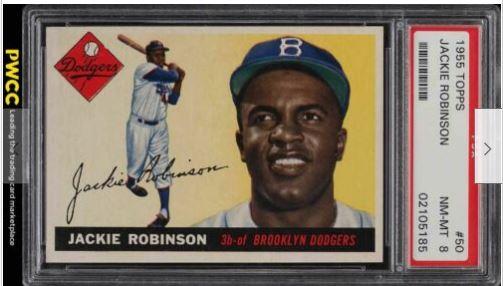
Let me tell you a story about that Jackie Robinson card. Some 20 years ago we went to a flea market in the mall in Halifax one Sunday afternoon. I came across a group of 1955 cards that were in such good condition that I thought they were reprints.
I went through the cards stacked in a pile and picked out five cards for $2.00 each. They were: Jackie Robinson (#50), Jim Gilliam (#5), Johnny Podres 9(#25), Sandy Amoros (#75), Karl Spooner (#90). That would be Spooner’s rookie card.
On the way home Jamie asked to see them. I took them out of my shirt pocket and mentioned they were reprints. I had not looked on the back of the cards. Jamie quickly indicated they were not as there was no reprint designation on the card. By shoving them in my pocket I actually put a tiny crease in Jackie’s card.
I am not sure what other cards were in the pile of probably at least 50 cards. It saved me from feeling guilty as I truly thought they were reprints. There was no point to drive back as by then the flea market would have been closed.
If I had realized what he had I would have advised the seller, a man probably in his 30’s, and suggested he go to a card dealer for appraisal.
I still can’t believe I stumbled across a gold mine and didn’t check the back of the cards.
We tossed cards against a wall and the card closest to the wall won all cards tossed. Leaners were always the best toss. We also dropped cards and called heads or tails. A lot of kids that did not follow baseball bought cards to play. That led to some tossing more valued cards while others who knew the players would toss less valued cards. It was fun for both though.
Thanks Harold for the continuation of your article on card collecting. I still have unopened boxes of entire years series up in my attic. My son bought them for a couple years in a row (1990 +/-). He bought them for “investment reasons”. But here, 30 years later they’re not worth much because of the over production you mentioned.
Buying cards in the 50’s, a few packs at a time was the way I bought mine. The opening of each pack was so exciting. So happy when you found cards that you didn’t have yet and so disappointed when you got doubles. I don’t think it will ever be that way for kids again.
I had two paper routes, one morning and one afternoon. I spent most of my money on cards until 1957 when R & R records started eating up a good part of my earnings. Unfortunately, I gave all my base ball cards away but still have hundreds of 45 rpm records.
BTW, I mentioned yesterday that I only collected Topps cards. I do remember having a few cards that showed a picture of a player set inside a T.V. screen. Do you know what company made those cards?
2020 All Star game at renovated Dodger Stadium cancelled, so we’ve been given the 2022 game. Damn, now I need to renew my seats for 2 more seasons!
Open on www.espn.comhttps://www.espn.com/mlb/story/_/id/29405120/mlb-cancels-2020-all-star-game-dodgers-now-host-2022The best card that I recall owning was a Piazza rookie. Bought it for $5, and sold it for $125 in college (because in college when you don’t have a brain, $125 seems like it could pay for an endless supply of Natural Light)