
What Would the Great Philosophers Say About the Dodgers?
Eight great minds. One baseball team. Absolutely no agreement.
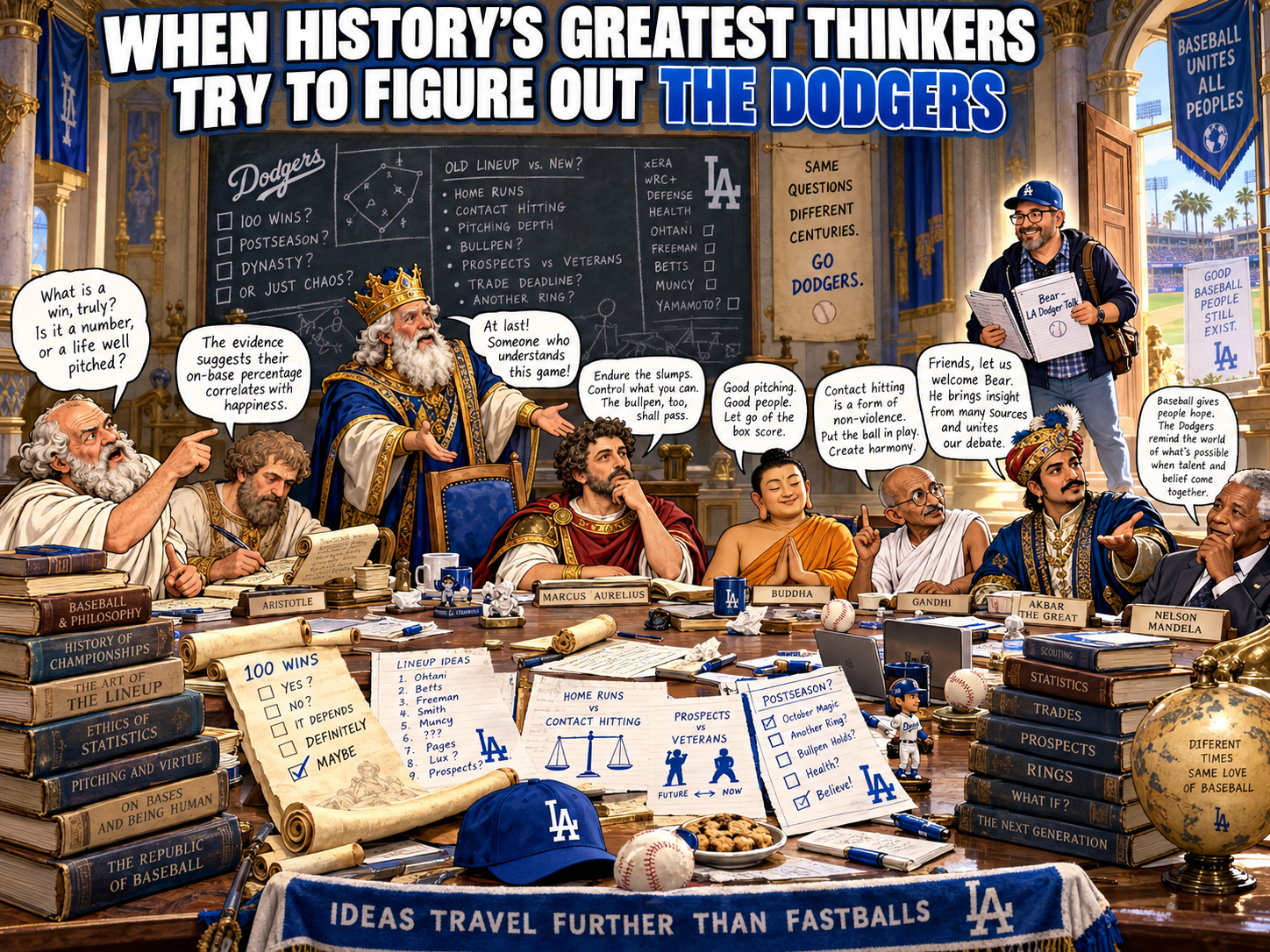
What Would the Great Philosophers Say About the Dodgers?
By Bumsrap
Eight great minds. One baseball team. Absolutely no agreement.
Somewhere beyond the boundaries of time, eight of history's greatest thinkers gathered to discuss the Los Angeles Dodgers.
The meeting had been called by Socrates, the ancient Greek philosopher who believed that asking questions was the best way to discover the truth.
Unfortunately, he had already asked forty-seven.
"Let us begin," Socrates announced. "Did the Dodgers have a successful season?"
"They won a hundred games," said Aristotle.
"Then they were successful?"
"They failed in the postseason."
"Then they were unsuccessful?"
"Can you ask a question that doesn't require another question?" interrupted King Solomon.
Socrates smiled. "Would that help?"
Solomon rolled his eyes. He had once been considered the wisest king in the world. He was beginning to question his decision to attend.
Aristotle, a student of Plato and a man who had studied practically everything, examined the Dodgers' roster.
"The problem is balance. Excellence in individuals does not guarantee excellence in the whole. A baseball team requires power, speed, defense, pitching, and the ability to adapt."
"Precisely," said Solomon. "The Dodgers have enough power to light up a city, but their lineup is so old it looks like they were elected to be in it."
Marcus Aurelius, the Roman emperor whose Stoic philosophy emphasized discipline and accepting what cannot be controlled, looked offended.
"Age does not necessarily diminish wisdom."
"Nobody said anything about wisdom," Solomon replied. "We're talking about getting from first to third on a single."
Buddha smiled.
"Perhaps the Dodgers have become too attached to the home run."
"What's wrong with home runs?" asked Aristotle.
"Nothing. But suffering begins when we insist that happiness can come only from one outcome."
Solomon leaned forward. "Tell that to a man watching three consecutive strikeouts with runners in scoring position."
"Then he must release his attachment."
"To what?"
"Winning."
Solomon stared at him. "Have you ever met a Dodgers fan?"
Gandhi, who believed deeply in discipline and that the means mattered as much as the ends, entered the discussion.
"Perhaps the hitters need greater patience. A pitch outside the strike zone does not deserve to be swung at simply because the batter possesses the strength to hit it."
"Exactly," said Aristotle. "And with two strikes, perhaps a shorter swing."
"Put the ball in play," Gandhi continued. "Make the opposition participate in your success or failure."
Solomon nodded. "Finally, someone who understands that striking out is not a productive out."
"Unless," Socrates interrupted, "the alternative is grounding into a double play."
Everyone looked at him.
"Must you always do that?" asked Solomon.
"Do what?"
"Never mind."
Akbar the Great, the Mughal emperor celebrated for encouraging discussion among people of different religions and philosophies, had been studying the Dodgers' hitting coaches.
"I find the disagreement fascinating. Some demand that Robert Van Scoyoc be fired. Others insist his approach helped produce championships. Perhaps both sides possess part of the truth."
"That's impossible," said Solomon. "This is baseball. Somebody must be wrong."
"Consider," Akbar continued, "whether the Dodgers should abandon their commitment to slugging or simply become more adaptable."
"An important distinction," Aristotle agreed.
"I once invited scholars of different faiths to debate their beliefs," Akbar said. "I believed I had witnessed the full range of human disagreement."
"And then?" asked Socrates.
"Then I discovered LA Dodger Talk."
Marcus Aurelius laughed.
"Perhaps the problem is not disagreement," he said, "but our response to it. The Stoics teach that we control our judgments and actions, not the behavior of others."
"Then Dave Roberts should control his pitching decisions better," Solomon said.
"He controls the decision," Marcus replied. "He cannot control whether the next batter hits a home run."
"Then why do we blame him?"
"Because," Aristotle observed, "fans possess a remarkable ability to know the correct decision after discovering the result."
"An interesting form of wisdom," Socrates said. "Perhaps we should examine it."
"Please don't," Solomon begged.
The conversation turned to the Dodgers' prospects.
"Should they trade their young players for proven veterans?" Socrates asked.
"That depends," Solomon answered.
"On what?"
"Whether the prospect becomes a star."
"But how can we know?"
"We cannot."
"Then how can we judge the trade?"
"Apparently," Solomon sighed, "we wait five years and announce that we knew all along."
Aristotle nodded. "A familiar method among baseball enthusiasts."
Nelson Mandela, who understood how sports could unite people across generations and backgrounds, had been listening quietly.
"Gentlemen, you have discussed batting averages, launch angles, prospects, payroll, and managerial decisions. But perhaps you have overlooked something."
"What?" asked Solomon.
"Why people love baseball in the first place."
He paused.
"A grandfather taking his grandson to Dodger Stadium. A father teaching his daughter how to keep score. Old friends arguing about a lineup they have argued about for fifty years. Sports can bring people together even when they disagree about everything else."
For a moment, nobody spoke.
"Beautifully said," Buddha replied.
"And perhaps," Mandela added, "a hundred-win season deserves some appreciation even when it ends in disappointment."
Marcus Aurelius nodded. "We cannot change the past. We can only prepare for the future."
"Then perhaps," Socrates suggested, "we have finally discovered wisdom."
"Not quite," Solomon said. "We still haven't decided whether Ohtani should pitch next year."
The room erupted.
Aristotle wanted to examine the statistics. Marcus Aurelius worried about what could be controlled. Gandhi urged restraint. Buddha counseled against attachment to outcomes. Akbar suggested hearing every viewpoint.
Socrates asked seventeen additional questions.
Then the door opened.
A gentleman entered carrying several pages of notes.
"Excuse me," he said. "I'm Bear, from LA Dodger Talk. I've been reading your discussion."
The philosophers turned toward him.
"I thought you might appreciate someone who actually knows something about baseball."
Solomon stood and offered him his chair.
"Thank heaven," he said. "We've been waiting three thousand years for you."
Quick Take
Mookie Betts presents a different problem from Freddie Freeman and Teoscar Hernández.
His offensive production has declined dramatically from his superstar years. However, unlike the other two, Betts has transformed himself into a genuinely valuable defensive shortstop.
Mookie is no longer an elite offensive player, but he's still a very valuable overall player. His defense is masking an offensive decline that would be much more concerning if he were still playing right field.
The real danger for Andrew Friedman isn't any single aging player. It's having too many players aging at the same time.
Apology
I made a comment that was too close to being politically polarizing, and I apologize. The site was shut down to defuse the situation. I sincerely apologize. Let's keep it Dodger-Related. My bad!!
HAPPY HALLOWEEN!
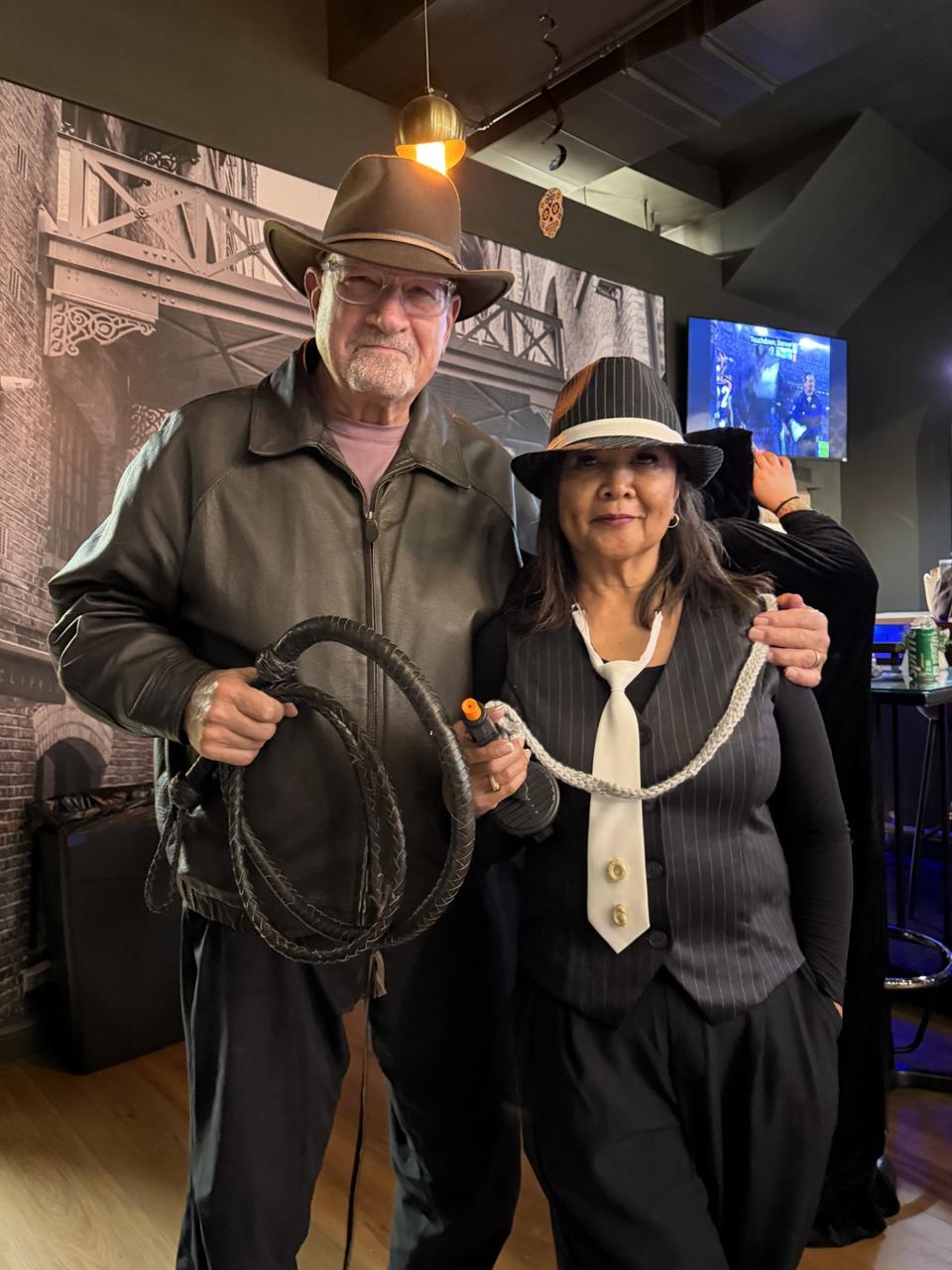
My wife had a Halloween Party at her bar last night, which included Movie Trivia. It was a blast. I was Indiana Timmons, and she was OG (Original Gangster). Her crew enjoyed dressing up. Normally, I am not big on Halloween, but this was a fun one.

Discussion (7)
Disagree, not disagreeable
Great piece, Bums!
That was a great article! It must of been fun writing it. Many thanks to Mark, Jeff, Bear, Bums and others for this awesome platform.
I am hoping for two major changes for next year, the obvious one is JDP, then one more? I like Edman but don’t want to watch him everyday at 2nd.
Well done, Bums!
Okay guys, when does the wheeling end dealing start? I thought it was right after the WS. What is the first move AF makes? First free agent off the boards?