
james tibbs III: Future Dodger or Trade Fodder?
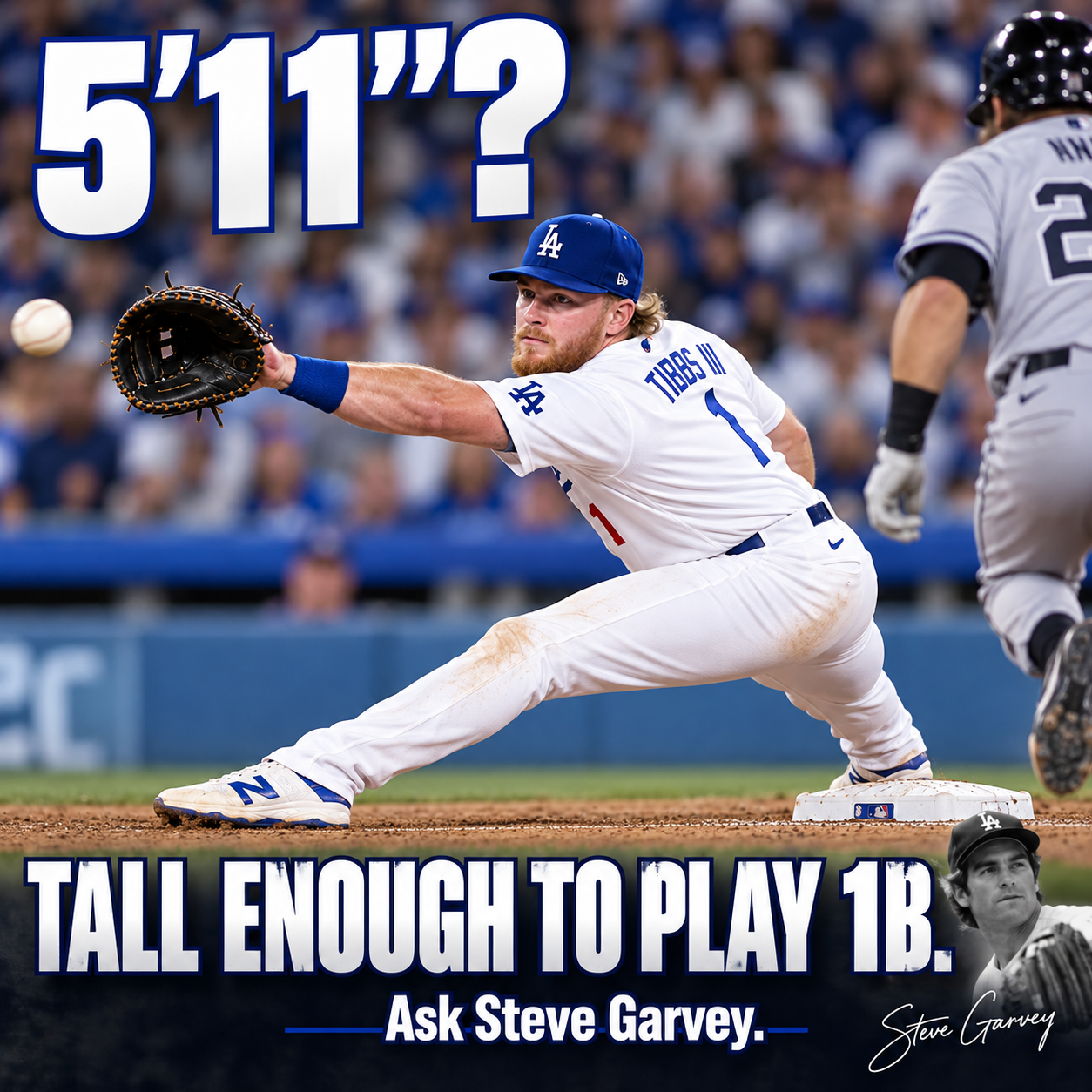
Keith Hernandez (11 Gold Gloves) and Don Mattingly (9 Gold Gloves) were both 1 inch taller than JT3. See, maybe some of you don't understand this, but the baseball glove doesn't sit on top of your head! It's attached to your hand
Congratulations to the 2026 World Champion Milwaukee Brewers. They deserve it!
I'd like to clear a few things up:
I do not think the Dodgers Dynasty has fallen... I think it needs a "remodel." It does not need to be blown up, but it does need to get younger. I have identified 1B and LF as two logical positions where that could happen. I have suggested that JT3 or Kyle Tucker could fill the void at 1B if Freddie were gone.
Believe very little of what the Dodgers say publicly... and that applies to every other team.
My Top Dodger Prospects are: Josue DePaula, Eduardo Quintero, Mike Sirota, Emil Morales, Christian Zazueta, Charles Davalan, Chase Harlan, and James Tibbs III... in that order. James Tibbs is a solid player, but not my favorite by any means.
A couple of days ago, someone questioned the logic of James Tibbs 3 at 1B. JT3 is listed at 5-11, and he would be one of the shortest in the league. "Mark should ask his beloved AI what it thinks of that. I did. Hint, not real positive."
My argument is that Tibbs' height is not a legitimate reason to dismiss him as a future first baseman. Steve Garvey was 5'10" and won four Gold Gloves. Vic Power was 5'11" and won seven.
Check this out:
Vic Power - 5' 11" 7 Gold Gloves
Steve Garvey - 5' 10" 4 Gold Gloves
Carlos Santana - 5' 10" - 1 Gold Glove
Ty France - 5' 10" 1 Gold Glove
There are currently just four MLB 1Bs under six feet tall.
However, Keith Hernandez (11 Gold Gloves) and Don Mattingly (9 Gold Gloves) were both 1 inch taller than JT3. See, maybe some of you don't understand this, but the baseball glove doesn't sit on top of your head! It's attached to your hand. I am six feet tall, and my armspan is 72". My son is also six feet tall, but has a 77" wingspan... and he's LH... that makes him more suited for 1B than me.
More importantly, Tibbs already has professional experience at first base. MLB Pipeline says he handles himself well there, although Baseball America has been more skeptical of his overall defensive ceiling.
I particularly like the fact that Tibbs bats and throws left-handed. That is a natural fit for first base. I am not proclaiming that Tibbs 3 is MLB-ready, but he could be. It has to be a consideration.
The bigger question is his bat.
Tibbs hit 30 home runs with a .941 OPS in Triple-A at age 23 for most of the season. That deserves serious consideration. However, Triple-A numbers, especially in the Pacific Coast League, don't automatically translate to the majors.
The Dodgers should evaluate three things in 2027:
Can Tibbs handle premium MLB velocity and breaking pitches?
Can he become at least an average defensive first baseman?
Is his offensive ceiling high enough to eventually replace Freddie Freeman?
I would give Tibbs extensive first-base work during spring training and in Oklahoma City. He doesn't need to become Keith Hernandez. If he can play an adequate first base and produce a .270 average with 25 home runs and an .800-plus OPS in the majors, he could be extremely valuable.
And there is a potentially bigger payoff: If Tibbs can become Freeman's successor, the Dodgers could fill first base with a young, inexpensive, controllable player rather than another expensive veteran.
I wouldn't pencil him in as a Gold Glover, but I certainly wouldn't rule him out because he's 5'11". Tibbs' height should not prevent the Dodgers from developing him at first base. The question is whether his defense and bat will be good enough, not whether he's tall enough.
I would also like to say this: "I have often hired people whom I think may not be qualified or trained to do a certain job, and sometimes we find out that they are a bad fit... they either move on or reinvent themselves. At US Water Systems, we have people who started in one position and now are blossoming in others. As I often say: "Progress is not linear."
Would it surprise me if JT3 turned out to be better than JDP? Yes... and no! This is baseball, and you never know. Just ask Jake Bauers. What a ride for him!
I just know that the biggest problem staring down the Dodgers is Father Time.
Projected Dodgers Starting Lineup: 2027 Ages
Here are the Dodgers' projected starting position players for 2027, assuming no offseason trades or lineup changes. Ages are as of July 1, 2027, rather than Opening Day.
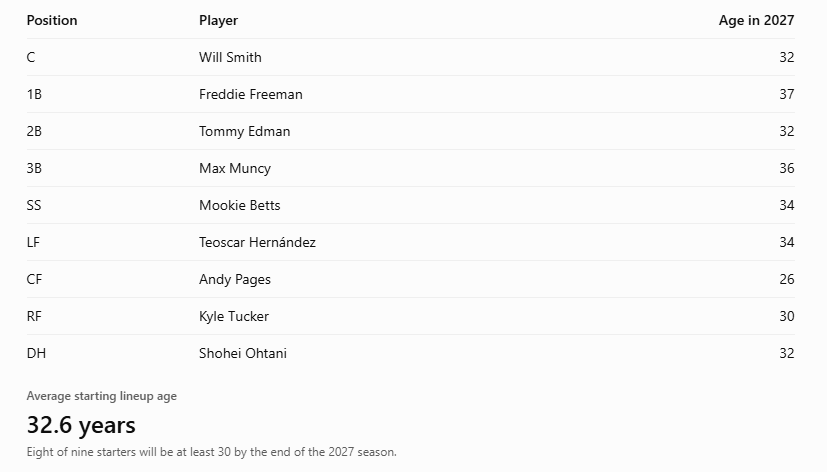
This is an exceptionally veteran-heavy lineup. The issue isn't simply whether these players can still hit. It's whether the Dodgers can maintain defense, speed, durability, and athleticism with eight of their nine projected starters in their 30s.
And if Friedman runs essentially the same lineup back in 2027, he'll be betting that experience can continue to overcome Father Time. Father Time, unfortunately, doesn't take deferred payments.
Dodgers vs. Brewers
This is a fascinating contrast in roster construction.
The Dodgers are built around established stars, expensive contracts, experience, and offensive power. Milwaukee is built around young, athletic, cost-controlled players who can run, defend, and potentially improve.
The Projected 2027 Starting Lineup of the Milwaukee Brewers is 26.1 years old. Let that sink in! The difference is enormous. Milwaukee's projected starting lineup is approximately 6½ years younger per player than the Dodgers'.
Dodgers: Eight of nine starters are 30 or older.
Brewers: Only one of nine starters is 30 or older.
Milwaukee: Four projected starters are younger than 25.
Los Angeles: No projected starters are younger than 25.
But there is a distinction worth making: Young doesn't automatically mean better, and old doesn't automatically mean finished. The Dodgers still have considerable offensive talent.
The more important question is what happens when declining range, speed, defensive ability, and injury risk begin to outweigh the advantages of experience.
The Brewers are approaching their collective physical prime. The Dodgers are trying to extend theirs.
It should be a given that Teoscar will be traded. His contract is relatively easy to move. Where else can they get younger? It would appear that 1B would be a logical opportunity if a lovable, popular legend weren't there.
SS and 3B are likely positions that the farm system won't fill until 2029 - Morales and Harlan... assuming both players can stay in those positions.
Here's the question I'd put to LADT readers:
If you're building a team to win championships over the next three seasons, would you rather have the Dodgers' 32.6-year-old lineup or the Brewers' 26.1-year-old lineup, especially when payroll and future flexibility enter the equation?
I asked the AI what happens to MLB Players as they age. Here's what it said!
What Happens to Older Baseball Players Over a 162-Game Season?
The biggest problem with aging baseball players isn't necessarily that they can't perform at a high level anymore. It's that their ability to recover, stay healthy, and consistently perform at that level becomes more difficult over a 162-game season.
And when you add another month of postseason baseball, the challenge becomes even greater.
For the 2027 Dodgers, with a projected starting lineup averaging approximately 32.6 years old, this is a legitimate concern.
Seven ways aging affects baseball players
1. Recovery takes longer
A 25-year-old player may recover from a demanding game or series more quickly than a 35-year-old.
Older players frequently experience:
More lingering muscle soreness and stiffness.
Greater difficulty recovering from consecutive games.
More accumulated fatigue during long road trips.
Increased need for rest days.
The problem is cumulative. A player might look excellent in April and May but struggle to maintain the same physical output in August and September.
2. Bat speed gradually declines
This is potentially devastating for older hitters.
As reaction time, explosive strength, and rotational speed decline, hitters may have less time to recognize a pitch and decide whether to swing.
Even a modest loss of bat speed can make a difference against a 98-mph fastball.
Veteran hitters often compensate through better pitch recognition, anticipation, and plate discipline. But those skills cannot always overcome declining physical ability.
3. Injuries become harder to overcome
Older players generally face greater challenges with soft-tissue injuries, especially hamstrings, calves, obliques, and other muscles essential to hitting and running.
A minor injury that once required a few days of recovery can become a lingering problem.
The danger isn't just the injury itself. It's the possibility of compensating for one injury and developing another.
4. Speed and defensive range decline
This is where aging can quietly damage a team's performance.
A veteran might continue hitting 25 home runs while losing the ability to reach balls he once fielded routinely.
Declining sprint speed can mean fewer infield hits, fewer extra bases, more double plays, and diminished defensive range.
For a veteran-heavy lineup, those lost fractions of a second can add up to a meaningful number of runs over a full season.
5. Fatigue can affect hitting mechanics
As the season progresses, fatigue may make it harder to consistently reproduce an efficient swing.
A hitter may compensate with his upper body, get out of his legs, or struggle to maintain his normal timing.
The results can include increased strikeouts, weaker contact, and reduced performance against velocity.
These changes aren't exclusive to older players, but diminished recovery capacity can make them harder to correct.
6. Playing through injuries becomes more consequential
Veterans often learn how to play through discomfort.
That's admirable, but it can also conceal declining performance.
A player might remain in the lineup while dealing with a bad knee, stiff back, sore shoulder, or strained leg.
His traditional numbers may remain respectable even as his defensive range and quality of contact deteriorate.
7. October may expose weaknesses
The postseason isn't simply another month of regular-season baseball.
Players face elite pitching, increased velocity, specialized relievers, and fewer opportunities to exploit weak opponents.
Older hitters who have lost bat speed may find these matchups particularly unforgiving.
But there's an important qualification: Research does not establish that older players universally experience a larger late-season decline than younger players. Workload, conditioning, playing time, injury history, and individual variation all matter.
In Conclusion:
Baseball aging curves support these concerns. FanGraphs research finds that hitters typically peak in their late 20s, with average performance declining afterward, although exceptional players can remain productive much longer.
The real danger: Several players declining together
This is what would concern me most about constructing the Dodgers' roster.
If one 36-year-old declines, a team can compensate. If four or five players enter meaningful decline during the same season, the cumulative effects become much more difficult to overcome.
Younger teams like Milwaukee can also experience fatigue, injuries, and performance slumps. But they generally have more players in the portion of their careers where physical improvement remains possible.
The Dodgers' biggest aging problem may not be how good they are on Opening Day. It may be how much athleticism, defensive efficiency, and availability they can preserve over 162 games and into October.
The Dodgers can buy experience and star power. What they cannot buy is a younger biological clock. How Andrew Friedman and Company reconstruct this team will be fascinating and paramount to future success. Here are some interesting stats that I will leave you with:
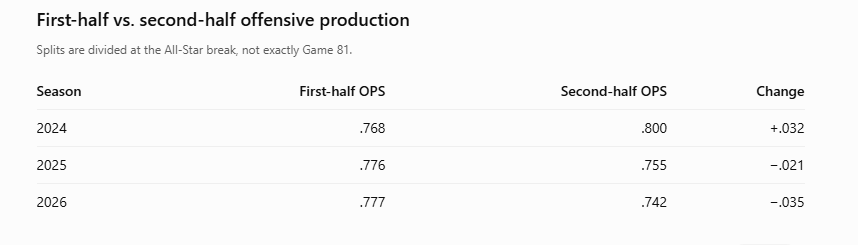
The trend is particularly noticeable in 2026:
Batting average fell from .262 to .249.
On-base percentage declined from .343 to .331.
Slugging percentage dropped from .434 to .411.
Runs per game fell from 5.22 to 4.54.
That's a decline of approximately 13% in runs scored per game after the All-Star break.
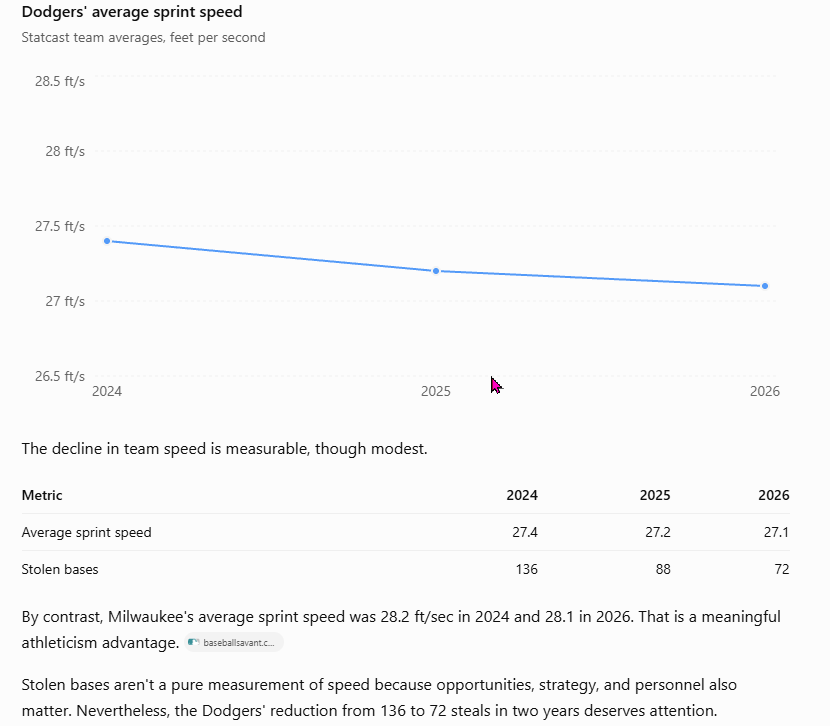
The question is whether Andrew Friedman is replacing declining athleticism quickly enough to keep the Dodgers from becoming a team that can outslug opponents in April but cannot outrun or outdefend them in October.
Discussion (5)
Disagree, not disagreeable
Congratulations to the Brewers. They will be twice as “cocky “ next year as they defend their title. As for the Dodgers? I read yesterday a story about some players who could be on the move. CJ Abram’s was one. The Dodgers were one of the teams that were mentioned in a possible landing spot for him. It did not suggest that Mookie would move from short, but Abram’s would be a second baseman. An interesting option. Kid might not be a great defensive shortstop, but he can hit! He can run. I don’t believe he would be a problem. As far as Freddie, I believe he’s going to be on a mission next season. Don’t be surprised if he goes .290,25 homers, and 30 doubles. It’s not a reach he gets those numbers. JDP? Growing pains could slow him down a bit, but I firmly believe he will be a fantastic player. He seems to be the kind of player who adjusts. He will be an all star within a couple of years. Can Will Smith have a whole season being healthy? If the Dodgers are to get back to the best team in baseball they need Will to be the catcher he can be. Andy Pages? I think we all believe he has the potential to be a top 3 center fielder in baseball. He did seem to be much more disciplined at the plate late in the season and playoffs. Maybe 27 is the year he takes his game to another level. Kyle Tucker will be a completely different player next season, count on it! As I said earlier, the bench needs to be stronger next season. Bear said it best. They need some pop on the bench. So long Kike. ( we believe). Just don’t see him back. He’s been special as a Dodger. But his defense alone doesn’t warrant a spot on this team. Thanks M. Rojas! You have been a Godsend to this team. Your game tying home run in the World Series will go down in dodger history as one of the greatest ever! Good luck with your dreams! This team is older. But not finished! A couple of infusions of youth next season and a couple more the year after? I see Freeland being a part of the team for a while. Kim ? I think he’s traded. Call? He is gone. Teo? Gone. I hope Alex Vesia comes back. Maybe the front office could get Milwaukee’s front office drunk and steal A. Ashby!!! That guy could change any team’s fortunes! I can see more trades and signings coming this offseason than ever! Baseball is in such a good place right now. Let’s hope the billionaires don’t screw it up!
Bear, how you feeling these days? Hopefully you are good!
Instead of JT3 at first base, how about JDP at first?
What month in 2027 will we see baseball again, if at all? Every article I read is that both sides are dug in and prepared for a long lockout with a salary cap being the main issue. Which side gives in on this crucial bargaining point?
AF has to interject some speed on the roster and IMO make Ohtani a one-way player, so we reap the full benefits of his offensive skills and prevent him from being hurt. I like the idea someone here suggested of him playing some outfield, preferably left field once Teo is traded and let DePaula DH.