
Dodger Fans Want Player Development. They Just Don't Want to Wait for It!
The point is that early major league failure is a terrible way to judge a young player's ceiling.
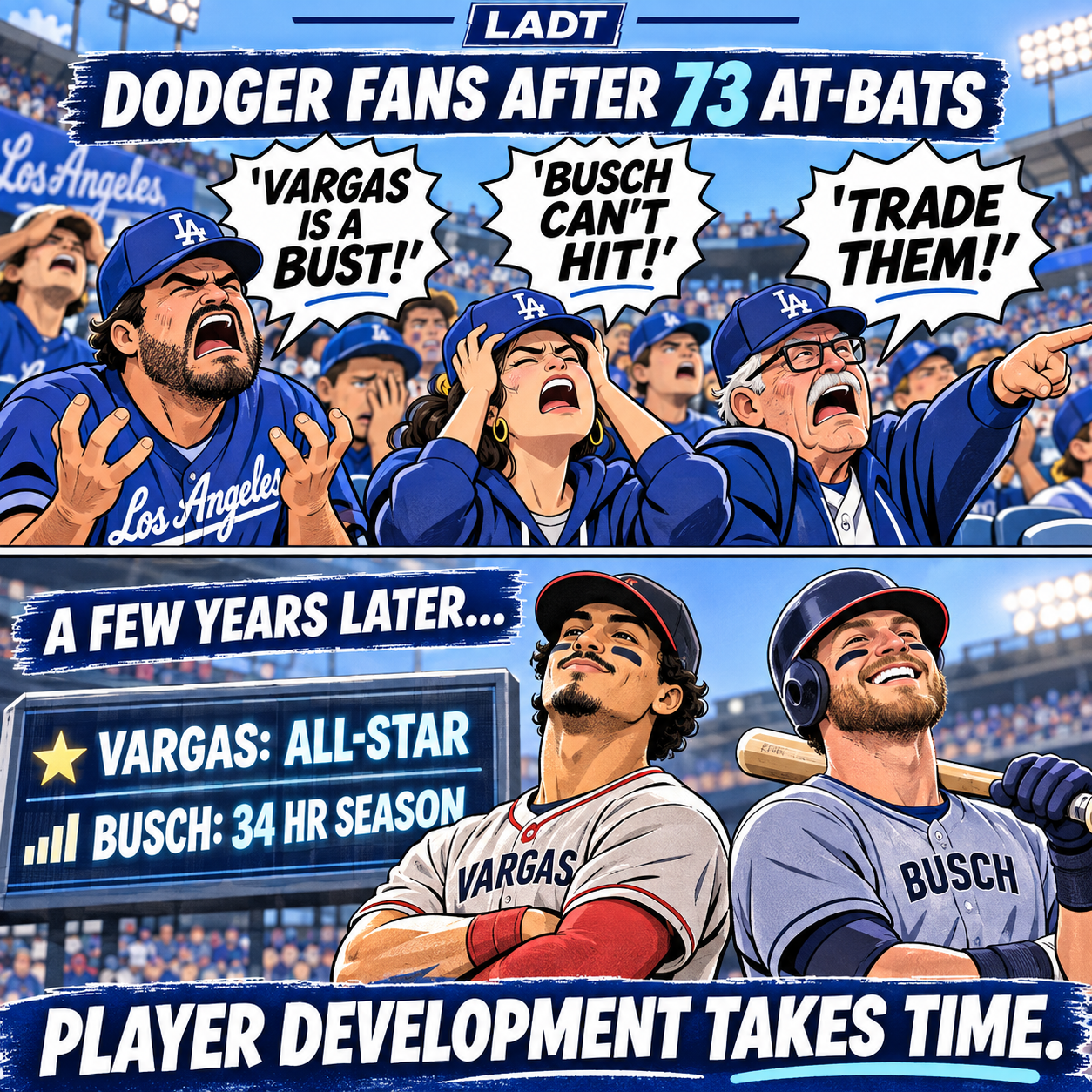
There is something fascinating about Dodger fans, and I include myself in this group.
We love prospects. We study prospects. We rank prospects. We argue about prospects. We follow them from the Dominican Summer League to Rancho Cucamonga, Great Lakes, Tulsa, Oklahoma City, and eventually Los Angeles.
We dream about the next Corey Seager, Cody Bellinger, or Will Smith.
But there is one little problem.
We want them fully developed the minute they step onto the field at Dodger Stadium!
We want a 22-year-old rookie to hit .280 with 25 home runs, play Gold Glove defense, never make a baserunning mistake, and preferably hit a three-run homer in his first at-bat.
If he goes 0-for-12?
"Send him back down!"
If he hits .190 after 100 at-bats?
"He's a bust!"
If he makes two errors in a week?
"Trade him while he still has value!"
And then, three years later, when that same player becomes an All-Star somewhere else, we wonder what Andrew Friedman was thinking when he traded him.
Welcome to the wonderful world of Dodger prospect development, where patience is apparently a four-letter word!
Exhibit A: Miguel Vargas
Remember Miguel Vargas?
Of course you do.
Vargas was one of the most highly regarded hitting prospects in the Dodgers' organization. He had excellent bat-to-ball skills, impressive plate discipline, and the ability to hit to all fields.
The Dodgers believed he could hit, and they had good reasons for believing that.
But when Vargas arrived in Los Angeles, things didn't go according to plan.
In 2023, he hit just .195 with seven home runs in 81 games.
That wasn't what Dodger fans expected.
Never mind that he was only 23 years old. Never mind that the Dodgers were trying to turn a natural third baseman into a second baseman. Never mind that hitting major league pitching is considerably more difficult than hitting Triple-A pitching.
He wasn't producing.
And the verdict from many fans was swift.
"He can't hit major league pitching."
"He has no power."
"He's another overhyped Dodger prospect."
Some even questioned whether the Dodgers' player development system had badly misjudged him.
In July 2024, the Dodgers traded Vargas to the Chicago White Sox as part of a three-team deal that brought Tommy Edman and Michael Kopech to Los Angeles.
At the time, there weren't many tears shed over his departure.
And to be fair, the Dodgers had legitimate reasons for making that trade. They were trying to win a World Series, and both Edman and Kopech helped them do exactly that.
But Vargas wasn't finished developing.
Not even close.
After struggling mightily following the trade, he began to figure things out in 2025.
Then came 2026.
Miguel Vargas, 2026:
33 home runs
93 RBI
106 runs scored
22 stolen bases
.250 batting average
.363 on-base percentage
.837 OPS
134 OPS+
5.4 Baseball-Reference WAR
American League All-Star
That's not a failed prospect.
That's a very good major league baseball player!
And he was still only 26 years old.
Think about that for a moment.
The young man who supposedly couldn't hit major league pitching just produced 33 home runs, walked 101 times, and became one of the better offensive players in the American League.
Was the talent suddenly created in Chicago?
Of course not.
The talent was always there. The development simply wasn't finished.
Exhibit B: Michael Busch
Now let's talk about Michael Busch.
Busch was another highly regarded Dodger prospect. He was a first-round draft choice in 2019 and consistently produced excellent numbers in the minor leagues.
He could hit. He could draw walks. He had legitimate power.
But where was he going to play?
Freddie Freeman occupied first base. Max Muncy was at third. The Dodgers tried Busch at different positions, but his defensive limitations complicated matters.
When Busch finally reached the major leagues in 2023, he struggled.
He hit .167 in 27 games.
And again, the criticism came quickly.
"He's a Quad-A player."
"He can't handle major league pitching."
"He has no position."
In January 2024, the Dodgers traded Busch and Yency Almonte to the Chicago Cubs for Jackson Ferris and Zyhir Hope.
Unlike Vargas, Busch wasn't traded primarily because the Dodgers had given up on his bat. He was blocked by established major leaguers and needed an everyday opportunity.
Chicago gave him one.
And a funny thing happened.
He started hitting.
Busch hit 21 home runs in 2024, followed by a breakout 2025 season in which he batted .261 with 34 home runs, 90 RBI, and an .866 OPS.
In 2026, his production declined to 20 home runs, 77 RBI, and a .745 OPS.
That decline matters. Player development isn't a straight line, and one excellent season doesn't guarantee the next will be even better.
But Busch has already demonstrated something many people doubted when he left Los Angeles.
He can be a productive everyday major league first baseman.
And he didn't become that player by sitting on the Dodgers' bench waiting for Freddie Freeman to retire.
He became that player by playing.
Every day.
Against major league pitching.
Against left-handers and right-handers.
Through slumps, strikeouts, mistakes, and adjustments.
That's how development works.
The Part Nobody Wants to Hear
Here is the uncomfortable truth.
Player development doesn't end when a player reaches the major leagues.
In many cases, that's where the most important development begins.
A hitter can dominate Triple-A pitching and still be completely unprepared for what major league pitchers will do to him.
They find his weaknesses.
They exploit those weaknesses.
They change how they pitch him.
And just when he figures out one adjustment, they make another.
The hitter must learn to adjust to the adjustments.
That takes time.
Sometimes it takes 300 plate appearances. Sometimes 700. Sometimes two or three seasons.
Some players never make those adjustments, and that's part of the risk.
But how do you know which players will succeed if you never give them a reasonable opportunity?
You don't!
You can have all the Statcast data, exit velocities, launch angles, swing decisions, and scouting reports in the world.
Eventually, somebody has to put the kid in the lineup and let him play baseball.
The Dodgers Have a Unique Problem
Now, before somebody accuses me of wanting the Dodgers to operate like the Chicago White Sox, understand something.
I don't.
The Dodgers are not rebuilding.
They are expected to compete for the World Series every single year.
That changes everything.
A team trying to win 100 games doesn't have the same freedom to give a struggling rookie 600 plate appearances that a rebuilding team has.
And Andrew Friedman understands that better than anybody.
The Dodgers must constantly balance winning today against developing players for tomorrow.
That's not easy.
But there is another danger.
If you never make room for your prospects because you always have a veteran who is slightly better today, you can eventually find yourself with a very expensive, very old baseball team.
Sound familiar?
Look at the Dodgers' aging core.
Freddie Freeman, Mookie Betts, Max Muncy, Teoscar Hernández, and others have been outstanding players.
But Father Time has never lost a baseball game.
Not one.
The Dodgers cannot simply keep buying expensive veterans indefinitely and expect their farm system to remain a renewable source of young talent.
At some point, prospects need opportunities.
And opportunities require patience.
The Next Vargas or Busch Might Already Be Here
Which brings us to 2027.
Who is the next Dodger prospect who will be declared a bust after 100 at-bats?
Alex Freeland?
Hyeseong Kim?
Josue De Paula?
Someone else?
Freeland has demonstrated versatility and the ability to play multiple infield positions. But what happens if he hits .210 for his first two months?
Will fans demand that the Dodgers trade him?
Kim has intriguing athleticism, speed, and defensive ability. But what if he struggles against major league fastballs?
Will we decide he can't play?
De Paula is one of the most exciting offensive prospects in the organization. But what happens if he arrives in Los Angeles and strikes out 35 times in his first 100 plate appearances?
Will we suddenly forget everything he accomplished in the minor leagues?
I can almost hear it now.
"He's overmatched!"
"He's not ready!"
"Get somebody who can hit!"
And maybe those criticisms will be justified.
Or maybe the young man simply needs time.
The challenge is knowing the difference.
Patience Does Not Mean Blind Faith
I am not suggesting that every highly rated prospect deserves 1,000 major league plate appearances.
Some players really are Quad-A players.
Some have holes in their swings that never get corrected.
Some lack the defensive ability to play a position at the major league level.
Some simply aren't as good as the scouts thought they were.
And sometimes trading a prospect is absolutely the right decision.
The Dodgers won a championship with significant contributions from players acquired in the Vargas trade.
Would I undo that championship to get Vargas back?
Absolutely not!
Likewise, Busch was blocked by Freddie Freeman, and the Dodgers acquired two talented prospects in return.
The wisdom of that deal must include what Ferris and Hope eventually become.
But those considerations don't change the central point.
A player's struggles at age 22 or 23 do not necessarily tell us what he will become at age 26 or 27.
That is especially true for hitters who have demonstrated excellent strike-zone judgment and a track record of hitting throughout the minor leagues.
Vargas and Busch were not unknown players who suddenly discovered how to hit after leaving Los Angeles.
They were accomplished young hitters who needed time, opportunity, and experience.
There's Another Side to This
Dodger fans aren't the only impatient people in this equation.
Sometimes the organization itself becomes impatient.
Or perhaps impatient isn't the right word.
Sometimes the organization becomes trapped by its own success.
Every season is a championship season. Every position is occupied by an established player. Every slump becomes a crisis, and every trade deadline creates another opportunity to acquire a veteran.
And because the Dodgers have the money and prospects to make those deals, they often do.
That's understandable.
But there is a price.
When young players aren't allowed to develop in Los Angeles, they sometimes develop somewhere else.
The Dodgers get the finished veterans.
Other teams get the growing pains and, occasionally, the payoff.
That's a reasonable strategy when the trades produce championships.
But it cannot be the entire long-term strategy.
What I Would Like to See in 2027
I believe the Dodgers need to make a conscious effort to inject youth into their roster.
Not five rookies. Not an entire rebuilding movement.
Just one or two legitimate opportunities for young players to establish themselves.
If Freeland earns the second-base job in spring training, give him a real chance to keep it.
If Kim earns it, let him play.
If De Paula demonstrates that his bat and defense are ready for left field, don't automatically dismiss him because he is young.
And don't judge any of them solely by their first month.
Give them clear expectations. Give them coaching. Give them opportunities to make adjustments.
And then evaluate whether the underlying skills are improving.
There is a difference between a young hitter who is overwhelmed and one who is learning.
Good organizations must recognize that difference.
Great organizations must act on it.
The Final Word
Dodger fans love the farm system.
We love talking about prospects.
We love dreaming about the next superstar.
We just don't particularly enjoy watching the process that turns a prospect into a superstar.
We want the finished product.
Preferably yesterday.
But Miguel Vargas and Michael Busch should remind us that player development doesn't operate according to the expectations of fans, sportswriters, or people typing furiously on baseball blogs.
It operates according to the abilities, maturity, opportunities, and adjustments of individual players.
Some develop quickly.
Some develop slowly.
Some never develop at all.
And some become All-Stars after we have already declared them failures.
The Dodgers cannot afford unlimited patience.
But they also cannot afford to have none.
Because sometimes the difference between a failed prospect and a future star isn't another batting coach, another swing adjustment, or another trip to Oklahoma City.
Sometimes the difference is simply 500 more major league plate appearances.
And if we aren't willing to endure the growing pains, we shouldn't be surprised when another organization enjoys the rewards.
So here's my question for LADT readers:
Are Dodger fans really willing to let young players develop, or do we only want prospects after somebody else has done the developing?
And more importantly, which young Dodger would you be willing to give 500 plate appearances in 2027, even if he struggles early?
Discussion (6)
Disagree, not disagreeable
Mark's essay points to a genuine dilemma... Should Freeland or Kim get the chance to prove himself? They are obviously in direct competition. In '26, Freeland got roughly double Kim's opportunity. Kim probably would have gotten even less if not for the injury to Mookie early in the season. We also saw how the Dodgers preference for veterans (perhaps certain veterans) limit the ability for prospects to demonstrate their value. The Dodgers went all-in with idea of "running it back" with Kike, with mixed results. (Perhaps it was fitting that Kike lined out to end the series. At least it wasn't an ignominious pop up or a whiff.)
In related news, Brice Turang will be battling Shohei in the ballots to determine who is the NL MVP runner-up to Pete Crow-Armstrong... Will the Brewers be able to hang on to Turang or will he the next Brewer to be traded before hitting free agency? I only recently learned that Turang attended the same Corona high school later attended by Dino Ebel's son, before they got drafted. Corona is a hot bed of youth baseball. One summer few years back, when he was about 11, I took my crafty southpaw to play with a team that needed a fill-in. We wound up at large faciilty with a couple acres of parking with four or five baseball fields all mocked up to resemble historic parks. Forget the name, something like "American Dream Fields," maybe I think the "Fenway" had a Green Monster. You paid an admission fee to get it, and there was a large eatery with good ballpark grub situated in the middle. Dozens of teams matched up at proper age levels. Quite a scene.
We can always count on the pot calling the kettle black. I can't help but recall, again, how Mark was so patient waiting for James Outman to develop he once went all Aesop on him and his boy Miguelito in their rookie seasons. After a blazing start--Max and Outman were carrying the Dodgers offense--went into a slump, while Vargas, having been gift-wrapped the 2B job by management, suddenly had a hot week. Mark likened Vargas to the tortoise and Outman to a hare. Get it? Well before the all-star break, as I recall it, Mark was calling Vargas a winner and dissing Outman as a loser. But waddaya know? Then Outman got hot, hit to a .780 OPS with 22 HRs and wound up finishing 3rd in ROY balloting. Meanwhile, Vargas's struggles on both offense and defense sent him back to OKC. The much-hyped Vargas, clearly, wasn't ready for primetime. Outman, with no hype, won the CF job in spring training. There was no actual competition between Vargas and Outman as they played different positions. The way I see, Vargas never got shafted by Dodgers management the way that Outman and Ryan Ward when AF made the mistake of spending $17 million on Conforto. Instead of an OF that read Conforto-Pages-Teo, an OF of Teo-Outman-Pages would have surely played better defense. There's also a good chance that Outman, or an Outman/Edman platoon, would have outhit Conforto. Of course we'll never know. Mark says the Dodgers management gave up on Vargas as a hitter? I don't know about that--but they clearly found him wanting on defense. If Vargas had stayed around, perhaps he'd have been Max's semi-platoon partner. Like others here, I think LF is a place to park an exceptional bat with a mediocre glove. If Vargas had succeeded, the Dodgers may not have extended Teo or decided to plunk down $240 million on Tucker. We'll never know. What we do know is that Vargas benefited greatly from to a team that would be counting on him to be an everyday player. That was a three-team swap that brought in Edman, a guy with great UT skills, and Michael Kopeck. I worked out great for Vargas. The Dodgers never shafted him. Outman would get traded to, which is why Brock Stewart is member of the Dodgers bullpen and probably why Justin Dean will be remembered in Dodger lore for the clutch defense of signaling to the umps that a driven ball was wedged at the base of a wall. Very smart. Could Outman have made that play? We'll never know. Did the Dodgers "give up" on Vargas or Busch? I don't think so. They received ample opportunity (especially Vargas) but never adequately proved their fit. The trades make sense. The Dodgers also gave more than ample opportunity for Gavin Lux to live up the hype. He fell short. It's amazing to me that the Reds wound up giving up Sirota and the draft pick that became Davalan to get Lux. Neither Sirota or Davalan have reached Triple A, but that deal looks like an absolute steal. Lux is a free agent now. I hope it works out for him.
I know, shocking!! I agree. I have been accused of limiting my sight to AAAA players. I believe in giving prospects a chance. We have already heard some here say they want an elite player at every position. That is a legit position, just not one I think is reasonable. IMO that gives reason to sign Teoscar to a 2nd FA deal, sign Michael Conforto, sign Jason Heyward, and sign Kyle Tucker to an outlandish contract.
Then there is Luke Raley who has grinded out a nice MLB career. Not an All Star, but a MLB player.
Connor Wong has had a decent career as a backup catcher for Boston. He even started for much of 2023 & 2024. He even had double digit HR in 2025. And Alex Verdugo played decently after being traded to Boston with Wong in the Mookie Betts trade.
Ryan Pepiot had 2 good years with Tampa Bay before sitting out all of 2026 (hip surgery, not an arm problem). He had 26 starts and 130 IP in 2024 and 31 starts and 167.2 IP in 2025, with 3.60 and 3.86 ERA. Ryan Pepiot did not get that start or even an appearance in the disastrous 2023 NLDS loss to Arizona. Instead the Dodgers chose veteran Lance Lynn to start Game 3. Did not go well.
Dodgers correctly chose Will Smith over Keibert Ruiz. That did not take away from what Ruiz has accomplished as a catcher for Washington.
At 25, Jorbit Vivas is still trying to establish himself with Washington, and is not embarrassing himself.
Like with Vargas and Busch, I would have made every one of the trades involving the above players. AF has had a great run in trades. One reason why I have no idea why other teams want to go up against AF in trades. Not so much for FA.
To be fair, there have been total busts of highly touted LAD top prospects. Diego Cartaya, Yadier Alvarez, Jeren Kendall, DJ Peters, Kody Hoese, and Maddux Bruns is well on his way to bust status.
I fully expect both Alex Freeland and Emmet Sheehan to get traded for one of those elite middle infielders.
Well, after watching a carefully crafted reverse-engineering of a 100 win regular season team, I'm ready for a rawer, realer group of guys getting after it this season. So much for saving it for the postseason.