
Can MLB Owners Force a Salary Cap Down the Players' Throats?
The Dodgers, the Players' Union, and the Battle That Could Threaten the 2027 Season
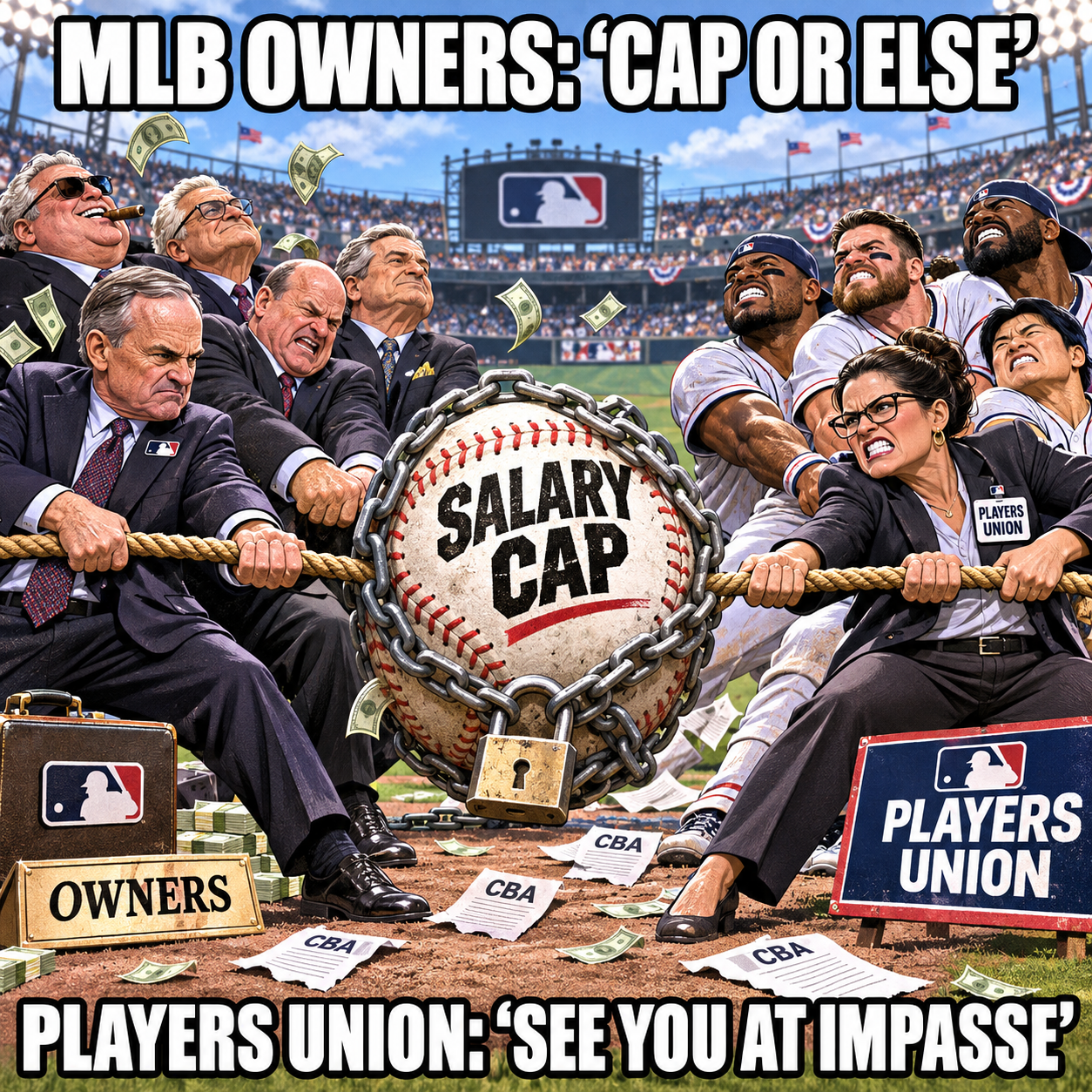
Bill Shaikin of the Los Angeles Times recently wrote an interesting article titled, "Why the players' union can't just walk away if MLB owners insist on a salary cap."
He raised a legal possibility that many baseball fans probably haven't considered. What if the owners don't need the players to agree to a salary cap? What if they can legally impose one?
Before you dismiss that idea, you might want to understand a little something called collective bargaining impasse. And if you're a Dodgers fan, you should be paying attention.
The Owners Have Drawn a Line in the Sand
On November 18, Commissioner Rob Manfred made his position clear. He couldn't envision owners approving a new collective bargaining agreement without a salary cap and salary floor. Not exactly the language of compromise, is it?
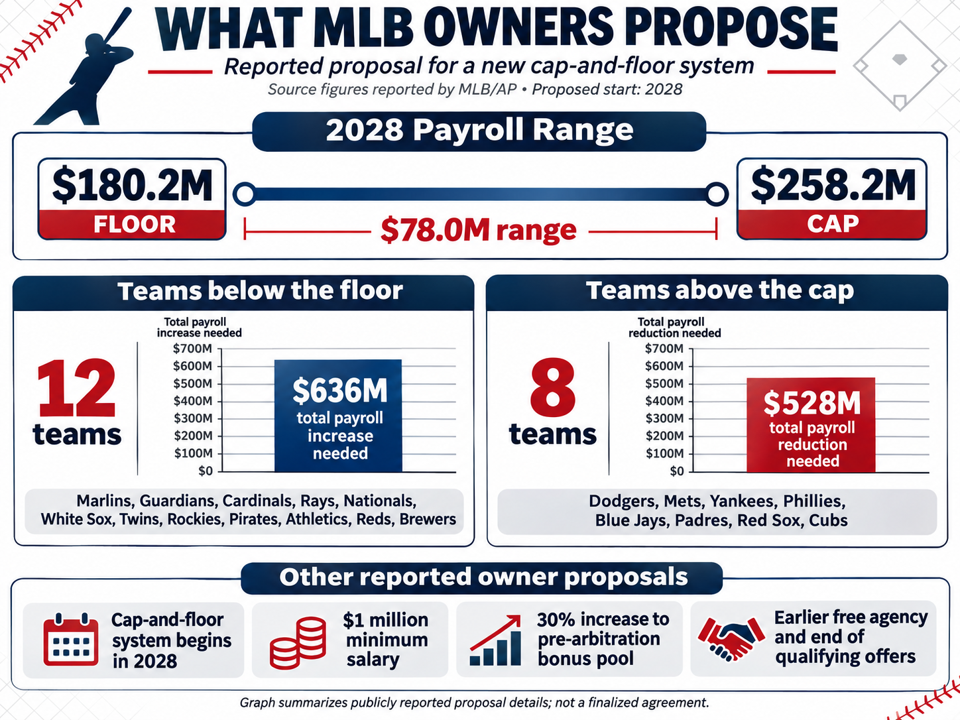
The owners have reportedly proposed a hard salary cap of approximately $258 million and a salary floor of $180 million, beginning in 2028. They also want to limit free-agent contracts to five years.
Meanwhile, the MLB Players Association, led by Bruce Meyer, has made it equally clear that a salary cap is unacceptable. The current collective bargaining agreement expires on December 1, 2026. Even Ray Charles can see a problem developing here!
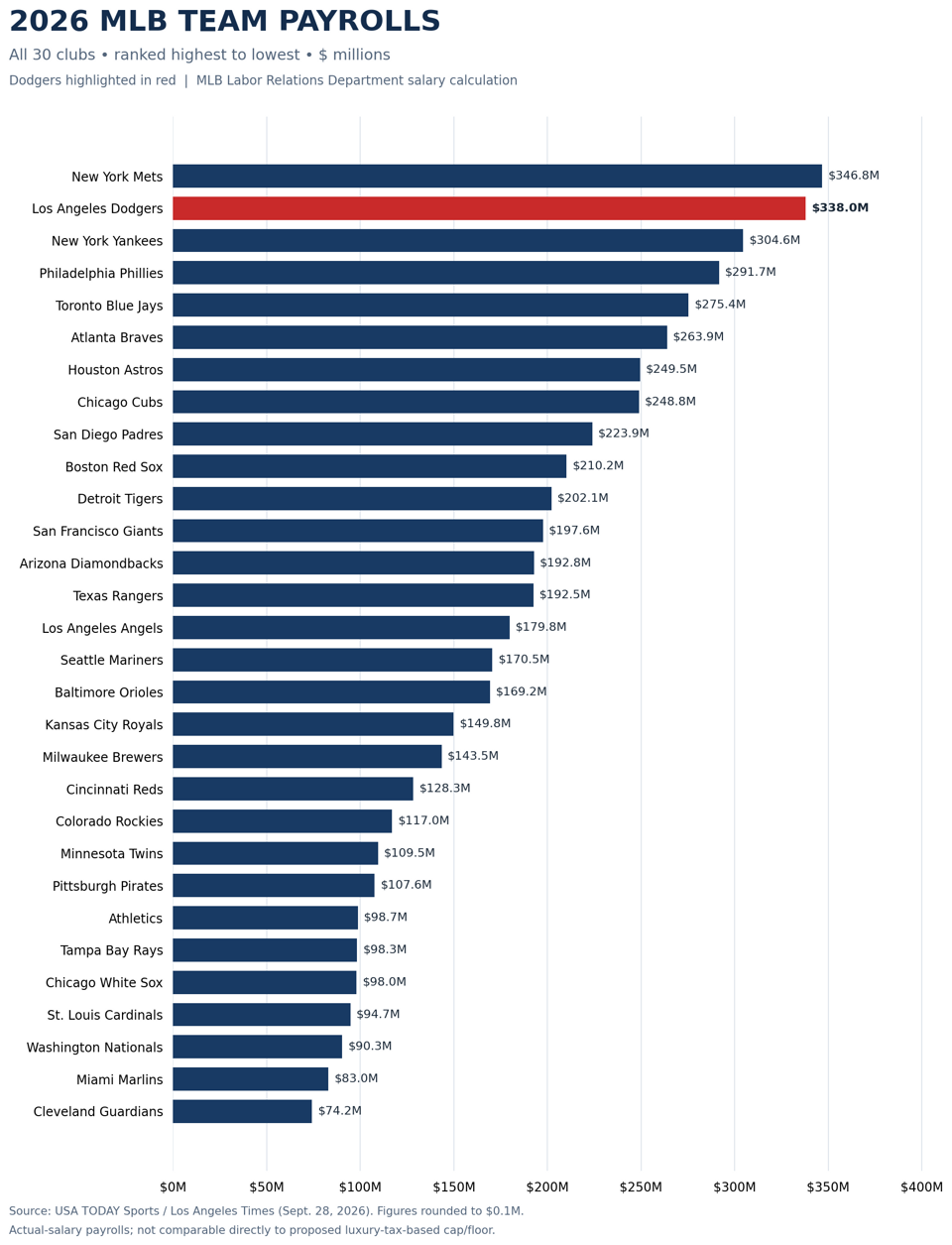
Just so we are clear, here are the 2026 payrolls ranked from highest to lowest, using the MLB Labor Relations Department salary figures reported by USA Today and the Los Angeles Times:
Enter the Legal Loophole
Federal labor law requires both sides to bargain in good faith. It does not require either side to agree, but it does require meaningful negotiations. If bargaining reaches a genuine impasse, an employer may, under certain circumstances, implement terms that were included in its final bargaining proposal.
In other words, MLB owners could attempt to declare an impasse and implement a salary cap without the players' approval. That doesn't mean they can simply announce an impasse and start making up the rules. The union could challenge the declaration, and the National Labor Relations Board could determine that the owners failed to bargain in good faith.
In fact, something similar happened during the 1994-95 baseball strike. The owners tried to impose changes, but the NLRB challenged their conduct, and federal Judge Sonia Sotomayor intervened. The owners lost that battle. But that was 1995. This is 2026.
The legal principles remain relevant, but the people overseeing labor-law enforcement have changed. Shaikin makes the point that the owners might believe they have a more favorable environment today. Whether that belief is correct remains to be seen.
The Players Aren't Powerless
The players have options. They can challenge an impasse declaration. They can strike. They could even attempt to decertify their union and pursue antitrust litigation. But none of those options come without serious risks.
A strike means lost paychecks. A lockout means no baseball. Decertification could produce years of litigation and uncertain outcomes, and while owners have significant financial resources, they also have substantial financial obligations.
There is no guarantee that either side emerges from an extended work stoppage looking particularly intelligent. Especially in the eyes of fans. Remember 1994? I do.
Is There Really a Competitive Balance Problem?
This is where I believe the conversation gets interesting. The Dodgers have become the poster child for everything the owners say is wrong with baseball economics.
They spend too much. They acquire too many stars. They exploit deferred contracts. They have too many financial advantages. That's the argument. But let's examine the other side.
The Dodgers develop players, invest in scouting, maintain an extensive international operation, spend on technology, and continually attempt to improve their organization.
They've built an international brand that generates enormous revenue. Is that something baseball should discourage? Or is that something other organizations should try to emulate?
I don't believe every franchise can generate the same revenue as the Dodgers. Geography, television markets, ownership resources, and fan bases matter. But I also don't believe every franchise is doing everything possible to win.
There are owners who spend aggressively, owners who spend cautiously, and owners who appear perfectly content to collect revenue-sharing checks while fielding inexpensive rosters. That last category deserves considerably more scrutiny than it receives.
A Salary Floor Makes Sense. Does a Hard Cap?
I've long believed baseball should seriously consider a meaningful salary floor. If you're fortunate enough to own one of only 30 Major League Baseball franchises, shouldn't you be expected to make a substantial financial commitment to putting a competitive product on the field?
A salary floor would address that issue. A salary cap addresses something entirely different. It limits how much the most ambitious owners can spend.
Now, I understand the argument for a cap. Without some spending restraint, the wealthiest franchises can enjoy enormous advantages in the free-agent market. But a cap doesn't automatically create competitive balance. Good ownership, intelligent management, player development, and competent scouting still matter.
A $250 million payroll assembled by incompetent management can lose to a $150 million payroll assembled by a brilliant front office. We've seen versions of that story repeatedly. Money matters.
But money isn't everything.
The Dodgers Didn't Create This Problem
Here's what bothers me about the whole discussion.
The Dodgers are being portrayed as the villains because they're willing to invest heavily in winning. Meanwhile, some organizations have spent years operating on budgets that would barely cover the Dodgers' annual deferred compensation obligations.
Why is one approach considered a threat to baseball while the other is treated as prudent management? If Major League Baseball wants genuine competitive balance, perhaps the first question should be whether every ownership group is making a reasonable effort to compete.
Revenue sharing without meaningful accountability can reward complacency. A salary floor could help. But any system also needs rules that prevent owners from simply collecting shared revenue while doing the bare minimum.
So, What Happens Next?
The owners have leverage.
The players have leverage.
Both sides have lawyers who are probably already anticipating the legal battles.
Rob Manfred and Bruce Meyer seem to have very different ideas about what baseball's economic future should look like. Perhaps there will be a negotiated compromise. Perhaps there will be a lockout that ends before Opening Day.
Or perhaps baseball is headed toward another ugly labor confrontation that damages the sport for years.
But I keep coming back to something. Major League Baseball reportedly generated nearly $13 billion in revenue in 2026. The sport is hardly on life support, and yet the people who own the teams and the people who play the games may be preparing to shut it down because they cannot agree on how to divide the money.
Somewhere, the fans must be wondering whether anybody remembers who actually pays for this enterprise.
My Final Thoughts
I don't think the Dodgers should apologize for their success, and I don't think the players should automatically agree to a salary cap. I also don't think owners should be expected to operate without considering the financial realities of their franchises.
There ought to be room for reasonable people to negotiate something that strengthens baseball without destroying what makes it special.
But here's the real danger.
When negotiations become less about finding solutions and more about proving who's in charge, everybody loses.
And if the 2027 season is shortened or canceled because 30 billionaires and hundreds of millionaires cannot agree on how to divide billions of dollars, fans will have every right to be furious.
Bill Shaikin has identified a legal weapon the owners might attempt to use - Whether they can use it successfully is another matter. Whether they should use it is an even bigger question.
And whether baseball can survive another self-inflicted labor disaster without serious damage is a question I hope we never have to answer.
What say you, Dodger fans?
Would you support a salary cap if it came with a meaningful salary floor, or should baseball preserve the system that has allowed the Dodgers to build their current powerhouse?
Discussion (2)
Disagree, not disagreeable
You closed comments on the other thread. Glad you're feeling better. The comment that was blocked:
@Mark Timmons
We live in a stupid time where people believe stupid things, and nothing was worse than during Covid.
Yeah, there were stupid stories surrounding mRNA vaccines, and some quite a bit of fear mongering, and it's true the FDA suspended normal safety protocols for the vax for an Emergency Use Authorization - as it should have at the time. It was a once in a 100 year epidemic, after all.
Still, mandating vaccines for children and young people to attend schools went against what we already knew about the virus. Firing people from their jobs for not getting the jab violates who we are as free individuals with body autonomy.
One the whole, the vaccine has been great, but the method in which is was rolled out and mandated created skepticism. When Jimmy Kimmel goes on TV during his "comedy" monologue and argues for essentially the genocide of those who don't take it (his political opponents, in reality), how does that foster trust? Reasonable people had a right to opt out.
Glad you are feeling better, Mark. It's sobering when you get to an age where you can't take great health for granted anymore. Good for you for persevering.
Lol Mets