


Burleigh Arland Grimes was born on August 18, 1893, in Emerald, Wisconsin. He was the first child of Cecil Grimes and his wife, Ruth. Cecil was a farmer and a former day laborer. His wife was the daughter of a former Wisconsin legislator. Cecil managed the Clear Lake Yellow Jackets and taught his son to play the game early in life. Burleigh also boxed as a child. Later they moved to Black Brook. His father died when he was very young, and his mother struggled to support the family. When he was old enough, he went to work in a lumber camp. He worked from 4 in the morning to 9 at night for a dollar a day. Later he got a raise to 36 dollars a month. For four winters, he worked in the camp. It was dangerous work. Once a heavy load of logs tipped over on him, but he lived to talk about it. He later related the story to a reporter. He was driving the sled with a load of logs 2 feet wide. They were 16 feet long, and the load was 14 feet wide. They were going downhill when they struck a rock, and the load pitched forward. He did not have time to jump clear. The only log that did not pitch forward was the one he was leaning against; he was covered for several minutes while a bunch of loggers toiled to uncover him.
When he was 13, he attended a Minneapolis Millers game. He was so impressed by the spitball offerings of Miller’s pitcher Hank Gehring that he went home and practiced the pitch until he perfected it. At 18, in 1912, he began his professional career with the Eau Claire Commissioners of the Minnesota-Wisconsin League. The league folded in mid-season. In 1913 he started the season with Ottumwa. He was effective enough so that the Detroit Tigers purchased his contract for 400$, But a week later, they sent him to Chattanooga without him ever having put on a Tigers uniform. He had only moderate success with the Lookouts.
He then was the property of the Birmingham Barons in 1914, who loaned him to Richmond, where he won 23 games. He broke his leg that winter, but when it healed, he had a very good season for the Barons in 1915. In 1916, he had a 23-11 record when on August 16th, the Pirates bought his contract and brought him up to the majors. He went 2-3 with the Pirates. In 1917, he had a decent ERA, 3.53, but he won only three games and lost 16. On January 9th, 1918, he was traded with two other players to the Brooklyn Robins for George Cutshaw and Casey Stengel.
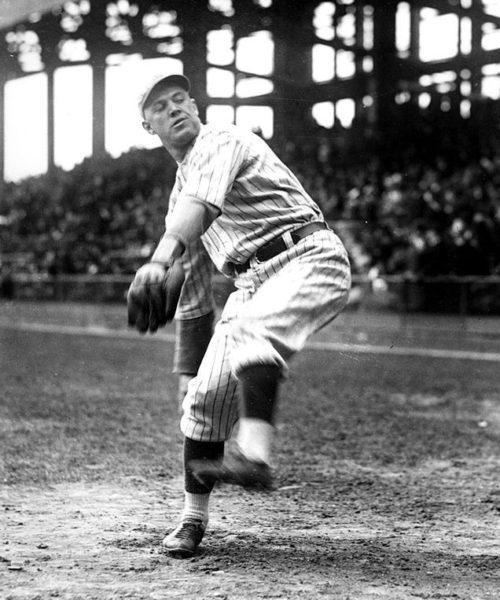
Grimes would chew slippery oak to load up the ball. But it irritated his sensitive skin, so on days he was pitching, he would not shave. This led to his nickname, Ol Stubblebeard. He was also not afraid to come inside to hitters. Like many pitchers of that era, the plate belonged to him. He had a reputation as onery and fearless. And batters of that era were afraid of him since he would throw at their heads without a moment’s hesitation.
He would load up his spitter more than other pitchers. Fielders would complain that the slippery ball was hard to grip and throw. Babe Ruth related a story about Heinie Mueller, an outfielder with the Giants. Mueller had heard about the sloppy ball, and he was taking no chances. When a line drive was hit to him, he deliberately wiped the ball clean on his shirt while the runner scored from third base. Ruth said the blunder cost Mueller his job with the Giants, and the next year, 1928, he was sold to the Toledo Mud Hens before being purchased by the Phillies later that year.
Being traded to Brooklyn was a godsend for the young pitcher. Even though he was a throw-in, he turned his entire career around. In 1918 he went 19-9 for the Robins. He started 30 games, pitched in 40 overall, and finished with a 2.13 ERA. Grimes was actually in the Navy during most of the 1918 season, but he and his teammate, Rube Marquard, were assigned to a recruiting station in Chicago and were allowed to pitch for Brooklyn. He came out of the Navy in 1919 and managed to win ten games even though he had a sore arm.
It was during the 19 seasons that his personal feud with Frankie Frisch began. Frisch bunted and spiked Grimes on a close play at first. The fisticuffs began, and the feud was on. Over the next ten years, Grimes said he aimed at least two balls at Frisch’s head anytime they played. For his part, Frisch would retaliate anytime they met on the basepaths. Frisch said, ” He only gets three shots at me, and then the so and so has to pitch.” One time Grimes crossed him up and threw at him four times, and the fourth really took him by surprise; he dropped to the ground so quickly that he literally fell from under his cap. “It was one of the few times in baseball I was really scared,” he said, and Burleigh just stood there and laughed at me.
On February 9th, 1920, the joint rules committee for the Major Leagues outlawed the spitball. Twenty-two pitchers were exempt for the 1920 season. After that, no one would be allowed to use the pitch. Bill Doak spearheaded a campaign to modify the rule so established spitball pitchers could continue to use the pitch. Grimes became one of the more eloquent spokesmen for the modification. He argued that he had spent 15 years developing a big-league-caliber-spitter. The muscles in a pitcher’s arm develop according to the way the arm is used. It would be psychologically impossible for a mature adult to change his style of delivery. If the ban is imposed, there are going to be a lot of ex-MLB players out there looking for an honest way to make a living. The ban was modified. and Grimes and 16 others were allowed to keep using the spitter until they retired.
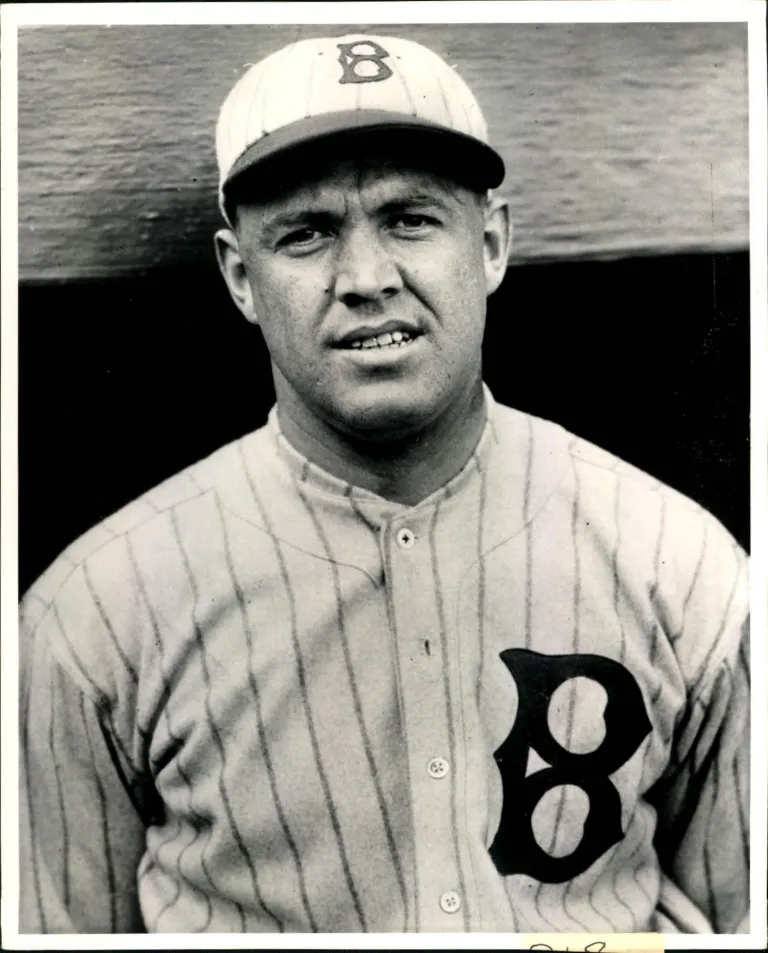
With his spitter still legal, Grimes pitched Brooklyn to the pennant. He went 23-11 with a 2.23 ERA. He went 1-2 in the World Series against Cleveland. One of his starts, game 5, turned out to be one of the most memorable games in World Series history. In the first inning, the Indians loaded the bases, and then Elmer Smith hit the first grand slam in series history. Later in the game, Jim Bagby, the Indian’s pitcher, hit a 3-run shot, the first homer by a pitcher in the series. If that wasn’t history enough, in the 5th inning, Clarence Mitchell, a spitball pitcher who had replaced Grimes, hit into what is still the only unassisted triple play in series history. Grimes would also lose the final game when Stan Coveleski, another spitball pitcher, threw a 5-hit shutout, and Cleveland won the series, five games to 2. When he was 90 years old, Grimes would still be emotional about the 20 series.
After that season, Grimes expected a raise. When he received his contract in the mail, he fired it back to Ebbets with a note saying, “I would rather stay home than a pitch for that amount of money. Ebbets sent a telegram saying, “VERY WELL, STAY THERE.” The Dodgers started spring training, and Grimes was not there. The day before the season opened, he still had not reported, and no one in the organization had heard from him for months. Wilbert Robinson went to Ebbets and said, ” I do not care how you get him. All I say is get him.” Ebbets caved to his demands and signed Grimes for what he wanted. No terms were announced.
He had another stellar season in 21, 22-13, 2.83 ERA. He tied for the league lead in wins and led the league in strikeouts. But the Robins fell to fifth place and would not win for another two decades. Pitching for a bad team, Grimes would spend the next six seasons pitching very well and usually leading the team in wins. His last two seasons in Brooklyn, however, were not that good, as he went a combined 24-32 with an ERA close to 4 over the 25-26 seasons. His time in Brooklyn came to an end on January 9th, 1927. He was part of a three-team trade with the Giants and the Phillies. He went to the Giants; the Giants sent Jack Scott and Fresco Thompson, yes, the future Dodger exec; the Phillies sent George Harper to the Giants and Butch Henline to the Robins. Henline was a backup catcher who spent three years in Brooklyn. He never played more than 67 games. As for Grimes, his one and only season for the Giants, he won 19 and lost 8 with an ERA a little over three point five. That winter, the Giants traded him to the Pirates.
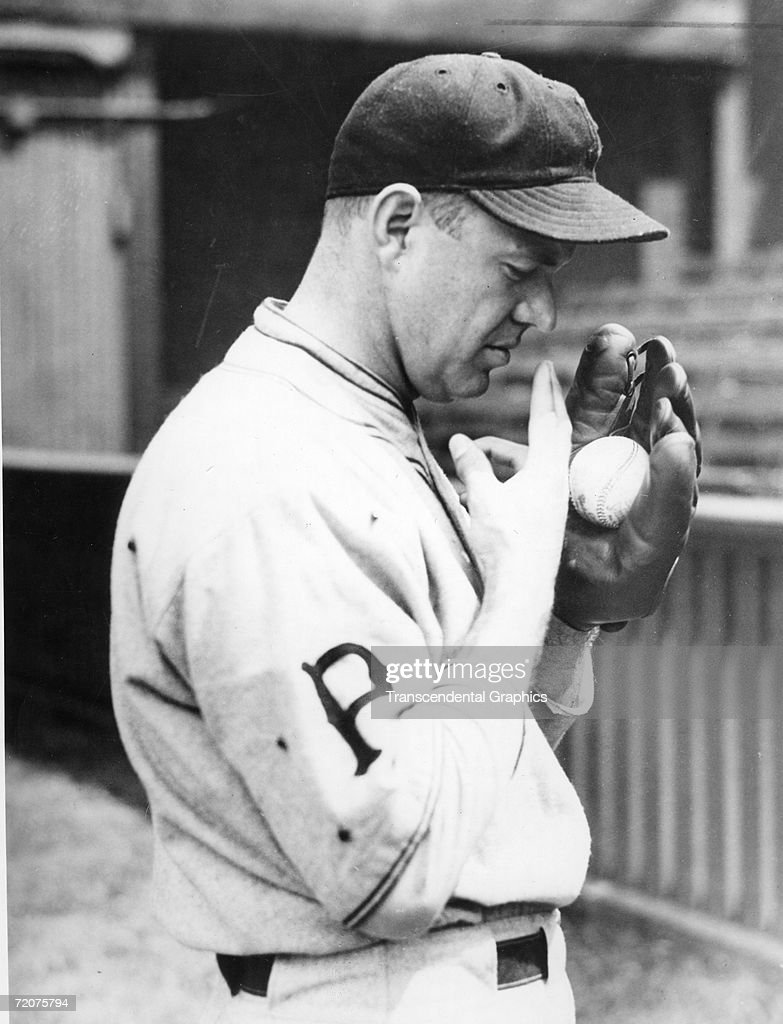
He would lead the league in wins in 1928 with a 25-14 mark. His ERA was a little below three. It would be the last time he was a 20-game winner. After 1929 with the Pirates, he basically became a baseball version of a vagabond. Going from Pitt to the Braves then the Cardinals for 1930-1931 and pitching in the series both those years. 1932 he was with the Cubs and faced the Yankees in the Called Shot series. It would be his last WS appearance. During 1933 he was traded back to the Cardinals. In 1934, his last season at age 40, he toiled for three teams. The Yankees, Cardinals, and Pirates. So, he retired, but he remained active in the game for another 35 years.
Branch Rickey wanted him to be a player-manager at his Class-B team in Bloomington, Illinois. He would win ten and lose five and help the Bloomers win the championship. The next season he managed the Cardinal’s top farm team, Louisville. They finished seventh in his only season at the helm. He was watching game two of the 36 World Series at the Polo Grounds when Tony Lazzeri unloaded a bases-loaded homer off of Dick Coffman. He was no longer the only pitcher to allow a grand slam in the World Series. Soon after he was approached by the Dodgers with an offer to manage the team, he accepted. He succeeded some guy named Stengel, who had been fired after Brooklyn’s seventh-place finish.
They did not improve much with his leadership, probably because he fought with everyone. Coaches, players, umpires. Brooklyn brought in Babe Ruth as a coach, but really as a box-office attraction. Babe would wow the crowd with mammoth homers in batting practice, but Grimes thought he was derelict in his first base coaching duties. He had an encounter with a young pitcher who had a great fastball but had not achieved success with the Dodgers. Grimes decided that the kid would give up on himself whenever he got in a jam. When Grimes shared this with the young pitcher, he became indignant. ” Why if you were not such an old man.” He never finished. Grimes’s fist caught him square in the mouth.
After leaving Brooklyn, he continued managing in the Dodger system, first at Montreal, then Grand Rapids, where he was suspended for allegedly spitting in an umpire’s face. After the suspension, his managerial odyssey began. Toronto, Rochester, Kansas City, Independence. He scouted for the Yankees from 47-52. He coached for the A’s in 1955, then scouted for them the next two years. He went to work as a scout for the Orioles in 1960 and stayed on that job until 1971, when at the age of 1977 he retired. He was very much into farming after he retired. He had invested in farmland in both Ohio and Missouri.
He raised horses, mules, and prize hogs. He had 545 rich acres of farmland near Trenton, Missouri. However, the townsfolk knew of his baseball reputation as a tough competitor and most considered him a nice man. They also said they had never heard anyone say a bad word about him. He and his wife, Inez, lived very comfortably there. In 1940 the locals built a high school ballfield and named it after him. They also named a ballfield for him in his hometown. And he and statesman Gaylord Nelson are the only two with a special room in the town’s historical museum. Included is a letter from Richard Nixon saying grimes was on his all-time team. In 1964, Grimes and Red Faber became the first two grandfathered in spit-ballers elected to the Hall of Fame. Faber was the best in the AL, and Grimes in the NL. He was married 5 times and had no children. He finished his career with a 270-212 record and a career ERA of 3.53. He went 158-121 with the Brooklyns. Grimes passed away at the age of 92 on Dec 6th, 1985, in Clear Lake. He is buried there. His gravestone has a small HOF symbol on it. Ol Stubblebeard was finally at peace.
Great writeup Bear. I’ve heard the name but I didnt know anything about him. What a character! Maybe someone like him as Roberts bench coach. Anytime someone strikes out with a runner on third and less than 2 outs he’d just punch em n the mouth! That would change a few approaches!
Last of the spit Ballers. Ol Stubblebeard was quite the character. I always thought it was pretty ironic that he was traded for Casey Stengel and then replaced him as manager of the Dodgers. He had a long and productive career in baseball. I would have loved to see him pitch. Can you imagine Tatis or Machado pulling that crap with him on the mound???? On your ass kid.
Or Drysdale!
Big D would have put one right in their ear, then when they charged the mound, kicked their ass back home.
I’m a Nolan Ryan Fan:
Don’t mess with the “Express”!!!! Rear naked choke hold. Tap out baby!.
Correa to Giants heating up
Bear,
I never knew that spitballers were “grandfathered” when the spitball was outlawed. That’s interesting. I guess Bonds, McGwire, and all the rest were also grandfathered in when steroids were outlawed. Maybe Pete was “grandfathered in” when Gambling was outlawed!
I had known about that simply because of Gaylord Perry. I read about the old timers and knew that they had been grandfathered in. Bonds and Clemens are not even assured that they will be on the next Era committee list for election. The Era committee is the only path they have to enshrinement. Go Army! Playing Navy today.
My son is a USNA graduate and serves as a Lt. Commander on a Navy Ballistic Submarine. Go Navy Beat Army!
Thank him for his service!
Go, Limeys!
Sink the swabbies!!!!!!
😉
Overtime, exciting game, maybe next year you guys win.
Good news
Kiermaier off the table. Off to the Blue Jays.
Thank you, Blue Jays!
What’s the point of us signing average players? Let the kids play unless we get an all star. Real futball France 1 England 1
Friedman was never going to sign Kevin!
Au contraire mon friere
France v Morocco a hot ticket now.
Friedman burning the midnight oil on waiver wire! Prove us wrong please!
Senga signs with the Mets. 5 years for $75 million. That’s the guy I was hoping we’d get.
Senga would have been nice but I hope the Dodgers go after Sasaki next winter when he gets posted.
More and more it looks like the Dodgers will see and approach 2023 as a transition year. Giving the kids a shot, getting under the luxury tax and keep the ammo dry for Sasaki and Ohtani in 2023. Maybe they get Correa or Swanson to fill the ss hole if Bauers suspension is upheld, but doubtful.
Not a bad plan. If that is the case and it works in the end.
Go Dodgers!!!!!!!!!!!!!!!
What’s is really interesting all these signings include a no trade clause. I think that’s more likely is what AF is avoiding.
Mets could go over 400 mil including tax penalties with Senga signing! We’re now a small market club! TIC. Lets go win a WS when we’re not the favorites!