

Today’s post is about the longest tenured Dodger manager. Walter Emmons Alston. Smokey to his friends. Alston was the manager when the team moved from Brooklyn. He was just 3 years removed from guiding them to their only World Championship in their long history. His team was a mixture of old Brooklyn stars, Reese, Hodges, Snider, Furillo, Erskine, and some new blood just beginning to make some noise on the MLB landscape.
But Jackie was gone, having retired after the 1956 season and a subsequent trade to the Giants. So was Campy, now confined to a wheelchair after a terrible accident in New Jersey that winter.
Untested kids battle hardened vets with numerous aches and pains. Quite a mix. But the bigger challenge was ahead, the ballpark. Since there was not a suitable major league facility available, the Dodgers would be playing in the Los Angeles Memorial Coliseum. Originally built for the 32 Olympics, it was now used mainly for football. USC and the Rams of the NFL used it as their home.
It also was used for 4th of July fireworks displays and circuses. They laid out a baseball field, and what the players saw the first time they laid eyes on it must have been a shock. The left field fence was 251 feet away. Protected by a 30 foot screen which extended from the foul line to left center field.
So in April of 1958 the Dodgers began play in LA. That year was not a good one for them. The aging vets and the kids limped to a 7th place finish. Power hitters like Snider and Hodges saw their power numbers dip significantly. Snider, who had hit 40 or more HR’s for 5 straight seasons, saw his total dip to 15. Partially due to the fact that he was injured, and also because the right field fence at the coliseum was a short cab ride away, not really, but it was nowhere near as friendly as Ebbets Field.
Walter Emmons Alston was born in Venice Ohio on December 1st, 1911. He spent much of his youth on a farm in Morning Sun. When he was a teenager, his family moved to Darrtown. He attended Milford Township High School in Darrtown and received his nickname ” Smokey” as a high school pitcher owing to the speed of his fastball.
He graduated from high school in 1929 and married his longtime girlfriend Lela the next year. In 1935 Alston graduated with a degree in Industrial Arts and Physical education from the Miami University in Oxford Ohio. He had stated that finances while he was at school were a challenge and that he paid his way through school by playing pool. He lettered 3 years in both basketball and baseball.
He played in the minors for the Greenwood Chiefs and Huntington Red Birds in 35 and 36. He hit 35 homers for Huntington in 120 games in 1936. His only major league at bat occurred in 36 on the 27th of September. He substituted for Johnny Mize at first base. In his only at bat, Lon Warneke struck him out. He also made an error on one of his two chances in the field.

He would not return to the majors until he became the manager of the Dodgers in 1954. He stayed in the minors for some years. In the 40’s he was a player-manager for many different teams. In 1944 he moved to Trenton and became the player-manager there. He was given that job by Branch Rickey, who had signed him as a player when he was in the Cardinals system.
He moved from Trenton to Nashua. He served as a player-manager for the first integrated US baseball team in the 20th century. The Nashua Dodgers of the Class-B New England league. The Dodgers featured Don Newcombe and Roy Campanella. They went on to win the New England title in 1946. Alston stated that he did not give too much consideration to racial issues and he simply thought how much they would benefit the team.
He moved on to Pueblo of the Western League the next season and led the team to a title. He also made his last appearance as a player that season. In 13 years at the minor league level, Alston hit .295 with 176 HR’s. But he only hit .239 at AA, which until 1945 was the highest minor league classification.
In 1948, he moved on to manage the St Paul Saints, a Dodgers AAA affiliate. The team finished in 3rd place. Campanella was on his team thus integrating the American Association. Some complained that he was only there to integrate the league, but Campy hit 13 HR’s in 35 games and was called up to Brooklyn.
The 49 team went on to win the league finishing a 1/2 game in front of Indianapolis. During the off season, Alston would work as a teacher in Darrtown.
In 1950, Alston moved on to manage the Dodgers other AAA affiliate, the Montreal Royals of the International League. Over the next 4 seasons the team won between 86 and 95 games every year. In 51 and 52 they won International League pennants. In 51 and 53 they won the Governor’s Cup playoff tournament. Alston would later be inducted into the International League Hall of Fame, 2010.
In the winter of 1953, Charlie Dressen was pressing ownership for a 2 or 3 year contract. O’Malley refused, so Dressen was out. Buzzie Bavasi campaigned hard for O’Malley to hire Alston, and finally he was named manager for the 1954 season. He signed a one year contract. And for the rest of his run as manager, he did the same thing every year.
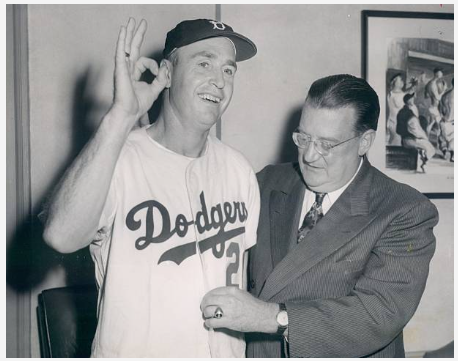
His first year, the Dodgers went 92-62 finishing 2nd to the eventual World Champion Giants. A let down since the Dodgers had won the pennant in 52 and 53. He was ejected from a game once that season. His star second baseman, Jackie Robinson, thought Alston was not fiery enough. Jackie loved arguing with umps, and Alston seemed to avoid it.
Then came 1955. The Dodgers burst out of the gate and were never headed. They won 98 games and lost 55 with 1 tie. Then the World Series with the dreaded Yankees.

Game one featured each team’s ace. Whitey Ford against Don Newcombe. The Dodgers jumped out to a lead, but the Yanks came back to tie. Snider’s HR in the next inning put Brooklyn back up, but the Yanks tied the score on an RBI groundout. Joe Collins leadoff HR put the Yankees back in front 4-3. Collins then hit a 2 run HR in the 6th to put the Yanks up 6-2. An error by McDougal put runners on 2nd and 3rd with 1 out. Zimmer hit a sac fly and Robinson then stole home and it was 6-5.
That was the final score as Bob Grim came out of the pen to finish the game. Game 2 featured Tommy Byrne, and Billy Loes, after jumping into the lead again, the Yanks went ahead and earned a 4-2 win. Now up 2-0, the series went to Brooklyn.
Game 3 was Johnny Podres against Bob Turley. The Dodgers scored 2 in the first on Campy’s homer. Yanks came back with 2 in the second on a Mantle homer, and a Rizzuto run scoring single.
The Dodgers came right back with 2 in the bottom of the second when Jim Gilliam and Pee Wee Reese both drew bases-loaded walks off the Yankee pitchers. The Dodgers scored 3 more in the 4th to lead 6-2. The Yanks then scored a run in the 7th, but the Dodgers came right back with 2 more and the final score was 8-3.
Carl Erskine started game 4, but was ineffective and the Yankees had a 3-1 lead going into the bottom of the 4th. Campy hit a solo shot, and Hodges hit a 2 run homer and they were up, 4-3. But in the 5th, Snider hit his second homer of the series, a 3 run shot and Brooklyn was cruising. The Yankees scored 2 in the 6th off of Labine to make it closer, but the Dodgers strung together 3 singles to get another run in the 7th for a 8-5 win.
The series was now tied 2-2. Game 5 featured Bob Grim, and rookie Roger Craig. Amoros hit a 2 run shot to put the Dodgers in front, and Snider hit his 3rd homer of the series in the 3rd for a 3-0 lead. The Yanks scored 1 in the 4th inning, but the Dodgers came back with one of their own in the 5th to make it 4-1.
Červ homered off of Craig in the 7th, and Berra hit one off of Labine in the 8th, and it was 4-3. But the Dodgers pushed across a run of their own, and won 5-3.
Up 3-2, the series shifted to Yankee Stadium. Karl Spooner started for the Dodgers and it was Ford again for the Yanks. The Yanks scored all 5 of their runs in the 1st inning off Spooner. A couple of walks, back to back singles, and then a 3 run bomb by Bill Skowron, and they were up 5-0. Ford for his part pitched a complete game 4 hitter allowing 1 run in the 4th on a single by Carl Furillo.
With the series tied, Alston went with the lefty, Johnny Podres against the Yanks Tommy Byrne. Podres bobbed and weaved his way through the Yankee lineup. He scattered 8 hits through the game. In the 3rd inning, with Rizzuto on base, the Yankees got their only hit with a runner in scoring position, but instead of it being 1-0 Yankees, Rizzuto was out because the ball hit him.
The Yanks had a couple of scoring opportunities, a Berra leadoff double, but they failed to score. Then in the 6th, came the play of the game, with 2 runners on, and 1 out. Yogi Berra hit a line drive to the opposite field. Sandy Amoros who had just come into the game as a defensive replacement for Gilliam raced to the line and caught the ball right in front of the stands. He fired the ball to Reese who relayed it to Hodges, and they were out of the inning.
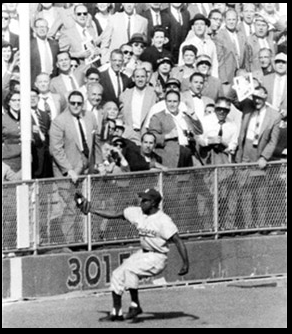
Podres had little trouble the rest of the way, and when Elston Howard grounded to Reese in the 9th, the Dodgers had their first Championship. And it was Alston at the helm.
One thing though, the heart and soul of the team, Jackie Robinson, was not on the field that final game. He had been replaced at 3rd by Don Hoak.
Alston’s run of success had just started. His 56 team went back to the series, but lost to the Yankees. Partly due to the perfect game pitched by journeyman pitcher, Don Larsen.
In 58 the team was gone from Brooklyn and moved to Los Angeles. Campy and Robbie were gone, Erskine’s balky elbow finally caught up with him. Snider was hurt for part of the year, and the team limped home in 7th place their first year in their new home.
They played on a converted football field with really odd dimensions. Snider’s power alley was so far away he would say it was a cab ride to get there.
59 was a transition year. The Vets were not playing as much, and off season pick up, Wally Moon became the regular left fielder. Snider shared center with Don Demeter. Reese had retired and was a coach. So Zimmer started the year as the SS. But he was so bad that they called up a speedster named Wills at midseason. Neal was at second, Roseboro was the catcher. Gilliam played third most of the time with Hodges at 1st.
They ended up tied with the Braves and won a 2 game playoff. Drysdale and Podres were the top pitchers on the staff. The top man out of the pen was Larry Sherry.
They beat the White Sox in 6 games. Duke Snider hit his 11th and final World Series homer, and in their second year in LA, they had their second World Series title.
Over the next few years Alston would get them to 3 more World Series, and really close to a 4th. They would win in 63 and 65, then lose to the O’s in 66.
As the team’s roster changed and the old guard moved on, Snider and Hodges to the Mets, others to the Astros, the 2 new expansion teams, it became a little harder to win since now there were 10 teams in the league.
Koufax called it quits after the 66 season and Alston lost his Ace. Big D was still there, but the team struggled scoring runs. In 67 and 68 they had back to back 8th place finishes.
In 1969 division play started, and the Dodgers finished 4th in the NL West. But new blood was coming.
1970 marked a 3 year stretch where they averaged 87 wins a year. Finishing 2nd twice and 3rd once. In 1973 they won 95 games and finished 2nd. It was the first year the infield of Garvey, Lopes, Cey and Russell was together.
In 1974 with the Addition of Jimmy Wynn they got Alston his 7th and final pennant. Facing the two time champion Oakland A’s, they lost the series 4-1. Oddly 4 of the games ended with the same 3-2 score. The other game was 5-2. In 75 and 76, they finished second to the Reds Big Red Machine. Alston turned the team over to Tommy Lasorda with 2 games left in the 76 season and he retired.
Over his last 8 years the team averaged 85 wins a year and had 5 second place finishes. In 71 they finished 1 game back of the Giants.
Alston was called “The Quiet Man” for his demeanor. He never would chew players out in public. He always would pull them aside and explain why he was upset with their performance.
He was also one of the strongest guys around. He once challenged anyone on the bus to get off and fight him if they had a gripe. The players had been complaining about a bus that was having engine trouble and they were stuck in traffic. He took responsibility when the team lost, and gave credit to his players always.
Some players characterized him as indecisive. But they also said he managed to get the best out of his guys.
His 4 Series Championships are the most of any Dodger manager. As are his seven pennants. He could have possibly had a couple more.
Alston retired to his home in Darrtown. The Dodgers retired his number in 1977, He became the 4th Dodger to be so honored. He was elected to the Hall of Fame by the Veteran’s committee in 1983.

He suffered a heart attack that year and was in the hospital for a month. His grandson went to Cooperstown to represent him at the induction ceremony. Alston passed away on the 1st of October, 1984 in Ohio. He is buried in his hometown of Darrtown. He was 72 years old.
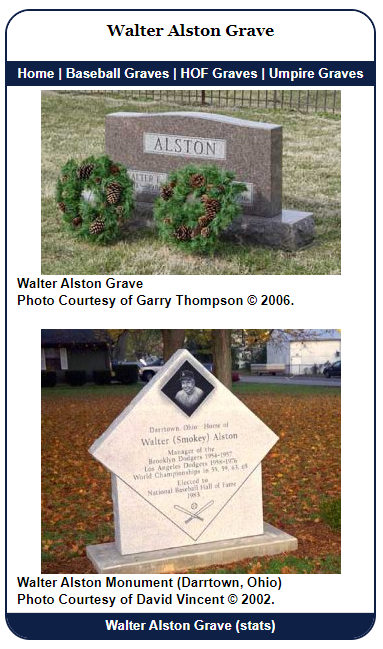
His winning legacy and the 2040 games his teams won in those 23 years have made him the winningest manager in Dodger history. Lasorda who managed 21 years had 1599, and Wilbert Robinson who managed for 19 years finished with 1399.
Walter Alston was a Dodger legend.
Didn’t Sandy Amoros return to Cuba and not return to MLB after the next year? Remember the year when Roger Craig & Don Bessent came up midseason to help the bullpen? Some memories!
No he did not. Sandy was back with the Dodgers and hit .260 with 16 HR’s and 58 RBI’s. All MLB highs for him, Amazingly he also walked more than he struck out, 59-51. His playing time diminished, and he spent all of 1958 with thier AAA team in Montreal. He got into 5 games in 59 in LA, then went back to AAA. He got into 9 games in LA in 1960 and then was sold to the Tigers. In 1960 he played in Denver, and in 61 he was in Mexico playing for the Mexico City Reds. That was the end of his career.
Bear how would you compare Alston and Lasorda as managers? And did they have any kind of relationship?
Almost exact opposites. There was nothing quiet about Lasorda. He also was a AAA manager before he became their 3rd base coach. He had managed many of the players he inherited in the minors, so his relationship with his players was a little more personal than Alston’s. Walt had managed a couple of the players, but the bulk of the team when he got there were established stars. And his style was totally different than Dressen’s. Walt and Tommy probably got along. I do not think Tommy was Walt’s choice. I think that was an ownership move to have who they thought was their best option in place in case Walt retired or was fired for any reason. There was a special on TV after Lasorda took over and it showed him and his players when he was managing Albuquerque. He would have them on there knees, they would bow and say I Love the Dodgers, and he would reply, and the Dodgers love you. Where as I never saw Alston chew a player out on the field, Lasorda was a different story. I remember a game where Doug Rau was pitching. For some reason, Lasorda was miked up. Rau had just given up a 3 run bomb and Tommy went out to get him and he was none to gentle with his words. Which started something like ” What kind of effen pitch was that? My mother could throw a better pitch than that! Yep, that was Tommy. And he once asked an umpire if he should remove his pitcher or not. Alston would never do anything on the field to draw attention to himself. Tommy had a fight with the Phillie Phanatic. Alston made one huge blunder during his managerial career that most Dodger fans who were alive at the time remember. In game 3 of the 1962 playoffs, the Dodgers were up 4-2. Duke Snider and Don Drysdale both went to Walt and pleaded with him to let Big D warm up to go into the game if needed in the 9th because Roebuck was tiring. Alston refused and told them, Drysdale is pitching game 1 of the World Series. Snider replied, we have to get there first Walt. Well in the 9th, Roebuck got into trouble, and Alston brought in Stan Williams, he of the blazing fastball, and not much control. He walked a couple of guys to tie the game, and then Mays hit a 2 run double and they lost 6-4. If you are wondering why he was fixated on Big D starting and not Koufax, Sandy was out with a circulatory problem in his hand. He had been on the DL for quite a while.
Connie Mack’s record of 3731 manager wins is probably untouchable but goddamn Tony La Russa only needs 35 to catch John McGraw for 2nd place.
Records are made to fall. But LaRussa has managed a lot of different teams. McGraw managed Baltimore for 3 years before going to the Giants in 1902. He won 9 pennants and 3 World Series. LaRussa has managed over 5000 games, and his won lost percentage is 50 percentage points lower than McGraw. He might pass him in wins, but that by no stretch of the imagination makes him a better manager. LaRussa’s teams have won 6 pennants and 3 series.
Another good one Bear. Thanks.
Those were the days. Alston didn’t take any fooling around. He required his players to perform but he was still a player’s manager in that he cared about them.
One anecdote I read from the Duke was that Alston didn’t want his players to have sex the night before a day game. He thought it would zap their strength. Not sure how he fared with that one.
Reported that Alston was alright with a handy before day games however.
Go City of Angels Baseball Team!
There aren’t many Angels left in the city.
Never heard that, but it sounds like Alston. He was pretty straight laced.
We are saved!!! Fed-Ex has signed a minor league deal to return to the Dodgers! It is true, he does hit RH. This is sarcasm people. The least of our needs is a backup catcher. The MLB has bestowed major league status on the Negro Leagues per MLBTR. My guess is that would make all of their stats official. At least the ones that can be verified. Rays resigned Zunino.
Considering that we have Barnes, Smith and Ruiz as major league ready catchers. Plus, a boatload of minor league catchers at various levels, what does this signing mean? A trade is imminent.
Hm, I guess that is possible. Then again maybe he is just taking Rocky Gales AAA job. But who knows what lurks in the mind of AF?
That’s certainly not as fun to speculate.
They are moving Will Smith to 3B.
If he had an entire spring training over there and played that position exclusively, he might be able to do it. You never know until you try. A lot of players have changed positions and been successful. Others, not so much. Look how Garvey improved by moving to 1st. And look how many fans were spared ducking for cover because of that move.
For the upcoming season? That’s almost as believable as a Bumsrap trade scenerio.
The AAA (Rocky Gale) job is the best bet, but MiLB contracts are the very low risk high reward contracts.
Cheap, no 40 man spot until needed, pretty loose roster limits as to how many you can sign. Not to mention someone else does not have that player. It’s like putting a player on retainer.
I expect more of these signings as the off season goes on.
Good article and thanks for it, Bear. Was it Alston, who was an extremely successful manager, institute the rule about the Dodgers not being able to grow beards, be face-shaven, etc? I had heard he was a strict manager. When and who was responsible for the change to allow beards and long hair etc, if anyone?
Back in those days there was a dress code in the majors with all of the teams. Not only were they clean shaven, they wore suits and ties to travel. Yankees still adhere to the no facial or long hair edict. And the Dodgers did this even though they had their own plane. The changes started with Charlie Finley’s A’s. He encouraged his players to grow facial hair. George Foster was the first Red to have it. Anderson did not allow facial hair, But, Foster had a skin condition that prevented him from shaving. His hair was so thick it would virtually grow back into his skin. I do not know if you have seen the movie, For Love of the Game. There is a scene in that movie where the Tigers are walking through an airport, and all of them are dressed up in suits.
The one story I heard about how strict Alston was concerned the curfew the Dodgers had. I cannot remember who the players were, but a couple came in, were spotted by a coach who informed Alston. Walt went to their room, where they had locked the door and he was beating on the door. Doing so, he broke his World Series ring which infuriated him even more. I read where both players recieved the maximum fine allowed at the time, which was probably about 100 dollars.
Good stories, Bear and Badger. Thank you.
Smith’s bat plays huge at catcher but not so much at third base. Leave him behind the plate. It’s a big advantage for our lineup. It will end up with Turner at third and Lux at second and a closer of AF’s choice. Remember be a pig AF!
I thought we were moving Smith to 2b and Lux to LF?
I just heard we are trading Gonsolin, Muncy, Hoese and another arm, in a three way for Gleyber, who will play first base, and a pitching prospect.
Thought it was Barnes going to 2B, Lux to LF, Muncy to 3B and resigning Joc for 1B. It’s still 2020, I can’t keep up.
Some minor deals going down, nothing major yet DeSclafini signs a 1 year 6 mil dollar deal with the Giants, and Luis Perdomo is set to sign a minor league deal with the Brewers.
Nice profile, Bear! I knew nothing about Walt Alston, other than that he was the manager during the years of my childhood, when I followed the Dodgers rabidly. I also knew he had a seemingly mild disposition, and received a series of one-year contracts from stingy Walter O’Malley. And that he was quite frustrated with Koufax early in his career. That was it. I’d be interested to know more about Walt’s qualities as a manager. It is evident that, unlike Lasorda, he didn’t make himself the center of attention. As a result, I find it hard to get a sense of the man. I gather that his players liked him, but what were the qualities that they liked about him? You could feel Lasorda’s passion (and temper). You can feel Doc’s positivity and decency. What were Walt’s qualities that motivated his players, that helped them to achieve to their potential? Also, how is he regarded as a tactical manager? The Dodgers were masters of the small-ball era, so clearly he knew situational tactics like when to bunt, hit-and-run, etc. However, I never heard him acknowledged as a great tactical manager. Maybe because he was so self-effacing, he never drew attention to himself. Didn’t get the credit he deserved. Curious about your opinion on these points!