

In the winter of 1973, the Dodgers sent longtime center fielder Willie Davis to the Montreal Expos for Mike Marshall, the Expos’ closer who led the league with 31 saves. The Dodgers’ closer at the time was Jim Brewer, a 36-year-old left-hander who had joined the team in a trade with the Cubs in 1964. He had been their primary closer since 1968.
Marshall was born in Adrian, Michigan, in 1943. His father, William, was a draftsman, and his mother, June, a homemaker. When he was 11, he was riding in a car with his uncle when the car was hit by a train. His uncle was killed, and Mike had a back injury that would bother him for years and shape his baseball career.
After he graduated from high school in 1960, he signed with the Phillies as a shortstop. He also enrolled at Michigan State University and began classes in the offseason. Sometime shortly thereafter, he married his hometown sweetheart, Nancy Matthes.
He climbed steadily up the minor league ladder in the Phils organization for 4 years, reaching AA. He was an above-average hitter but made an alarming number of errors in the field. Then things started to go south. He told the organization that he wanted to pitch, believing it would be easier on his back than diving for ground balls.
The powers that be in Philadelphia, unwilling to let a player dictate which position he would play, became the first of 11 teams to decide they could do quite well, thank you, without the services of Mike Marshall.
So, the Phillies sold him to Detroit in 1966. He completed his conversion to pitcher, and by May of 1967, at 23 years of age, he made it to the Tigers. He had an excellent rookie season, pitching in 37 games, he had a 1.97 ERA with a 1-3 record and 10 saves. The Tigers missed the pennant by 1 game. His reward? A trip back to the minors in 1968.
He figured out he had a problem retiring left-handed batters. He started working on throwing a screwball. At that time, screwballs were considered arm killers by most baseball coaches and organizations. Tigers’ manager, Mayo Smith, told him to quit using it. When he refused, the Tigers let him go to the Seattle Pilots in the expansion draft.
The Pilots’ pitching coach, Sal “The Barber” Maglie, told him the same thing. He was 3-10 with a 5.14 ERA in 69 games with the Pilots; they sold him to the Brewers, who then sold him to the Astros. Astros skipper, Harry Walker, told him the same thing. He was with Houston for just 4 games before being traded to the Expos, his fifth team in just 4 years.
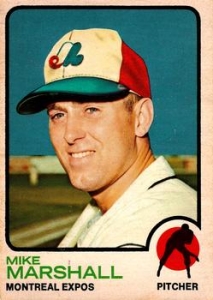
Marshall was 27 when he was traded to the Expos. He and his wife had been married for 9 years. They lived in transient housing during the season, taking their three children with them. In the winter, they lived in graduate student housing at Michigan State while Mike earned a master’s degree and studied for a PHD.
In 1970, he was 3-7 with a 3.48 ERA and three saves in 64.2 innings. In 1971, Expos manager, Gene Mauch, installed him as his “late inning fireman”, they were not called closers yet. Mauch, known as “The Little General”, was an old-school type manager. Mauch had told him, ” Do it your way as long as you don’t try to influence other players that your way is the right way.
Now able to control his screwball, Mike seized the role. His first year in the job, he had a 5-8 record with a 4.28ERA and 23 saves in 111.1 innings. He led the league in games finished with 52. After 10 years of butting heads, he had finally found home. Mauch said he never argued with Marshall because he was intelligent and always thinking.
1972 saw Mike go 14-8 with a 1.78 ERA, 18 saves, and he led the league in appearances. He pitched 116 innings. 1973 saw him with a 14-11 record, a 2.66 ERA, and 31 saves in 92 appearances. He pitched 179 innings. His 31 saves and 92 appearances led the league. Surprisingly, he did not make the All-Star team. On the downside, he blew 12 saves. Since he often came in for multi-inning saves, he had more chances to blow a game than modern-day closers.
It had taken him a long time to be successful in the game. But success did not keep him from putting his foot in his mouth. He refused to accept a $5,000 check awarded to the team’s outstanding player because he did not believe teammates should compete for individual awards. That embarrassed the club’s radio sponsor, who sponsored the award.
He then told an interviewer a couple of weeks later that the Expos’ defense stunk and he named names. A huge taboo in baseball circles, even though he had said the comments were off the record. He finished 2nd to Seaver in the Cy Young voting, but the team had seen enough. He was traded to the Dodgers for CF, Willie Davis, who was 3 years older.
Marshall was apprehensive about the move. He knew the Dodgers were an excellent organization and that they worked hard to achieve success. He was also leaving his favorite manager. He now had to convince Alston to buy into his program.
“I will tell you on days when I am not able to pitch; otherwise, you can pitch me every day you feel I can help you win a ballgame,” he said. Alston believed him. “Walter Alston was a beautiful human being,” he said.
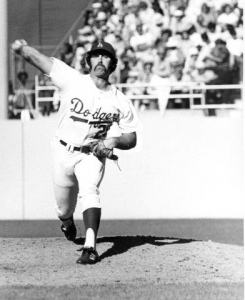
Marshall began 1974 by pitching in 5 consecutive games. Starting on June 18th, he threw in 13 consecutive games in 16 days, breaking the MLB record of 9. During that stretch, he picked up 5 wins in six days. He pitched on consecutive days 53 times and both ends of a doubleheader once. He would pitch in 106 games with 208.1 innings. He was 15-12 with 21 saves.
No pitcher has come close to pitching in that many games since. Kent Tekulve and Soloman Torres came the closest with 94 each. Marshall once said, after 3 days off, “If I had not pitched tonight, I would have had to pitch batting practice tomorrow. It felt like I hadn’t pitched all year.
Alston used him like most managers of the day. He would come in if the team were ahead, tied, or behind, often as early as the 6th inning. Marshall’s heavy lifting allowed the Dodgers to carry nine pitchers instead of the usual 10. It should be noted that the save rule was different than. It made it harder to record a save.
LA won the division, and Marshall was unscored on in two games of the playoffs against the Pirates. The Dodgers then faced the two-time champion A’s. Marshall would pitch in all five games, but his teammates remember the last one best since they believed his bullheadedness cost them the win.
The Dodgers were down, 3 games to 1. Game 5 was in Oakland. Marshall came in to relieve Sutton with the game tied at 2 in the 6th inning. The A’s leadoff hitter was Joe Rudi. Someone in the left field stands threw a whiskey bottle at LF, Bill Buckner. The game was held up for close to six minutes.
Marshall refused to take the traditional warm-ups even though catcher Steve Yeager and his teammates urged him to keep loose. When play resumed, Rudi hit Marshall’s first offering for a series and game-winning homer. Rudi said he got the fastball he expected because he did not think Marshall would throw a screwball after waiting around that long.
“You have to throw a few pitches when you wait around that long,” Yeager said. The Rudi homer was the only run Marshall allowed in the series. Marshall had come in after finishing warming up in the pen, and his point was that the delay was not that long. But some Dodgers never forgave him.
After the season, Marshall earned the Cy Young award and finished 3rd to Garvey in the MVP vote. He refused to say he had done anything special. “I have a simple job; I pitch for the Dodgers when they need a relief pitcher. I do not count appearances, wins, losses, earned run average, or saves; I am just ready to pitch.”
He was proud that his arm showed no signs of damage with all of the pitching, but his body was another matter. The 75 season was less than 2 weeks old when he fell to his knees on the mound in Dodger Stadium with a pain in his side. “I felt like someone stuck a knife in me.” The diagnosis was torn rib cartilage. He went on the DL. When he returned, he pitched inconsistently. He finished with a 9-14 record, eight blown saves, and just 13 saves. His ERA was 3.19 in 109 innings. He said the injury had nothing to do with his arm but was most likely a result of the love handles in his waistline.
Many of his teammates sought him out about ways to keep their arms healthy, including Messersmith, John, and Sutton. Joh,n who had undergone the surgery that would bear his name, enlisted his help with rehabilitation. John would pitch until he was 46. Fran Tarkenton and Billy Kilmer also sought him out.
He also landed in legal trouble in the winter of 75 over his insistence on having his own way. While studying for his doctorate, he kept in shape by taking pitching and batting practice in the university’s intramural center. But when players on nearby tennis courts started complaining about baseballs being hazardous, university officials said he would have to reserve time rather than just practice when he wanted.
Marshall ignored them and kept doing what he wanted. That resulted in him being arrested. The court fight would drag on for several years. He was late to spring training because of court appearances and then angered Dodger management with his role as player rep. He aired grievances about hotel accommodations in several cities and demanded that sportswriters be kept off the team bus.
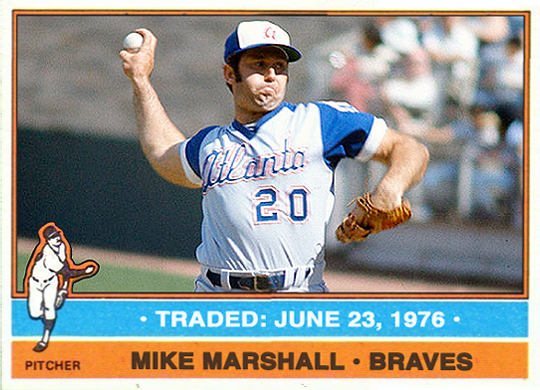
At the time, knuckleballer Charlie Hough was pushing him out of the closer role. When he left the team for another court appearance early in the season, team president Peter O’Malley had had enough. On June 23rd, he was traded to the Braves for Lee Lacy, Elias Sosa, and cash. Jim Murray wrote, “There isn’t a team in the league that would not want Mike if they could just keep the arm and get rid of the rest.
Marshall arrived in Atlanta without his trademark sideburns, like a man looking for a fresh start. He would pitch 24 games for the Braves before his season ended because of knee surgery. He showed up late for spring training in 77 because of another arrest in his ongoing feud with Michigan State.
In his 4th appearance of the year, Braves skipper Dave Bristol came out to relieve him. He rolled the ball across the infield and left the team. The Braves put him on the disqualified list. He was sold to the Texas Rangers on April 30th.
His stay in Texas would not be long. They tried him as a starter, but he injured his knee fielding a bunt. He had surgery on the knee and, after the season, an operation to repair the back problem that had been bothering him since childhood.
He was 35 and close to getting his PHD. He decided to retire. He kept up his rigorous routine, and his wife knew he wasn’t ready to quit. After the season started, she called Gene Mauch, who was now managing the Twins. Needing relief help, Mauch asked him to work out with the team.
Calvin Griffith, the team owner, said they could not afford Marshall’s salary, now over $ 100,000. Several Twins players, including Rod Carew, a six-time batting champ, fumed at the owner’s penny pinching. How can he expect anyone to want to join the team when he does things like that? Marshall got his contract at a reduced rate.
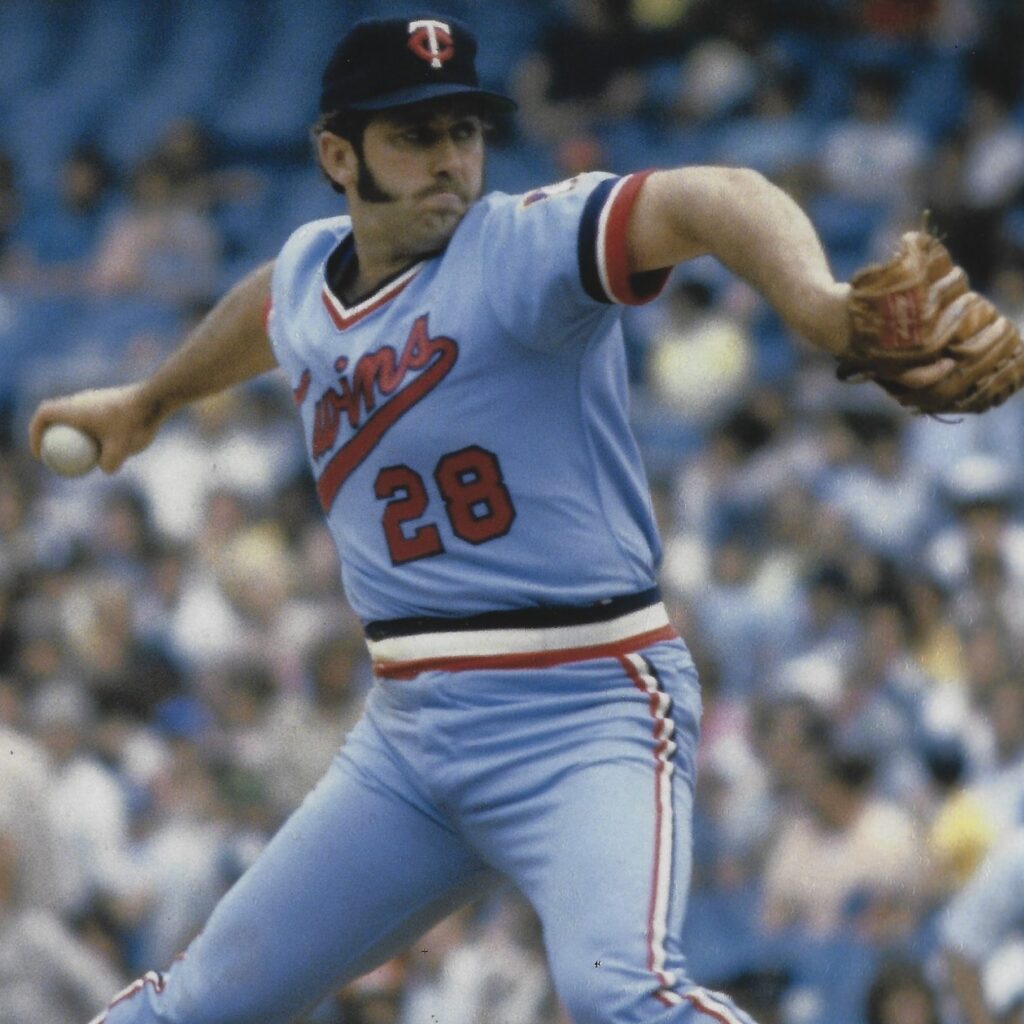
He would call it his second career. Now that he had some financial security, he said this time it is for fun. He went 10-12 with a 2.45 ERA and 21 saves in 99 innings for the Twins. Griffin then signed him to a 3-year, $850,000 deal.
In 1979, he went 10-15 with a 2.65 ERA, led the league in appearances with 90, and saves with 31. In 1980, his second career suddenly went south. Mauch started using him in mop-up situations. Marshall was pitching poorly, but he suspected there was another reason for his demotion, and Mauch confirmed it.
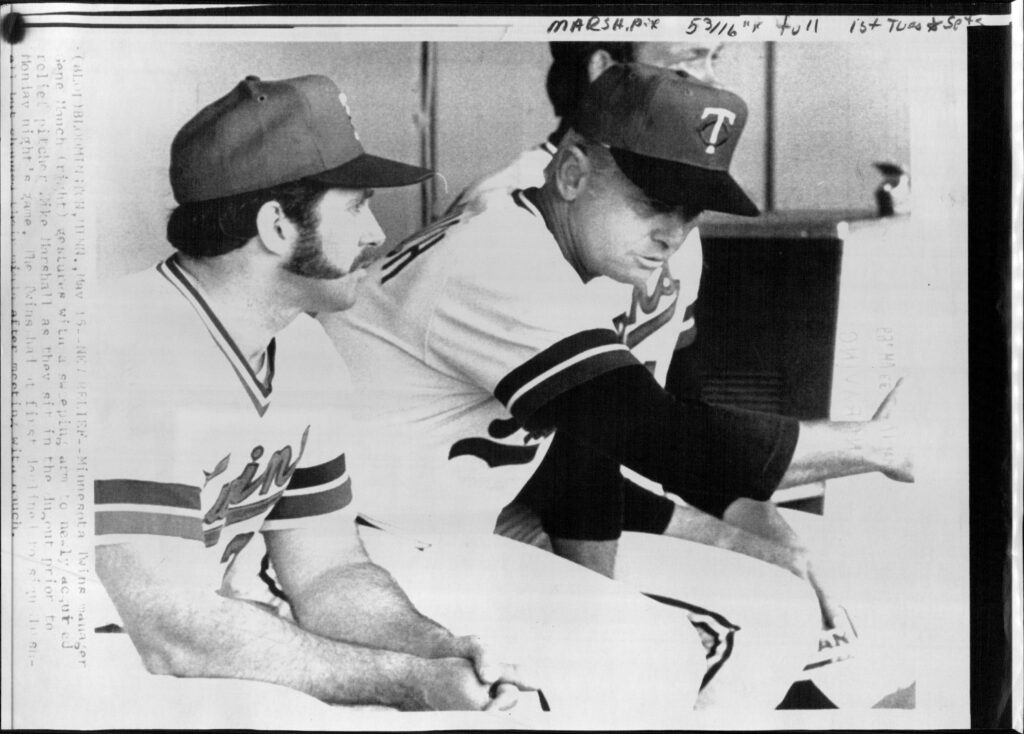
“It’s this player rep stuff; you have to quit doing it.” Marshall was one of the players’ union’s most high-profile negotiators, and they were in a standoff with the owners over a new union contract, and Mauch hated the union.
When the two sides agreed on an interim contract which would postpone the inevitable strike until the next season, Griffith decided to eat the 500,000 still owed to Marshall, and the Twins immediately released him. Mauch and Mike had been such good friends, but by the time he left the Twins, they were no longer talking.
Through the beginning of the 1981 season, Marshall could not find a job. He was 37, but just a year removed from one of his best seasons. After the strike ended, he found a job with the New York Mets who were managed by Joe Torre, a former union rep.

He pitched in 20 of the Mets’ last 43 games to a 3-2 2.61 mark with no saves. But the Mets released him anyway. He tried out with the Expos in 82 but was cut during spring training. He was forced into retirement with 188 saves. At the time, that was fifth on the All-Time list—58th in 2021.
After 17 years, Major League Baseball was through with Mike Marshall. He pitched one game at AAA in 1983 and continued to pitch in senior league sandlot games until he was 56. He was unable to find an organization willing to let him coach. In the early 90’s he wrote all 30 franchises offering his services by he did not receive a single reply.
They are still teaching pitching the same way the first guy who won a ballgame was pitching. None of them knows anything about science. They think Sir Isaac Newton invented the Fig Newton, he said. He coached at several small colleges for over a decade and then opened a pitching academy in the Tampa, Florida area. He did not try to get rich. He charged just 10$ a day for his course of instruction. He posted his treatise of pitching online for all to see. His routine involved throwing trash can lids and 12-pound iron balls with 30-pound sandbags strapped to the student’s wrist. He taught them a pitching motion so weird that onlookers wondered if he had ever even thrown a baseball. He insisted that delivery made them injury-proof.
His approach influenced Kyle Boddy, the founder of Driveline Baseball, one of the leading private pitching labs and a consultant to colleges and MLB. He took the name from Marshall’s drive-line theory, which holds that a pitcher’s arm and body should always be moving forward. His company hit the mainstream in 2019 when the Reds hired him as a minor league pitching coordinator. But he and several researchers took issue with some of Mike’s theories.
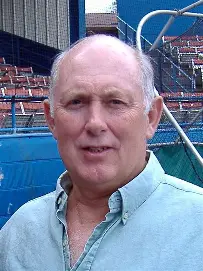
Most of Mike’s students were high schoolers and collegians who were not likely to get drafted or washed-up minor leaguers. One of the major leaguers who sought his help was Rudy Seanez, who came to him to help him recover from an injury.
Shortly after his baseball career ended, he and his first wife, Nancy, divorced. She would collaborate with Bobbie Bouton, Jim’s ex, on a tell-all book about their lives as baseball wives. Bouton and Mike had been teammates on the 1969 Pilots.
Marshall’s legacy indirectly connects to Brent Honeywell Jr. His father was Mike’s cousin. He taught the screwball to Honeywell Sr., who taught it to the kid. Honeywell made it to the majors with the Rays in 2021 and was a member of the Dodgers’ 2024 Championship team.
Marshall remained an outcast from baseball’s establishment, but he never gave an inch. “I know what works, I have a responsibility to give it back, if nobody wants it, that is not my problem”. Marshall passed away on May 31st, 2021. He had been in hospice care.
thanks Bear! nice work! it’s funny, we remember players like marshal playing for the dodgers, but we don’t always know who they really are in real life. i remember hearing he wasn’t liked that much. But evidently he was pretty much hated! unlike the other Mike Marshal who was a big likable dude!
Mike was a lot like Trevor Bauer. Bauer had his own routine and wanted to stick to it because it worked for him. Marshall was a highly intelligent guy. He might have thought he was smarter than most baseball people of the time. I had never heard of kinesiology until Marshall came along.
Great piece, Bear! Learned a lot!
Marshall was a fascinating character. And unique. Nobody like him before or since.
It wasn’t surprising that Mauch, known for his intelligence, would connect with Mauch. For some reason I thought it was Lasorda, not Alston, who kept sending Marshall out to the mound when he was the ultimate workhorse. (Quite a counterpoint to the contemporary approach of starters going for six innings, and relievers making “one and done” appearances.)
Thanks Duke. Tommy took over the last 4 games of the 76 season, Marshall was gone by then. Most believe that he over worked Fernando and caused his later arm troubles. But that is the way pitchers were used back then. They are treated like fine China now.
He’s no Brian Holton!
Nice post Bear
Very informative and detailed.
Thank you for all your stories of our Dodgers history.
You are welcome Bob. Love Dodgers and baseball history.
I appreciate it guys. I am working on a post about the “other” Mike Marshall.
Great post Bear! Not many relievers like him these days.
Thanks Andrew. Nope, relievers, especially the back-end guys rarely face more than 3-hitters, let alone go more than 1 inning.
Bear –
Great article on a unique individual. My lifetime memory of Mike was in a playoff series with the Oakland A’s – one of baselball’s dominant teams in the 1970’s . It was a playoff game at the old Oakland Alameda Stadium. It was a very cold night – like only the Bay Area can have. Mike was brought in late to stop a rally and he was the only player on either team without an baseball undershirt on because he didn’t believe in them. It would be a great story if Mike had closed out the rally with a save – but it did not happen.! Mike gave up the winning hit; the A’s won the series and Mike was traded that off season and I forgot about him. Thanks for completing “the ptofile” on Mike for me; he was a person who stood up for what he believed which is more meaningful to me now as a 79-year- old!!
Thanks Tom. He would have had to been with the Twins then. Dodger players never forgave him for that homer he gave up in game five in the World Series. I was at the game where he injured his ribs. Also lost that day was Bill Buckner. His replacement in left, Tom Paciorek, ran into that low fence in left and was also injured. Bad day for Dodger baseball. Standing up for what you believe is something I have always done, and I admire those who stick to their beliefs.
Gavin Stone Completed Rehab & Expects To Be ‘Full-Go’ In Spring Training
“The Los Angeles Dodgers are set to welcome back Gavin Stone next year after he missed the entire 2025 season while recovering from right shoulder surgery.
The former fifth-round draft pick made his MLB debut in 2023 and took a big step the following year after earning the final spot in the Dodgers rotation.
Stone led the team in wins (11), innings pitched (140.1) and starts (25) while posting a 3.53 ERA and 1.21 WHIP to go along with 116 strikeouts against 37 walks. However, he did not pitch after Aug. 31, 2024, due to right shoulder inflammation”.
Excellent news.
Looks like Stone will compete with Sheehan and River Ryan for the 6th spot in the rotation.
Not long ago, Stone was playing second fiddle to Bobby Miller among the pitching prospects. Now I think Miller may need a change of scenery.
it’s going to be quite a spring training next season!! with sasaki supposedly joining the rotation, that 6 spot is going to be a battle royal! that is unless one of stone or sheehan is traded. Ir maybe both of them will join the rotation and Sasaki doesn’t win the #5 spot. Do they even consider leaving Sasaki in the bullpen? What about skrubal? the dodgers wouldn’t, would they ? it would probably cost dePaula,sheehan, and more. Sooner or later one of these top prospects is going to be a superstar. DePaula has the hit tool. defensively he lacks a little. I don’t think they trade him for one year of Skrubal. But we never know! I’m not sold on sasaki just yet. At least as a starter. He seems to “panic “ just a bit at times. the stuff is there, the confidence may lack a little. just me. River Ryan could also have something to say about that rotation! And lastly, what in the world do they do with Bobby Miller? can they even find a taker in a trade?
Skubal is a rental. If Detroit trades him at all, it probably would not be until the deadline when a team desperate for a top starting pitcher would overpay. It happens all the time. They can maximize their return if they feel he is not going to sign with them. I cannot see the Dodgers making that trade unless he did an extension like they did with Glasnow. Miller either becomes a bullpen guy or he gets dealt. My take, he needs a fresh start somewhere else. His trade value is low.
Starting pitching is NOT the problem, we need an outfield left handed bat. NO to Skubal!!!! NOT interested in the length of the contract Tucker will eventually get.
I believe Mark proposed in a prior thread the idea of including Glasnow in a potential Skubal trade. I would argue that 3 years of control of Glasnow likely outweighs 1-year of Skubal, but I may be a bit bias here (tongue and cheeck). Realistically, the Dodgers may need to include 1 prospect, but no more than 2 in my opinion.
Why would the Dodgers pursue such a trade? It opens a window of opportunities:
– Assemble one of the best starting rotations of all time
– Greater odds of winning back to back to back titles
– In doing so, cementing the Dodgers as the most successful and dominant sports organization of this generation
– If the Dodgers extend a longterm contract to Skubal after the 2026 season, Snell becomes expendable and could be traded to open a spot for a youngster like Sheehan
– In a scenario where Skubal leaves via free agency, the Dodgers can fill the spot with one of our young starting pitchers; i.e. Sheehan, etc.
Why would Detroit pursue this trade? What team possesses the depth in their system to make a pitcher like Glasnow available for a 1-year rental? Unless Detroit covets prospects, getting 2 additional years of control in return for an experienced pitcher like Glasnow should be a huge win for the Tigers.
Now we’re trading Snell?
This gets weirder and weirder
Speculative; hence, the premise that it “could” open a window of opportunities.
Did you read the entire post?
I never proposed trading Glasnow. That was an article in a blog or news source.
My bad Mark, you merely quoted
Tis the season for rumors… and they all serve as click-bait as we scour the internet.
Lately I’ve read that the Rangers may deal Seager–and the Dodgers might get him!
The Rangers are allegedly shopping deGrom around…. and the Dodgers get him too!
Most are merely trade proposals, not rumors. Often, these proposals get taken out of context by folks who designate them as rumors 😉
never said starting pitchers were the problem. just read some articles about the dodgers possibly having interest in skrubal. they have interest in everybody! And what it would take for them to get skrubal. He will eventually be a NY Met. as far as tucker, no body knows what he’ll get and from what team. i don’t believe he gets 400 million. 10 @ 350 million is probably the most he gets. 10 @. 300 million he would be a dodger. Either the mets or giants would be my guess. possibly the yankees if bellinger signs elsewhere. Have some fun with all the rumors and talk! i am!
Rumors is Yanks are trying save money. Toronto might be biggest challenger for Tucker.
OK. I reworked it!
It works according the trade simulator! It doesn’t work in terms of ever happening!
But this is so much fun!
Here’s how it plays out:
Dodger send to Nationals:
River Ryan 17.2
Zyhir Hope 33.2
Dalton Rushing 37.4
Nick Frasso 2.8
Chase Harlan 10.4
Nationals send to Dodgers:
MacKenzie Gore 48.4
CJ Abrams 52.7
Dodgers flip Gore to Red Sox for:
Wilyer. Abreu 26.2
Carlos Naravez 24.8
Mikey Romero 22.6
Payton Tolle 13.9
Juan Valera 11.6
Sadbiel Delzine 2.8
Dodgers get younger, better on the IF. Replenish lower farm system, move off of older prospects who don’t fit. Naravez, Abrams and Abreu go right onto the 40 as position players, where our 40 is really short.
Red Sox get quality #2 lefty starter.
Nationals reset short, medium and long term.
You are smoking crack again, Bluto.
Put down the crack pipe and back away slowly from the Trade Simulator.
😉
there is as much chance of my trade happening, as me starting to smoke crack!
Where’s Bradley when you need him?
😉
“The Dodgers did not tender a contract to closer Evan Phillips, reports Ken Rosenthal of The Athletic. He was only under club control for one more season and projected for a $6.1MM salary but underwent Tommy John surgery in June”.
Frasso not tendered as well.
“Los Angeles Dodgers president of baseball operations Andrew Friedman has taken on an advisory role with the NBA’s Los Angeles Lakers, per ESPN’s Ramona Shelburne.Dodgers special advisor Fahran Zaidi will also lend his services to the Lakers.Mark Walter, who owns both the Dodgers and Lakers, has already made massive changes since his appointment on Oct. 29, uprooting the Lakers’ scouting team and removing Joey and Jesse Buss from their positions Thursday”.
,Lakers should now dump Lebron.
Phillips and Frasso non-tendered
37/40
Now add Tucker, Williams/Fairbanks & Rojas
I wouldn’t be surprised if they worked out something with Phillips knowing he’s going to be in the IL for the first part of the season.
Yep!
I think they may try to sign him to a 2 year deal.
3 Years/$10 Million
Longenhagen Chat:
https://blogs.fangraphs.com/eric-longenhagen-prospects-chat-11-21-25/
Avery: On EW a couple weeks ago and in some write-ups you group Justin Wrobleski in with depth guys like Ben Casparius and Landon Knack as opposed to being a reliable starting option. Why don’t you see him as a ML starting option?
Eric A Longenhagen: I think he looked good enough at the very end of the postseason for me to backtrack on that one.
Telemachus: Off the top of your head, which teams have the top 3 farm systems right now?
Eric A Longenhagen: Uhhh I like the Dodgers, Orioles, Cardinals, maybe the Mets are in there
Ozzie: What can we expect from River Ryan next year?
Eric A Longenhagen: I just don’t know, saw him throw a bullpen in the Fall and I didn’t think he looked in great shape. Long time between then and ’26, though.
Kevin: This is maybe a big picture, long-term question, but do you think a salary cap in MLB would push more young internationals to soccer?
Eric A Longenhagen: Not really. Good question, though. It’s worth it for MLB to be thinking about this kind of stuff but I think what sport kids choose to play is more cultural than it is purely aligned with their economic incentives.
T2: Yoshi Yamamoto does not lift weights but does workouts that focus on core strength and flexibility. Do you think this way of training can become popular in US? Or, there are not sufficient number of trainers who have the expertise?
Eric A Longenhagen: I wouldn’t consider that guy a template for the entire player population, he’s an outlier.
MLB.com breaks down the free agent market into 5 tiers.
There are, of course, several guys in the top two tiers who would look good in pantone.
But there are two Tier 3 guys I really want the Dodgers to sign.
One is Harrison Bader, who would fill a real need in CF, creating an outfield of Teo-Bader-Pages. Could the Dodgers do better with a Tucker, Belli or ??? Sure–and then Bader could become a valuable fourth outfielder.
The other is Tyler Rogers, the submarine-throwing ground ball specialist. Why him? Because there are several closer-types on market, and a couple already on the roster. But Rogers is unique.
Btw, the MLB.com placed 38-year-old Kenley Jansen in the bottom tier of free agents. Zero respect for a guy who just coverted 29 saves out of 30 chances.
1. Bader just had his career year for the Phils. He will most likely hit like he did in 2023 (.232/.622 OPS) and 2024 (.236/.657 OPS) – them’s Conforto numbers. He will not be a Dodger.
2. I like Tyler Rogers. He’s a different look!
3. 29 saves for the Angels is a lot different than 29 saves for the Dodgers. The pressure is different!
Jansen has a turn around year and suddenly people want him back. I wonder, do any of these same people think Scott can have one as well?
Excellent point
Scott is fine as long as we use him as a set-up man.
Scott > Jansen
kenley doesn’t need to be a priority! 38 years old and prone to the long ball. he will always be a dodger. but he’s not what he used to be. sometimes the numbers are deceiving as Mark stated. I’m looking for tanner scott to bounce back big time! So a pete fairbanks would be just fine! i hope they do resign phillips! He’s a class act and a very good reliever, even if it’s just for half of 2026.
read an article concerning Kike. Says he’s the fire in that dugout. And there’s no doubt he is always money in the postseason, but as i read on it says how much longer will the dodgers keep bringing him back. He’s so versatile defensively, but that batting average keeps dropping. He’s almost down to a “Barnes” average during the regular season! i don’t know how they will decide whether to keep him or let him walk. he’s been fantastic for the dodgers for quite a while, but is his time up? if they were to trade for Brendon donovan as some rumors suggest, his future with the dodgers is probably coming to an end.
Thanks again Bear for doing the Marshalls like i requested. Another one i would love for you to do is Steve yeager. really liked him. he and joe ferguson mDe a pretty good pair.
I can definitely do one on Yeager for you. Boomer was one of my favorites on that team. The one on Moose Marshall is finished, and Mark will publish it soon. I don’t think the Dodgers consider Jansen an option. He is chasing 500 saves, just 24 away, he is just 2 behind Lee Smith for 3rd All-Time. Getting 500 would put him as one of three with 500 or more. He is not getting 600 plus like Hoffman and Rivera. But I have to believe that he is now a lock for the Hall of Fame. He has more saves, 476-422 than Wagner, who just got in. He might not be first ballot, but if he reaches 500, he should be a lock. I expect Scott to be much better in 26. The man has pride, and he knows he needed to be better. Maybe after getting the infection taken care of, he will be his old self. As for Kike, he will not be ready for opening day most likely. He was not all that in the postseason this year. He was awful in the World Series but made a great defensive play in game six. He struck out 15 times in the World Series and 24 times overall in the postseason in 64 at bats. That is way too much.
in a perfect world, kenley signs with another team and gets to 499 saves and is traded to the dodgers and gets number 500 and retires as a dodger!
yeager gets credit for inventing the throat protector. I can’t understand why any catcher wouldn’t use one. not only because of foul balls , but broken bats too! Those big glasses still make me smile.
after reading more about steven kwan, i’ve changed my mind about the dodgers acquiring him. he’s a very good left fielder, but only a left fielder. that would make teo the permanent right fielder. And that’s not good! that brings Byron Buxton back into play. It’s only for 2 years as his contract expires then. That puts Pages in right with that strong right arm , and Teo in left where he won’t be such a weakness. i know the injury history of Buxton , but i believe he can play 140 games a season for the next two seasons! He’s good! Probably Hope, Ryan. headline a package for him. DePaula ain’t going nowhere!
Buxton has played in 140 games, and it was 9 years ago. Here’s how many games he has played in:
2015 – 46
2016 – 92
2017 – 140
2018 – 28
2019 – 87
2020 – 39
2021 – 61
2022 – 92
2023 – 85
2024 – 102
2025 – 126
IF YOU THINK HE CAN PLAY 140 GAMES IN A YEAR DESPITE THAT HISTORY, I AM NOT EVEN GOING TO TELL YOU THAT SANTA CLAUS AND THE EASTER BUNNY AREN’T REAL!
Haha 124.5 is over/under
would you take 130 games? i would! no santa clause?? dang it mark, i already made my list!! Ain’t got no teeth, so that doesn’t matter!
Buxton is older than Bellinger and not as reliable. Robert Jr. is younger than he is and has played more over the last 3 years. He also has a huge upside, but the Dodgers have enough injury issues as it is without signing or trading for either of these injury prone guys.
excuse me. you said easter bunny! not tooth fairy!!
😉
I think getting Buxton is like playing Russian Roulette with a five-shot revolver and four rounds in the chamber.
Here’s something funny:
that’s funny!lol
Hilarious. Never seen this guy before.
I was so busy today that I forgot what day it was. In 1963, I was at choir practice when we got the news. I was at lunch when they lowered the flag to half-staff. I spent most of the next four days watching TV. I usually watched CBS because of Walter Cronkite. The country changed dramatically after that. I often wonder how things might have been different had JFK lived.