



Once upon a time, early in the 1950s, there were three professional baseball teams in New York City. The Brooklyn Dodgers, the New York Yankees, and the New York Giants. At that time, perhaps three of the best center fielders who ever played the game played for those teams. Duke Snider with the Dodgers, Willie Mays with the Giants, and Mickey Mantle with the Yankees. Over their careers, the three of them would amass 1603 HRs, 4,751 RBI, and 5 MVP awards. Mays earned 12 Gold Gloves and Mantle one. But all three were excellent defenders. Snider and Mantle would suffer injuries that would hamper their career numbers but Mays was relatively injury-free in his career. Mantle’s and Mays’ numbers were superior to Sniders’, but he led all of MLB in Home Runs in the ’50s. So let us take a look at three of the best whoever roamed the outfield. And the fact that all three played in the same city simultaneously is amazing to me.
Willie Mays

Willie Howard Mays was born May 6, 1931, in Westfield, Alabama. Willie’s father was William Howard Mays. He was named after President William Howard Taft. He worked in the steel mills of Westfield and also played Semi-pro baseball. His mother Anna was a former high school athlete who ran track and led her high school team to three consecutive basketball championships. Willie’s grandfather was a sharecropper and a pitcher. So being an athlete ran in the family.
When the parents split up, Willie stayed with his father. They moved to Fairfield, another Birmingham suburb when he was about 10. His father was now a porter on The Birmingham to Detroit Train, so Willie was virtually raised by Anna’s two young, orphaned sisters, Aunt Sarah and Aunt Ernestine. Contrary to the many stories, his father did not push him towards baseball. Being black and poor during the depression had its challenges, but his family managed to pull together and make it through.
Willie played basketball and football in high school. He played baseball on his dad’s industrial league team. He excelled for the industrial league team and, for a short while in 1947, the Chatanooga Choo Choos, a negro minor league team. When he turned 16, his dad introduced him to Piper Davis, the manager of the Black Barons. He became very influential in Mays’ life. Robinson had just broken the color barrier with the Dodgers, but Willie always asserted that the bigger breakthrough was in 1946 when Robinson broke into white baseball with the Montreal Royals.

Mays played like he was much older. Since both his father and Davis insisted that he graduate from high school, he only played for the Barons on weekends. The first time he met Satchel Paige, he doubled off of Paige in his first at-bat. Paige said, “that’s it, kid” His next three at-bats, he struck out. Mays kept hammering negro league pitching in 1948-1949 and 1950. With teams now looking to sign black players, he was drawing a lot of interest.
After the 1949 season, Dodger catcher Roy Campanella led a barnstorming team in the south. In a game with the Black Barons, Campy saw Mays throw out Larry Doby at the plate after catching a ball near the CF fence. That impressed Campy and he begged the Dodgers to send a scout down to sign Willie. The scouting report filed by scout Wid Mathews echoed what Buck Leonard had said, the kid can’t hit a curveball. Just think, with a little foresight, the Dodgers could have had an outfield of Duke Snider, Willie Mays, and Roberto Clemente.
Durocher told the Giants, there is a kid down here playing center field practically barefooted and he is the best ballplayer I have ever looked at. Send someone down here with a barrel full of money and sign this kid. Giant scout Eddie Montague signed Mays for a 4000-dollar bonus and 250 dollars a week. Since he was underage, his father had to sign too.
By 1951 Mays was in spring training with the Giants’ top farm team, the Minneapolis Millers. Since the Giants hierarchy would not call Mays up, Durocher arranged a game between Ottawa and Minneapolis because he wanted to see Mays play. Willie hit a long homer and a double and Durocher began to lobby owner Horace Stonham resisted. His excuse? Mays would be going into the military at any time.
When the Giants stumbled out of the gate, Mays was called up on May 19th at Philadelphia. The Giants were in 5th place. Mays was immediately installed in the lineup and although Willie was hitless in his first 12 at-bats, they won all three games.
Despite his hitting woes, Durocher had him hitting 3rd when the Giants came home against the Braves and Ace Warren Spahn. In his first at-bat, he homered on top of the roof for his first MLB homer. He went 0-13 the rest of the series. Mays once again told Durocher he did not think he could hit major league pitching. Leo replied, ” As long as I am the manager of the Giants, you are my center fielder. You are the best-looking center fielder I have ever seen”. Mays then went on a 14-33 tear after Leo told him to hitch up his pants to get a more favorable strike zone.
Mays was assigned Monte Irvin as a roommate. The veteran looked out for the young southern boy who must have been somewhat overwhelmed by the city. Mays would babysit Durocher’s six-year-old and he also would play stickball in the streets with the local kids. He made good on his promise to Leo to hit .250 in the majors and earned ROY honors with a .274/20/68 line.
36 games into the 1952 season, Mays was drafted into the Army. He would spend the 52 and 53 seasons playing ball for the military. When he returned to the Giants for the 1954 season, he was a half-inch taller and 10 pounds heavier. As soon as he walked onto the field, Durocher said, here comes the pennant. He figured Mays would make up the difference between the Giants and the powerful Dodgers. His prophecy would be true. Mays and the Giants won the 1954 flag. Then went on to sweep a very powerful Indians team. The highlight of course was ” The Catch” Willie made of Vic Wertz’s deep drive to center. But the hero was Dusty Rhodes, a journeyman outfielder who hit a couple of homers.
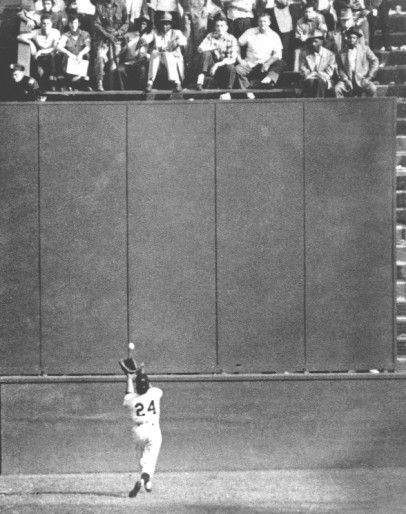
The Giants immortalized Mays in a bobblehead depicting this a couple of years ago. Willie was now on his way. He was the MVP in 1954 with a .345/41/110 line. Amazingly he would win only one more over his brilliant 23-year career. He was better in 1955 with a .319/51/127 line, but the Dodgers ran away with the flag. For the next 10 seasons, Mays would be over .300 or within 4 points of that mark. He would win the 1965 MVP with a career-high 52 homers. But the Giants would win just one more pennant with him on the team. 1962 when they caught and beat the Dodgers. The move to San Francisco did not affect Mays much. His HR totals were in the double figures most of the time. He hit 40 or more six times. Four of those were in SF.
Mays played 21 years for the Giants with a .304 avg, 646 HRs, far surpassing Mel Ott’s team-leading total, and 1859 RBIs. He also did not strike out a lot with 1526 over his career. He walked almost as many times with 1468. Mays finished his career with 2 years with the Mets. He went to his third World Series while a Met, but he was far from his prime. He hit only one homer in all his post-season play. He was elected to the Hall of Fame in 1979 with 94.7 % of the vote. On a personal note, Mays was simply the best all-around player I have ever seen. He could do it all and make it look so easy. Run, hit, hit for power, throw and field. Willie was a real 5 tool player.
Mickey Mantle

Mickey Charles Mantle was born in Spavinaw Oklahoma on October 20, 1931. He was the son of Elvin “Mutt” Mantle, a former semi-pro player and lifetime baseball fanatic, and his wife Lovell. He had proclaimed that if his first child was born a boy he would name him after Mickey Cochrane, who was the best catcher in baseball at the time. So when the first was a boy, he became Mickey.
What the elder Mantle did not know was the fact that Cochrane’s first name was actually Gordon. Mickey was a nickname. Years later Mantle would express relief that his dad did not know that. “I would have hated being named Gordon,” he said.
By the time Mickey was three years old, the country was mired in the great depression. Mutt Mantle found himself nearly broke. The family moved to Commerce, Oklahoma and Mutt was lucky enough to find work at the Eagle-Picher company’s lead and zinc mines. The work was dangerous and dirty. Those who worked there for many years were at risk for lung disease, cancer, and heart ailments. Cancer had been a grim reaper in Mantle’s family claiming his grandfather, an uncle, and a couple of other relatives all-in their early 40’s or younger.
But Mutt still found time to play the game he loved and teach his son to play. Among the most important lessons of the game, he taught his son was the need to become a switch-hitter. Mantle was a natural right-hander. He had no interest in hitting lefty, but his father pressed him. He would bat RH off of his grandfather and LH off of his dad. It did take a while for him to embrace this part of his game. Like most boys who grew up before little league and T-ball, Mickey honed his skills playing sandlot baseball with his friends. They played almost every day, and on weekends they would scrimmage with one of the local semi-pro teams.
Mickey also loved to play football. An injury early in his freshman year of high school ended his budding pigskin career and nearly his life. During football practice, he was kicked in his lower leg by a teammate. Within hours, his ankle had swollen to three times its normal size and he had a 104-degree temperature. His parents took the 14-year-old Mantle to a local hospital. The doctors there diagnosed him with osteomyelitis, a potentially fatal bone disease that had been aggravated by the injury. Doctors told the Mantle’s that they had to amputate the leg to save the boy’s life. They sought a second opinion at the Crippled Children’s Hospital in Oklahoma City. The doctors there agreed that he had osteomyelitis but prescribed a much less drastic treatment. 8 shots a day of the new drug penicillin. Within a week the swelling in Mickey’s leg had dissipated and he was soon back playing sports. His football life was over, but his baseball life was just beginning.

Late in the 1948 season, a Yankee scout, Tom Greenwood came to evaluate a young player on the semi-pro team Mantle was playing for, the Baxter Springs Whiz Kids. His focus quickly shifted to the 16-year-old Mantle, who was playing SS at the time after he hit a homer from each side of the plate, both landing well beyond the outfield fence in a creek. After the game, he approached Mantle and asked how he would like to play for the Yankees. Both Mantle and his dad were stunned and then excited at the prospect of him becoming a Yankee. Greenwood then explained that because Mantle was only 16, he would have to wait until he graduated from high school to sign.

Mantle signed the next spring after graduation for $1,100 dollars and $400 a month for the rest of the season. He was sent to Class-D Independence of the KOM league, and he hit an impressive .315 there. After the season, he returned to Commerce and worked in the zinc mines with his dad. One weekend he met a high school senior named Merlyn Johnson and the two began dating regularly. He got his first taste of the majors in 1950 when he was called up on September 17th with the Yankees waging a battle for the pennant with the Tigers and Red Sox. He got to see DiMaggio and Rizzuto up close. He never got into a game, but he traveled and took BP with the team.
When he arrived at spring training in 1951, clubhouse manager Pete Sheehy gave him #6 since he was expected to be the next Yankee superstar and it seemed to Sheehy a natural progression since Ruth was 3, Gehrig 4, and DiMaggio 5. Mantle never liked the number nor the expectations that came with it. The pressure was compounded when DiMaggio announced that the 1951 season would be his last.
In spring training, the pressure did not bother the kid. He hit prodigious homers and left his teammates in the dust in running drills. Casey Stengel said he had never seen a slugger who could run so fast. But two months into the season he was slumping and in July, Stengel sent him down to AAA telling him not to worry, he would be back when he started hitting. But things got worse and he was 3-18 in his first week back. He called his dad and told him he wanted to quit. So his dad drove from Commerce to Kansas City and while talking to his son, he lashed into him calling him a coward and telling him he thought he raised a man. Mantle was pretty much stunned by this, and even though his dad had packed all his belongings, he told him he would try one more time.
The incident lit a fire under him. After 40 games with the Kansas City team, he was hitting .361 with 11 HRs and 60 RBIs. The Yankees called him back and he was assigned uniform # 7. He would wear it for the next 18 years. He hit .284 in his return with 6 HRs and 20 RBIs.
In the fifth inning of game 2 of the series, Willie Mays hit a fly ball that was in between Mantle and DiMaggio. It looked as though the two would collide then Mantle heard DiMaggio say “I got it“. Mantle stopped short from a full sprint and in doing so, caught his spikes on the rubber cover of a drainpipe and dropped to the ground. DiMaggio bent over and asked if he was alright, then said don’t move, they are bringing a stretcher.
Trainers rushed on the field and carried Mantle off to an eerie silence. On the way out of the stadium, Mutt was trying to help Mickey into a cab to take him to the hospital. Mantle leaned on his dad with his full weight and Mutt collapsed. They were given side-by-side beds in the hospital and watched the World Series from there. Mantle had torn ligaments in his knee and needed surgery. Mutt had Hodgkin’s disease. Mantle was sent home to recover, and Mutt was sent home to die. It was what Mickey would call, “The Mantle Curse“. Cancer had claimed several of his relatives, and now his father, at age 39 was given the bad news.
Mickey always felt he was going to die young, and that pressure most likely helped fuel some of his destructive behavior. But on December 23rd he married Merlyn Johnson. He had grown up quite a bit in just a year.
He did well in 1952, hitting .311 with 23 long balls and 87 driven in. He then clubbed two more HRs against Brooklyn in the Yank’s win in the fall classic. Jackie Robinson gave a lot of credit for the Yank’s win to Mantle. The following year in April, he hit what would be considered his longest homer against Chuck Stobbs of the Senators. The left-field foul pole at Griffith Stadium was 405 away, behind it a grandstand extended 65 feet until it reached a massive sign advertising Bohemian Beer. There was a huge image of Mr. Boh, the beer’s mascot. Batting right-handed, Mantle drove Stobbs’s second pitch high, long, and incredibly fast. It blew past the 55-foot-high Mr. Boh sign, clipping off his mustache and continuing its flight over the rooftops of houses on neighboring 5th st. Estimates of the blast were between 545 and 560 feet.

Mickey continued to improve, and in 1954 he hit .300 for the first time in his career. He had helped the Yanks win the 1953 series, but the Indians won the flag in 54. Rebounding in 1955, Mantle was .306/37/99. But he was in only 3 World Series games due to a barking hammy and the Dodgers won their first title.
1956 Mantle became the superstar everyone thought he would be. He won the triple crown in the AL with a .353/52/130 line and was a shoo-in for the MVP award. The Yankees restored order and beat Brooklyn in the series. Mickey hit only .250 in the series but had 3 homers. His power numbers and RBIs dropped in 57 but he hit .365 to win the MVP again. This time the Braves beat the Yanks in 6 games.
He had another strong season in 1958 .304/42/97. The Yanks got a measure of revenge and beat the Braves in 7 games. Mickey contributed a pair of homers to the win. The Yanks finished out of the money in 59 so they went out and got Roger Maris from the A’s. Mantle would lead the league with 40 long balls in 1960 and the Yanks would meet Pittsburgh in the series. Mantle had his best series so far in 1960. He hit .400 with 3 HRs and 11 RBIs. It was not enough as the Pirates stunned the baseball world by beating the Yanks in 7 games on a walk-off homer by Bill Mazeroski.
1961 was a season of legend. A Yankee would break Ruth’s season mark of 60 homers. But it would not be Mantle. The press wanted Mantle to break the record because he was a real Yankee. Raised in the system. They considered Maris an interloper who was sullen and detached. On September 10th, with 18 games remaining, Mantle had 53 and Maris 56. The anticipated battle to the finish was not to be. Mantle had been suffering from muscle soreness and stiffness for weeks. Then he developed a bad cold which knocked him out for four games. He returned on Sept 23rd and hit # 54 off of Don Schwall in his first at-bat. But the next day he was removed after going 0-3. Knowing the HR race was over for him, he was now worried that his illness would knock him out of the upcoming World Series.
On the advice of a friend, he went to a doctor and was given an injection of what he was told was a vitamin shot. The next day he woke up and felt like he had been stabbed with a hot poker. He was taken to Lennox Hill Hospital where the doctors lanced and drained the infected wound. He would miss 10 of the Yankee’s last 12 games. He watched Maris hit # 61 from his hospital bed. He was released on October 2nd but played in only 2 games of the series. It did not matter as the Yanks won in 5.
Although Mickey missed 39 games in 62, he managed to win his 3rd MVP award. The Yanks beat the Giants in the series. In 63, he started off hot, but the Mantle curse hit on June 5th. He ran into a chain-link fence chasing a Brooks Robinson HR and ended up breaking a bone in his foot. He would play only 65 games in 1963. He was almost totally shut down in the four-game sweep by the Dodgers hitting .133 with a HR and one RBI and only two hits.

Even though the front office was upset by another injury truncated season for their star, Mantle signed a deal for $100,000 for the 1964 season. He rebounded and had another good season, hitting .303/35/111. The Yanks had their fifth pennant in a row, but again they would lose the series, this time to the Cardinals. No blame could be placed on Mickey though as he had one of his best performances with a .333/3/8 line. That gave him 18 long balls in World Series play. They would turn out to be his last.
1964 would be his last hurrah. Mickey’s late-night escapades, years of abuse of his body, and the injuries almost seemed to age him overnight. He would say later in life that he could probably have called in sick but he kept dragging himself out there hoping that maybe by some miracle, the aches and pains would go away. He still had some nice moments. He hit # 500 off of Stu Miller in May of 1967. Then on September 19th, 1968, he was facing Denny McLain of the Tigers. Mantle at the time was tied with Jimmy Foxx on the all time HR leader list with 534.The Tigers had already clinched the pennant, so McLain told his catcher, he only needs one, let’s give it to him. He threw Mantle two BP fastballs. Mantle fouled off one and took the other. McLain yelled from the mound, “where the hell do you want it?” Mickey pointed and McLain threw another meatball and Mantle deposited it in the right-field stands. As he rounded the bases, the sparse crowd of 9,000 gave him a standing ovation.
McLain said almost everyone had tears in their eyes. He represented the game of the 1960s right up to the day he retired. Mantles’ last game was on September 28, 1968. He would officially retire on March 1, 1969. Exactly 18 years after Joe DiMaggio announced that 1951 would be his last season.
Mantles’ final line was .298/536/1509. No doubt that without the injuries, those numbers would have been much higher. He also would most likely have finished with a career .300 average had he retired sooner. But he kept playing. The Yankees held Mickey Mantle Day on June 8th and his #7 was retired. He was a much better hitter right-handed with a .330 avg. He hit .281 as a LH hitter. He was elected to the Hall in 1974 along with his pal, Whitey Ford. Mickey struggled to find a new career after retiring from baseball. He found out quickly that coaching was not for him.
He had several failed business ventures. In 1983 he took a job in public relations for Casino in Atlantic City and was promptly banned from baseball by Bowie Kuhn because he was working for a gambling facility. He had banned Mays for the same reason. But when Peter Ueberroth became commissioner, his first official act was to reinstate both Mays and Mantle.
In the 1980s, Mickey became the beneficiary of the exploding baseball memorabilia craze. His signature was one of the most sought-after by fans. He made more signing baseballs than hitting them. He would take along his former teammates like Moose Skowron and Phil Linz who would make money sitting next to Mantle signing balls. He became a rich man doing this. It is no secret that Mickey was an alcoholic. It has been well documented.
He sought treatment in 1993 at the urging of Pat Summerall and he checked into the Betty Ford Clinic. After he emerged sober from the clinic he made several public service announcements denouncing the dangers of alcoholism. He traveled the country spreading his message.
But the feel-good story did not last long. In January of 1994, Mantle was diagnosed with hepatitis, cirrhosis of the liver, and liver cancer. So Mantle, who always feared the disease that took so many of his family at young ages, now had the disease. But it was his drinking that ultimately led to his demise. Mickey passed away on August 13, 1995. The liver transplant he received in June had been a success, but cancer had spread too far.
The Mick, was one of the best players I ever saw play. I respected him as a feared opponent. But he was a Yankee, and Yankees were to be despised. Especially if you are a Dodger fan. Nonetheless, in my only year of Little League, I was on the Yankees. And I wore # 7. Side note. Mantle still holds the record for the most homers in World Series play. Not to be confused with the way they count them now as post-season homers. Babe is second with 15, Berra 12, Snider 11, Gehrig 10, and Reggie Jackson 10. Those are the only players in double digits.
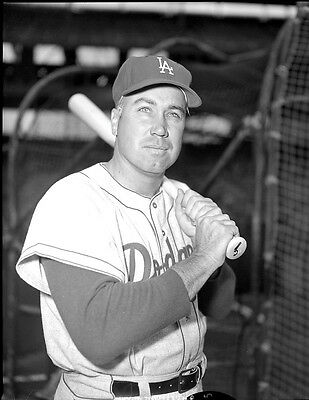
Duke Snider
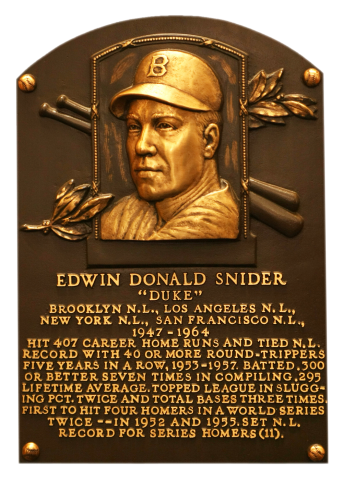
Edwin Donald Snider was born on September 19, 1926, in Los Angeles California. He was the only child of Ward and Florence Snider. He was nicknamed Duke by his father for his self-assured swagger. Most accounts list his birthplace as Los Angeles, but according to writer Al Stump, he was born in Belvedere and grew up in Compton, a LA suburb. His dad was supposed to have played semi-pro ball in his native Ohio.
Duke grew quickly once he reached adolescence and was six foot one hundred and fifty pounds when he reached high school. He played football, basketball, baseball, and track at Compton High school. He had a powerful arm and once threw a 63-yard touchdown pass. He played basketball on the same team as Pete Rozelle, the future commissioner of the NFL, and pitched and batted cleanup on the baseball team.
The Dodgers held a tryout camp in Long Beach and Snider performed well. He was offered a $750 dollar bonus and $200 dollars a month. He signed. The Pirates subsequently offered him a $15,000 bonus, but Duke honored his Dodger contract.
Invited to 1944 spring training in Bear Mountain New York, Snider quickly demonstrated both his baseball talent and difficult temperament. Cold and homesick-he failed to bring a coat-the 17-year-old moped instead of following instructions to run laps. After apologizing for his behavior he was inserted into the lineup against the West Point team. He belted a long three-run homer and Branch Rickey praised his power, arm, and the steel springs in his legs.
Snider was sent to Newport News Virginia in the Class-B Piedmont League. He played in 131 games, hitting .294, leading the league with 34 doubles and 9 homers. He also put up 25 outfield assists. His potential forced the Dodgers to overlook his growing pains. When flashed a take sign by Jake Pitler, Snider became infuriated. He would return to the dugout and kick the water bucket in anger and demand to be sent to another team in the Dodger system. His temper erupted whenever he failed to make contact at the plate. After his first season in pro ball, Snider enlisted in the US Navy and spent 18 months between 1945 and 1946.
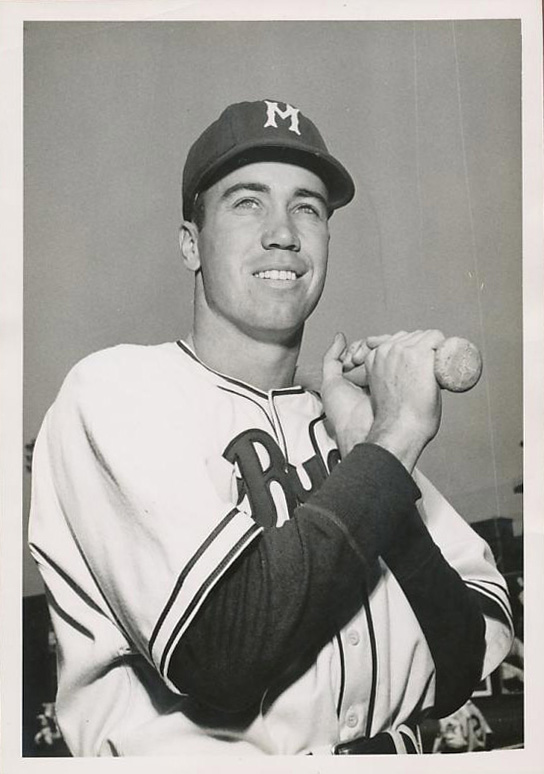
Duke played 68 games at AA Ft. Worth in 1946 and although he hit only .250, Rickey was enthralled with his potential. His explosive swing, his grace in the field, and his blazing speed on the bases. Duke was clearly the jewel of the Dodgers system. He played well enough in spring training in 1947 to make Brooklyn’s roster as a backup outfielder. He got his first MLB hit in his MLB debut, a single off of Si Johnson of the Braves on April 17th.
He was joined by Jackie Robinson in his climb to the big club that season. Duke admired Jackie’s courage and athleticism. He occasionally ate with him and kidded around with him in the batting cage trying to ease the burden on him. When asked by some of his new teammates to sign a petition against Robinson, he refused.
Duke had a limited role with the 1947 team. He hit .241 in 40 games with 24K’s in 83 at-bats as a pinch hitter and part-time outfielder. He proved to be a very gifted outfielder, but with all his gifts, manager Burt Shotton pegged him as a player who had to be kicked to perform his best.
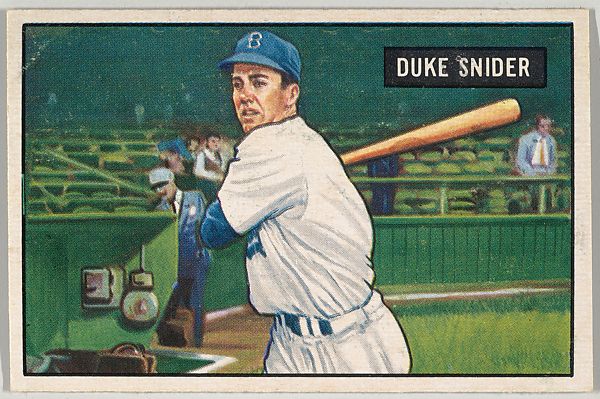
He was sent to St. Paul on July 4th. There he hit .316 with 12 HRs in 66 games. He was called back up but was a spectator during the World Series. He was voted a quarter share of the World Series bonus. He went home and married his high school sweetheart, Beverly Null. They raised four children, Pam, Kurt, Kevin, and Dawna.
In spring training in 1948, Rickey decided to teach his prize player the strike zone. He and batting coach, George Sisler, worked hard to correct Duke’s tendency to lunge and overswing at the plate. It was slow work but Snider learned the strike zone. He would later say that without Rickey, he never would have made it.
Duke started the 1948 season in Montreal. In 77 games he hit .327 with 17 homers and 77 RBIs, He once refused to bunt when given the sign by manager Clay Hopper and in anger swung away and hit a homer. He later apologized to Hopper and was fined for his insolent behavior. Duke was called up on August 6th and hit .244 with his first five MLB homers the rest of the way.
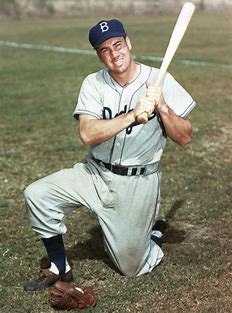
At the start of the 1949 season, manager Burt Shotton told Duke he was the starting center fielder and he would hit third until he proved he could not do the job. The confident Snider answered the bell and responded with a .292/23/92 line. The Dodgers were neck and neck with the Cardinals down to the last day of the season. Snider came up in the 10th inning of a 7-7 game with the Phillies and drove in Pee Wee Reese with a single that won the pennant for the Dodgers. Snider had a very forgettable series striking out eight times to tie a record set by Rogers Hornsby. He was 3-21 at the plate and failed to drive in a single run.
1950 was a great year for Duke. He had one of the best games of his career on May 30th. At Ebbets against the Phillies, Duke hit 3 long homers. In his fourth at-bat, he hit a ball that hit one foot below the top of the right-field screen. The ball was hit so hard that he was held to a single. His line for 1950 was .321/31/107. He had 199 hits and 343 total bases. The Dodgers lost the pennant to the Phillies on the last day of the season when Dick Sisler hit a three-run homer in the top of the 10th inning.
Duke regressed some in 1951, and he was frustrated because he felt had he performed better the Giants would not have caught the Dodgers and then won the playoff. At the age of 25, his hair was already turning grey. After the 1951 season, he asked to be traded feeling it was too hard to live up to his potential playing in New York. His teammates considered him a pouter, a crybaby with a personality problem. Finally, team Captain Pee Wee Reese had had enough and told Duke to grow up and stop his moaning. Snider rebounded in 1952, and even though manager Charlie Dressen benched him for a short time, he helped lead the Dodgers to the pennant hitting .303/21/92. Brooklyn got beat in the series again in 7 games by the Yankees, but Duke had arrived with a 10-29 performance with 4 homers and 8 RBI. He felt he had finally arrived.
In 1953, Duke had the first of 5 consecutive seasons where he would hit 40 or more homers in a year. He would average over .300 in those 5 years. He would drive in 126,130,136,101 and 92 runs. He would help the team to pennants in 1953, 1955, and 1956. He would hit 4 homers in the 1955 Series to help the Dodgers win their first and only World Series in Brooklyn.
1957 brought change. Jackie Robinson had retired. Walter O’Malley was in a pitched battle with the City of New York over building a new stadium in Brooklyn. Robert Moses wanted the team to build the park in Flushing Meadows, which would eventually become the home of the New York Mets Shea Stadium. O’Malley preferred a spot in Brooklyn.
Duke had his last 40 homer season in 1957, but there were rumors flying that the team would be moving west. They played 7 home games in Roosevelt Stadium in New Jersey. The rumors got louder when O’Malley purchased the Los Angeles franchise of the PCL, thus securing that area for the Dodgers. A deal was finally struck to move the team to Los Angeles. Snider was not happy about the move even though he was a native Californian. He had many friends and fans in Brooklyn and played in a ballpark made for his game with a short right-field fence.
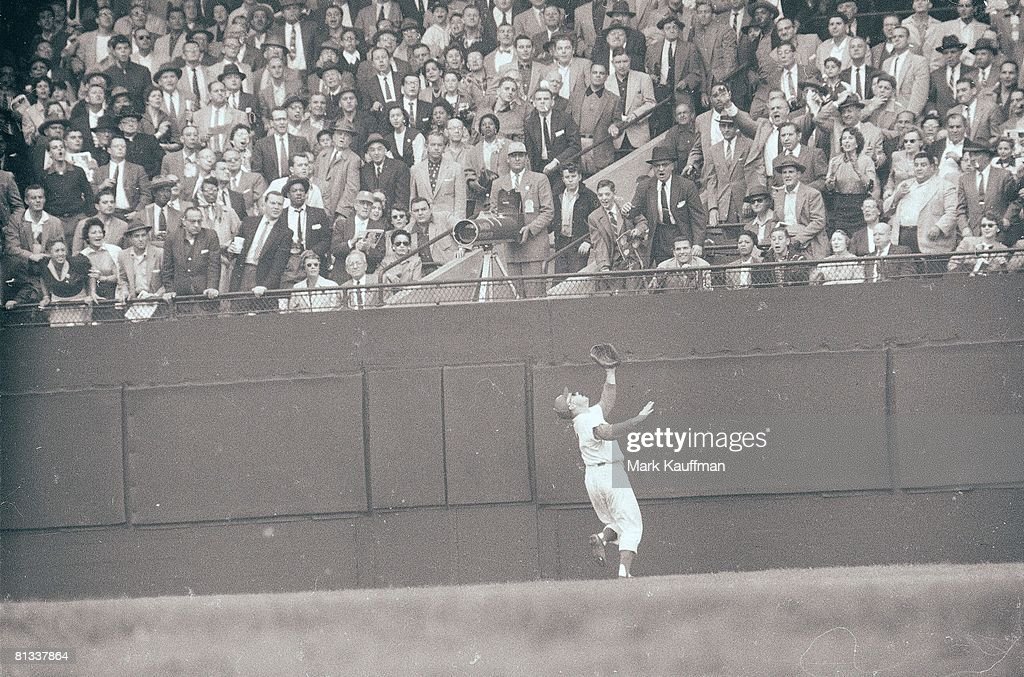
Duke would be even more disappointed when he saw where they were going to play. The Los Angeles Coliseum was cavernous. But, it was a football stadium. Built for the Olympics, when a baseball diamond was lain out, it featured a 40-foot high screen in left field 251 feet away from home plate. Inviting to RH pull hitters. Lefty’s on the other hand had to hit one a long way,
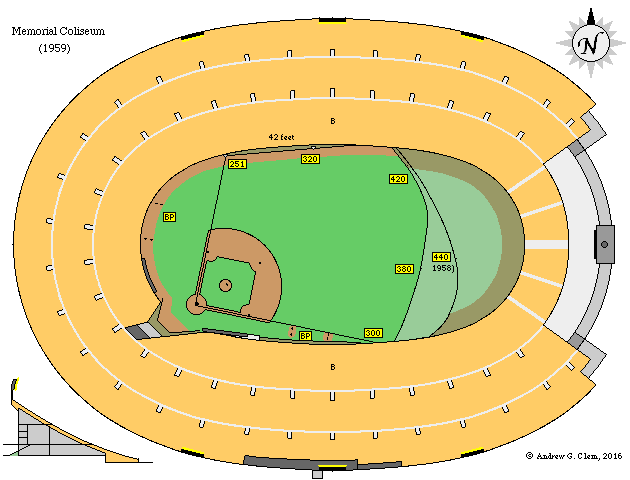
440 feet to right field in 1958. They shortened it later. But this, plus an injury to his elbow sustained when he tried to throw a ball out of the Coliseum limited Duke to 15 homers in 1958. It was a lost season for the former HR king in Brooklyn. The Dodgers suffered through a 7th-place finish. The Brooklyn Dodgers were old, and the Los Angeles Dodgers were welcoming some new blood. Campy was gone, lost to a tragic car accident that left him paralyzed. Furillo was a shadow of his former self, and Pee Wee Reese was in his last year of active playing. Hodges did ok, but he too was slowing down.
1959 would bring much new blood, better dimensions to the ballpark, and a pennant and Championship in their second year in LA. Wally Moon came from the Cardinals, Maury Wills took over at SS mid-season, and the team fought hard and tied the Braves on the last day of the season. They then won a 2 game playoff with Hodges scoring the winning run on a single by Furillo. Duke would hit his final World Series homer against the White Sox. # 11 in World Series play.
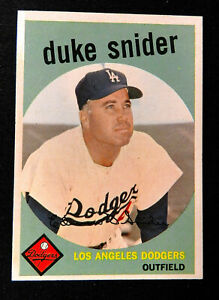
1959 was also Duke’s last season in which he would hit .300 and have 20 or more HRs. Don Demeter was now the Dodger’s primary CF, and Duke was playing right with Furillo hurt and then released in 1960. Duke, at 32 with a bum knee and elbow issues slowed down even more in 1960 hitting only .243 with 14 homers and 36 RBIs. He only played in 101 games. He would play over 100 games only once more in his career in 1963 while with the New York Mets. Duke was now a spare outfielder and pinch hitter. He stayed with the Dodgers through 1962 and then was sold to the Mets. He hit .243/14/45 with the Mets and then was sold to the Giants. Buzzie Bavasi was pretty steamed about that since he thought he had a deal with the Mets to sell him back to the Dodgers if they decided to trade him. Duke was way past his prime and hit only 4 homers with the Giants, one of them at Dodger Stadium off of Joe Moeller. He retired after the season was over with a .295/407/1333 line. Duke had the distinction of getting the first Dodger hit in their new stadium in 1962. He, Gilliam, and Johnny Roseboro were the only position players remaining from the Brooklyn days in 62. Now retired, Duke had a couple of ventures going for him, an avocado ranch in Fallbrook and a bowling alley. The bowling alley failed and Duke finally had to sell the ranch. He went into coaching and scouting working for the Dodgers until 1968 and then moving to the expansion Padres. He was a broadcaster for them for a while and then moved to the Montreal Expos. In 1980 he finally was elected to the Hall of Fame.
Part of the reason it took so long was the fact that Duke had a difficult relationship with the press. In 1981 Terry Cashman wrote Talkin Baseball, the refrain Willie, Mickey, and the Duke, honoring the three Hall of Famers put Duke back in the public consciousness.
Duke also had a hit with his autobiography, The Duke of Flatbush. He had a heart attack in 1987, one year after he retired from the Expos. In the 1990s, Duke benefited from the memorabilia craze. But he took some of these fees in cash and did not claim them on his taxes. He and fellow Hall of Famer, Willie McCovey, were indicted for tax evasion. Both pleaded guilty and Snider cooperated to avoid jail time. At his sentencing in Federal Court in Brooklyn, he admitted to not claiming $100,000. He was fined $5,000 dollars, put on two years’ probation, and ordered to pay almost $57,000 dollars back. His reputation tarnished, Duke told reporters he made the wrong choices. After suffering for years from diabetes and hypertension, Duke passed away on February 27th, 2011 at the age of 84 in Escondido, California.
I must admit to all that Snider was and always has been, my favorite Dodger. I was lucky to meet him through my friendship with Wes Parker. The autographed 8X10 photo he signed for me is one of my prized possessions. He was graceful, and he was so much fun to watch. I patterned my stance through my youth playing the game I love. There was only one, Duke of Flatbush.
Dodger News & Notes by MT
- What a difference a week makes! A week ago the Dodgers couldn’t hit and Urias could not pitch. This is why you don’t panic in baseball – There is no crying in baseball!
- In what might be classified as GOOD NEWS, Tommy Kahnle evidently does not have “forearm issues” involving his UCL, but rather has a bone bruise and will be shut down for a couple of weeks. Hopefully, that is all it is.
- Let’s see if Mitch White can give the Dodgers 4 innings tonight! I have a feeling the Dodgers have something for Aaron Nola.
- Landon Knack pitched 5 innings last night for Tulsa and look at this line: 3 H, 0 R, 0 BB, 9 K. After Knack, Robertson, Adames, Washington, and Zuniga all pitched a scoreless inning to deliver the shutout.
- Kody Hoese was 2-4 with a triple. There is still hope…
- Kendall Williams went 4.2 for GL, allowed 6 hits and 2 ER… He just always seems to be a little off.
- Luis Rodriguez (.290 BA) was 3-5 last night for RC with his 3rd HR and 2 RBI. Still only 19, he is growing!
- Ronan Kopp went 2 Innings, allowed 1 hit, 1 BB, and stuck out 6!
Somehow, the comments were turned off. Sorry.
This was an epic post!
HA! I thought something was wrong with my phone, so I grabbed my laptop!
Great post Bear! Three of the greatest ballplayers of all time. Was fortunate enough to see all 3 play in their prime.
Bullpen game today at 6:05 PM ET with probably White starting and Price making a nominal appearance.
Very well written Bear! A nice deep dive.
BTW, snowed & still snowing in Canon City! I was checking road cams, there & Pueblo West had more snow than Monarch Pass! Looked like 2-3in of wet, heavy stuff. Too warm to stick to the roads, but the kind that breaks those spring branches!
cheers
pb+
I saw that and got a ton of messages from friends who live there on Facebook.
BEAR!!!!
Good trucking You drove us back into a good era.
Great stuff, as always Bear. I loved those 3, especially Mays.
* What a treat to see Freddie Freeman on a daily basis. Pros, pro. I always though he was great but now seeing him play everyday; he’s better than advertised.
* I loved Freddie’s steal of 2nd and eventual manufactured run, top 9th. Very important run and good baseball.
* Last night was one of those irritating games where we should have been up like 6 – zip after 2, And we let the Phillies hang around. Kept the Phils in the game enough to warm up and use Kimrel. Unnecessary wear and tear that Bickford needs to take care of. Out pitching held but I’d like to take better advantage of those early scoring opportunities.
* Best hard play made look easy was Trea Turner, bottom 7. I wasn’t sure he had that play in his bag? Not every shortstop makes that play.
* Lux is beginning to look like the guy you put at 2nd and leave him alone.
Yep, truly epic post for epic players.
Mays was my third favorite player as a kid, behind Koufax and Wills. It’s fascinating to read about my not-namesake Snider, who flamed out fairly young due to injury and perhaps other factors OldBear mentions. He was off my radar when I became a fan, so I had always assumed he was much older than Mays and Mantle. Maybe the premature gray added to my confusion. (I read somewhere that Snider told the story of going up to UCLA to witness Robinson play–and that one inning he departed and stripped off his baseball uni to reveal his track silks. He won the long jump in a single attempt, dressed and got back to the ballgame. Perhaps apocryphal, but a good story.)
Happy to see Mitch White back on the bump and I hope he gives them more than four. Didn’t he deliver 8 innings one day last season?…. (paused for googling) … nope, 6.1 shutout innings but another blank inning the day before or after… So 7.1 shutout innings in a3-game sweep of Pittsburgh… Anyway, he’s often seemed like the forgotten man to me.
Awesome Bear. I always enjoy all the family and personal info. I’m still waiting on my Richie Allen story. It will remind me of the transistor under the pillow days listening to my Phillies of the 60’s! And Connie Mack stadium! And Mark I thought you were giving us all a time out
until we played nicer!
It is in the works. As are other 80’s players some have asked for. Little hard to do the research here as I am busy helping with my brother. But once I am back home, they will come more easily.
Thanks Bear, I think this was your best post ever. That was quite the threesome, all in NY at the same time. Incredible for those that got to see that first hand.
300 Batting average and 50 homers! We need to get some some of that back.
I’m also pleased to see Mitch White get the nod. This is a big opportunity for him to make a statement. I hope it goes well.
PhilJones, I agree about Freeman. The dude is an example of how to play the game. The guy just keeps doing all the little things. What about that over the head basket catch, like it was no big deal. I absolutely love this guy.
I also agree about Lux, but I don’t see harm in letting Muncy play second from time to time against lefties with a fly ball pitcher on the mound for us. But, Lux sure looks like a plus defensive second baseman to me. I fully support putting him back at SS when Trea departs in free agency. I think he’ll surprise a lot of people around here.
Now, I need to get a bike ride in before the game. Cheers!
Game time 6:05PM ET
Dodgers (26-12)
Phillies (18-21)
SP Mitch White R
0-0 4.82 ERA 11K
Confirmed Lineup
RF Mookie Betts R
1B F. Freeman L
SS Trea Turner R
C Will Smith R
3B Max Muncy L
DH J. Turner R
CF C. Bellinger L
LF Chris Taylor R
2B Gavin Lux L
Partly-cloudy-day
0% Rain
90° Wind 10 mph Out
05/20/22 Los Angeles Dodgers sent RHP Shane Greene outright to Oklahoma City Dodgers.
Sorry, but just had to post this video, for those who haven’t seen it.
This kid understands that baseball is supposed to be fun.
https://twitter.com/i/status/1528069254796410881
What? That’s my normal walk up routine!
Looks to me like he has more power than you do off the tee, Mark.
Barrels are overrated.
Depends on what’s in them.
More like my walk back to the dugout dance.
How do you knock a guy down in Tee-Ball?
Too funny! And that’s why I loved Joc (still do). He was goofy and always seemed to be having fun!
Thanks guys. This one was a labor of love in many ways. Duke was my favorite player,, I totally respected Mays, and Mantle was the star in the other league who always seemed to rise up and derail the Dodgers in their quest to win the last game.
Michael Grove starts for AAA Oklahoma City after being promoted and Bobby Miller starts for AA Tulsa tonight. Who will have the better outing?
Excellent post Bear. One of my great regrets is having been born too late to see the three of them play.
I had no idea the LA Coliseum had such crazy dimensions. Great stuff.
Mookie!
At least somebody on this Dodgers team is reaching the seats with regularity. He won’t get there, but his 9th HR puts him on a 40+ HR pace…even with the humidors.
I have thought of him as a mini-Mays–a five-tool player who is a catalyst and clutch.
Being a left handed hitter myself, Duke became my favorite Dodger on those Brooklyn teams. I memorized his batting stats and would argue with anyone that Duke was better than both Mays and Mantle. I really believed that then and would stick to my guns. My prized autographed baseball is one with “Willie, Mickey and the Duke’s” autographs when they were still all alive. I coach high school baseball and Talking Baseball is one of the songs I play on the loud speaker at our home games.
Good work again Bear.
Obviously I saw them all. Duke’s best years were behind him when they got to LA and that right field fence did him no favors. I did see him hit one into the darkness beyond that fence but there was NO good reason to have it 380’ to straight away right. It was much farther than that his first year out here.
As you know Mickey Mantle was my favorite. As a kid I had no idea of his dysfunction.. All I know is in the first game I ever attended, in Kansas City, he hit 2 monstrous home runs and I was hooked. Fastest player in the game who could hit 500’ home runs from either side. I wanted to be him. Every kid I knew wanted to be him. But there was only one Mickey Mantle.
Nice swing going the other way by Belli! Can Taylor do the same now? Everyone wants to be like Freddie! Taylor just has to do better there! Wow, big miss there! That’s gonna hurt!
BAZOOKA has pitched really well today.
Mookie giveth and Mookie taketh away.
And then he giveth right back again.
NO NO NO…. NO TAYLOR, BRING RIOS TO BAT!
Well, what a surprise that Taylor struck out!
Chris Taylor better watch out, or Miguel Vargas might just come up and be our LF soon and into Oct.
(Just my random wild prediction after my 2nd glass of Menage a Trois)
Zero chance Bobby
And who was it yesterday who said, “just put Lux at 2b and leave him there!!”????
Props to that person
I still can’t figure our what Will Smith was thinking on that play. Why didn’t he throw?
Thank you, Lux.
Brain fart. Happens to the best of us.
I keep singing the same tune. Bring up Pillar, sent Bruil down and give CT3 a couple days off.
A couple like two? An entire series off?
Twos series?
Chris Taylor has struck out 52 times in 36 games. On pace for well over 200. Bellinger has struck out 48 times, also on pace for over 200. Pitiful. Went to the Angel game tonight. Montas was literally knocked out of the game by a vicious comeback line drive. It was like old home week though, former Dodgers Sheldon Nuese and Adam Kolarek were in the game.Kolarek took the loss, Chad Wallach, son of Tim was catching for the Halos.
Got to think there will be some roster moves today. With 7 pitchers used yesterday I’m thinking Bruhil, White are candidates to be sent out and they’ve got to find an OF to spell CT3 for a day or two or three. Is it Pillar time?
14 pitchers in 2 days. Keep the revolving door moving.
When the Dodgers go to 13 pitchers and 13 position players at the end of the month , DON”T bring up Mckinstry( which they probably will) but bring up Pillar. Figure out a way to add him to the 40 man roster. Also that will give Taylor some much needed time off. In my humble opinion Taylor is NOT an everyday player.
One player to consider to DFA is Andre Jackson. His stuff will not play in the majors.
He hasn’t pitched much in the majors, jut 3 games and 11.2 innings, but his ERA is 2.31.
He started out well enough this season, 1ER through his first 3 games, then he seems to have just lost it. Maybe he’s working on another pitch? Injured?
Mark, I will be attending my grandson’s Communion service and after service restaurant celebration, and will be unable to post the lineup against the Phillies today but will be on against the Nationals tomorrow.
Will will pick up the slack! Thank you for your help and congratulations for your Grandson!
Congrats!
Oddly I’ve never been to a communion. But I saw one in the Gidfather
That was self-important. Congrats again I hope it goes flawlessly.
Thank you Bluto!