
JOHNNY PODRES THE ORIGINAL HYUN-JIN RYU
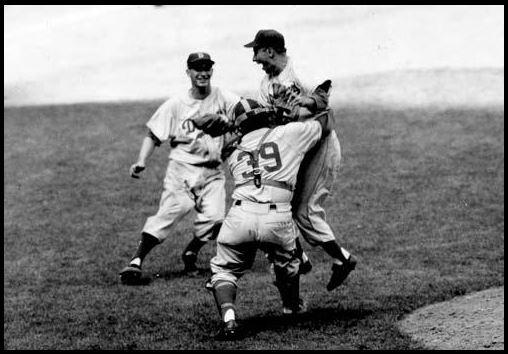
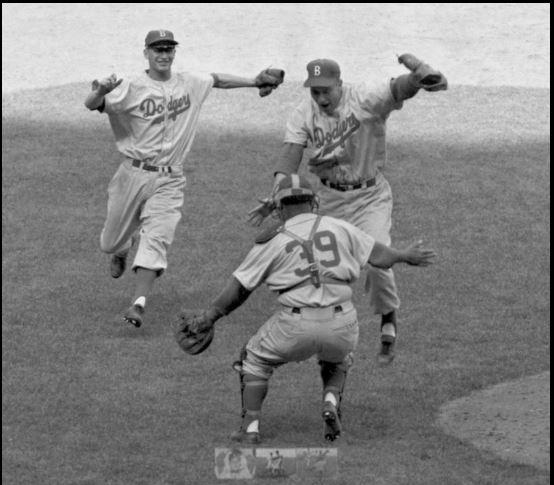
Outside the National Baseball Hall of Fame and Museum in Cooperstown, New York, a statue depicting southpaw Johnny Podres after a pitch release stands 60 feet, six inches from a statue of catcher Roy Campanella. They commemorate the Brooklyn Dodgers winning the 1955 World Series over the New York Yankees, one of the most iconic moments in Dodger history! The photo of the elated Podres leaping into the arms of Roy Campanella, with Don
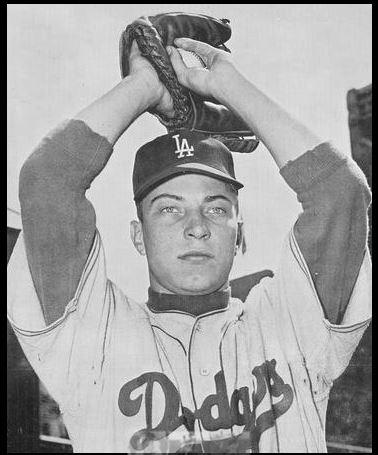
Outside the National Baseball Hall of Fame and Museum in Cooperstown, New York, a statue depicting southpaw Johnny Podres after a pitch release stands 60 feet, six inches from a statue of catcher Roy Campanella. They commemorate the Brooklyn Dodgers winning the 1955 World Series over the New York Yankees, one of the most iconic moments in Dodger history! The photo of the elated Podres leaping into the arms of Roy Campanella, with Don Hoak ready to join in, is one of the most revered in Dodger history.
On October 4, 1955, the 23 year old the dimpled chinned, sleepy eyed, Johnny Podres (who was a dead ringer for silent-film comedian Buster Keaton) pitched a complete-game, 2-0 masterpiece in Game 7 of the World Series, and riding his shoulders, dem lovable Bums, won their first World Series Championship over the mighty and, seemingly, always triumphant Yankees. Podres had also started game 3 of the Series, with the Dodgers having lost the first 2 games. As in the final, Podres pitched a complete game, albeit not a shutout, leading the Dodgers to a 7-2 victory. Because of his efforts, Podres won the first ever World Series Most Valuable Player Award given to a player.
For you younger readers, let me tell you that should you not know of him, Johnny Podres was the Dodgers’ 1955-65 version of Hyun-Jin Ryu. He was also the first Dodger pitcher that I had the opportunity of seeing pitch live at the L.A. Coliseum. I don’t remember much of how he pitched that night. What I do remember, however, was that Podres would smoke a cigarette on the clubhouse steps leading into the dugout, whenever the Dodgers were at bat. In my young, very impressionable mind, I thought that was so cool. I had smoked my first cigarette in 3rd grade.
The night I saw Podres pitch, I had just entered 4th grade. At school, the day after the game, I told my good friend, Steve, about Podres and, beginning that day, he and I made it our daily habit to sneak off to the cigarette machine outside the liquor store down the street, to put our quarter and get a pack of Pall-Malls or Winston cigarettes(you could easily do that in those days). After watching Podres, I had become convinced that smoking would make me a better baseball player. I definitely was not the smartest 4th grade walking the streets, and I did not possess the good sense that God gave a grasshopper. (In case you wonder, I did quit for good when I was 27).
Because of the storied exploits of Sandy Koufax and Don Drysdale, Podres’s career gets overshadowed in Dodgers lore, scholarship, and history. But Podres was so much more than just his world series exploits. In a 15 year career, the lefthander, compiled a 148-116 record. Podres led the National League in ERA and shutouts in 1957, went 18-5 in 1961, and was a four-time all-star. Let me tell you just a little bit about him.
Former Brooklyn Dodgers General Manager Buzzie Bavasi had this to say about him:
“He was one in a million. I have said this many times: I’ve had many good pitchers on my teams during my career, including the best in the business in Sandy Koufax, and I am sure that all these pitchers will agree that if a club had to win one game, it would be (Johnny) Podres that would get the call.”
Don Newcombe added this:
“When I heard of Johnny’s passing, my mind went back to Yankee Stadium, 1955, the seventh game of the World Series. I thank God for Johnny Podres, as I do all the time. I remember how confident he was in the clubhouse before Game 7. Walter Alston called a meeting and Johnny said, ‘Just give me one run.’ Well they gave him two, and we were champs. He was a man of his word, he lived up to his word, and I appreciate it.”
Curt Schilling wrote on his blog after Podres died:
“Outside of the Lord, my wife and my father, there was no person who impacted my life more than Johnny Podres. A true man’s man if there ever was one. No one ever cared about me more, or watched out for me as much as he did. There is no doubt in my mind that the career I’ve been blessed to enjoy is a direct result of this man’s commitment to me and to my life. I’ll be forever grateful for his love and his friendship and hope that when I’ve thrown my final pitch I’ll be able to look back on my body of work and it will have been something he was proud of. The game lost a man that has truly made a difference.”
Jason Stark called him “the true pitching magician for the age.”
Tommy Lasorda, who roomed with Podres, added:
“He represented the Dodgers to the highest degree of class, dignity and character. He was a great roomie, a great teammate, and a great friend.”
John Joseph Podres was born on September 30, 1932 in the Adirondack Mountains town of Witherbee, N.Y., where his father was an iron-ore miner. ironically enough, only 160 miles from those two statues in Cooperstown. Podres, of Russian, Polish and Lithuanian descent, was born into a hard working mining family. Podres’ father Joe, worked in the mines and then on Sunday’s he would play semi-pro baseball. Something he did for 25 years. His mother, Ann worked at the Moriah Central School cafeteria. From his earliest memories, Podres was always a Dodger fan, doing what a lot of young boys have done over the years, going to sleep listening to the Dodger game on the radio. Only difference being he listened to Red Barber, while most of us listened to Vin Scully.
Podres was a star for for Witherbee’s Mineville High School. He, along with an uncle who was his teammate, pitched a 1-0, 17-inning game to win the 1949 Southern Essex County League title.
Podres signed with the Dodgers out of high school. He spent 2 years in the minors and made his major league debut in 1953. In his first year of minor league ball, pitching for the Hazard (Kentucky) Bombers in the Mountain States League, he went 21-3, with a 1.67 era and leading the league with 228 strikeouts. In 1952, Podres had a 5-5 record for the Montreal Royals, where he was a teammate with Tommy Lasorda.
Podres made his debut for the Dodgers in 1953. During spring training, manager Charlie Dressen said that Podres, “ has looked the best of the young pitchers.” Podres went 9-4 in his rookie season, started 18 games, completed three, and pitched 15 times in relief. He helped the Dodgers repeat as National League champions. But as had happened in 1916, 1920, 1941, 1947, 1949, and 1952, they lost to the Yankees I the World Series.
Podres returned to the Dodgers in 1954, having a relatively successful sophomore season. He had an 11-7 record, completing six of his 21 starts and throwing two shutouts. The Dodgers would finish second that year.
In 1955 started out real well for Podres, he had 7-2 record by June. Unfortunately, a shoulder injury landed him on the disabled list. After coming back, he suffered another injury when the grounds crew at Ebbets Field accidentally crashed the batting cage into his ribs during pre-game practice. He ended the season 9-10, with a 3.95 ERA and 114 strikeouts. “They (Dodgers) weren’t even sure I would be on the Series’ roster,” Podres recalled. “But I had a good outing against Pittsburgh late in the season to make it.” But, given the opportunity, Podres made the most of it. Alston named Podres the starter of game 3 of the series, which happened to fall on his 23rd birthday. As mentioned before, the Yankees had won the first two games. Podres held the Yankees at bay, and with the support of a good offensive from Roy Campanella, the Dodgers beat the Yankees, 8-3.
“After I won Game 3, Alston told me that if there is a Game 7, I would be his starter,” Podres said. “That gave me a lot of confidence.” Despite his sleepy eyed appearance, confidence was not something that the young Podres lacked. After Whitey Ford beat the Dodgers in game 6, the stage was set for Podres in game 7. Podres pitched a complete game, working around 7 hits and 2 walks. Podres credited Dodgers catcher Roy Campanella with the 2-0 victory:
“Campanella was calling the greatest game of his career. Every time he’d give me a sign, ‘I want you to throw it here,’ I was throwing it there. ‘I want it up and in.’ I’d throw it up and in. ‘I want it low and away.’ I’d throw it low and away. ‘Curve ball in the dirt.’ I put it in the dirt.”
In case you think Podres did it by himself, he didn’t. He got major help from one young Sandy Amoros, who saved his bacon in the 6th inning. In the bottom of the sixth inning, Podres walked Billy Martin. After a mound visit from Alston to settle him down, Podres started off with 2 balls to Gil McDougald who then got a bunt single on the third pitch. This set the stage for Amoros. Yankee manager Casey Stengal did not particularly like to bunt. With Yogi Berra, his hottest hitter up, Stengal had him swing away. Podres pitched him outside, but Berra reached out and hit a long, high fly into the left field corner. “I had Yogi Berra, two strikes. I threw him a fastball had to be nine, ten inches outside. Wasn’t even close to being a strike. A little pop fly to left. But it was a slice,” recalled Podres. Amoros, playing Berra far over toward center, had to run over 100 feet. Fortunately the ball stayed up long enough for Amoros to reach out his right hand while running at a full sprint and he was able to catch the ball in fair territory about 6 feet in front of the fench in left field. Martin and McDougal, like most everyone else in the ball park, did not think that Amoros had any chance of catching the fly. As a result, they both took off at full speed “rounding third and heading for home” as the song goes. To their dismay, Amoros did catch it, and not only that he was able to make a perfect pivot and fire the ball to Pee Wee Reese, who then fired to Hodges at first to double up McDougal. Podres would bob and weave through 3 more innings. In the 8th the Yankees would get a runner to third, but Podres got
Berra to pop out to Carl Furillo in short right, holding the runner at third. He then struck out Hank Bauer to end the inning. In the ninth, Podres got Elston Howard to hit a grounder to Reese, who fired to Hodges for the final out and years of Brooklyn frustration had come to an end. The Brooklyn faithful who still survive, will never, ever forget Johnny Podres. Even Podres enjoyed reliving the moment. “Sometimes when I’m home doing nothing, I’ll put the video in,” Podres told The Philadelphia Inquirer 50 years later. “I get the feeling that I’m young again. What a time that was.”
Podres always will be remembered for his dramatics in the 1955 World Series. But his career record proves he was far more than a “one-season wonder.”
Podres will forever be remembered for his exploits in the 1955 World Series, as he should. But, he was more than a one year wonder. He would spend 1956 in the Navy. After he returned, Podres was a consistent winner on strong Dodger staffs from 1957 to 1963. In 1957 he led the NL in both ERA (2.66) and shutouts (6). In 1961 he won a career-high 18 games and led the NL in winning percentage (.783). On July 2, 1962, other than game 7, he pitched probably his finest game, retiring the first 20 Phillies, including striking out eight batters in a row. Ted Savage would ruin his perfect game with a single.
In 1964, Podres suffered an elbow injury which led to an operation. In 1965, he returned to pitch for the Dodgers, who had cut his salary significantly. He started 22 games that year and went 7-6 with a 3.43 ERA.
Before the 1966 season began, Podres married Joan Taylor, an Ice Follies skater. That year he only pitched in one game for the Dodgers, who then gave him a choice of which team he would like to be traded to. Podres chose Detroit because he was familiar with their manager, Charlie Dressen. The Dodgers accommodated him and to the Tigers he went, for $20,000.00. Podres would go 4-5 with the Tigers in 1966 and then 3-1 in 1967. The Tigers let him go in 1968. At age 36, Podres made a comeback with the San Diego Padres during the expansion year of 1969, his last year in a major league uniform. Podres ended his career with a 5-6 season.
He retired after that season. When Podres’ playing career ended, he went on to become a pitching coach for a number of major league teams, such as the Boston Red Sox, Minnesota Twins and Philadelphia Phillies, for a total of 23 seasons between 1973 and 1996. He was one of the most popular pitching coaches the Phillies ever had. “He was the best pitching coach I ever had,” said Mitch Williams, the ex-Phils closer. “He was the only one that dealt with the mental side of the game, the most positive person and, again, hands down the best pitching coach I ever pitched for. He will be missed.” Podres was old-school. He was quiet, grizzled and gruff, and disdained technological advances in the game, like computerized charts. “I don’t know nothin’ about computers,” he said. “I know pitchers.”
Larry Bowa added:
“He was a great pitching coach, got his points across with no pressure. I know I learned a lot from him. He never talked a lot about his career but when you look at the numbers, he was special. Johnny had the knack of being dead serious about baseball and a minute later, having everyone laughing. He was a very funny man.”
John Kruk especially enjoyed Podres’ mound visits:
“Johnny made mound visits very interesting. I came in from first base just to listen. We might have had a pitcher on the mound who was getting lit up and Johnny would come out and say, ‘You’ve got great stuff. I don’t know how they are hitting you. Just go get ’em.’ Another time he came out, ‘Jimmy (Fregosi) is getting pissed at me because you aren’t throwing strikes. You know I don’t like it when he gets mad at me. Throw strikes.”
His wife Joan added:
“He knew how to talk to pitchers, He showed them that they could have the confidence to go out there and perform. He knew what pitchers go through, pitching every four games and being on your game plan. There comes a point when you have to think about what happens when you’re not getting it over the plate, and that’s when the coaching came in. Two of the pitchers he coached were Curt Schilling and Tommy Greene.”
Podres was very proud of his Polish and Lithuanian. He counted among his most treasured achievements when he was inducted into the National Polish-American Sports Hall of Fame in 2002. Podres explained his heritage: “A lot of people don’t even know I’m Polish. They think I’m Spanish, but I’m Polish and Lithuanian. This is quite an honor and I’m proud to be part of an organization that has so many distinguished athletes.
Podres loved to fish and hunt deer and after he retired he spent much time in the Adirondack’s hunting whitetail and ice-fishing on Lake Champlain. But as I mentioned in the beginning of this post, Podres smoked heavily, and, by his own admission, he also drank too much at certain stages in his life. Despite his passion for the quieter life, these habits led to heart and kidney issues. On January 13, 2008 after battling a severe leg infection, Johnny Podres died. He was survived by his wife and two sons, along with millions of Dodger fans (and Brooklyn residents) who will forever see him jumping into Roy Campanella’s arms. It was a moment to treasure!!
More from Dodger Talk

Dodgers Food Trailer
I did this interview a couple of weeks ago with Chef Mike, who runs the Dodgers Food Trailer for the Great Lakes Loons. They are there for every home and road regular season and playoff game. They prepare three meals a day for approximately 50 people (players and coaches). Since games end late most evenings, they do not prepare breakfast. Many of their hotels have a complimentary breakfast anyway. However,…
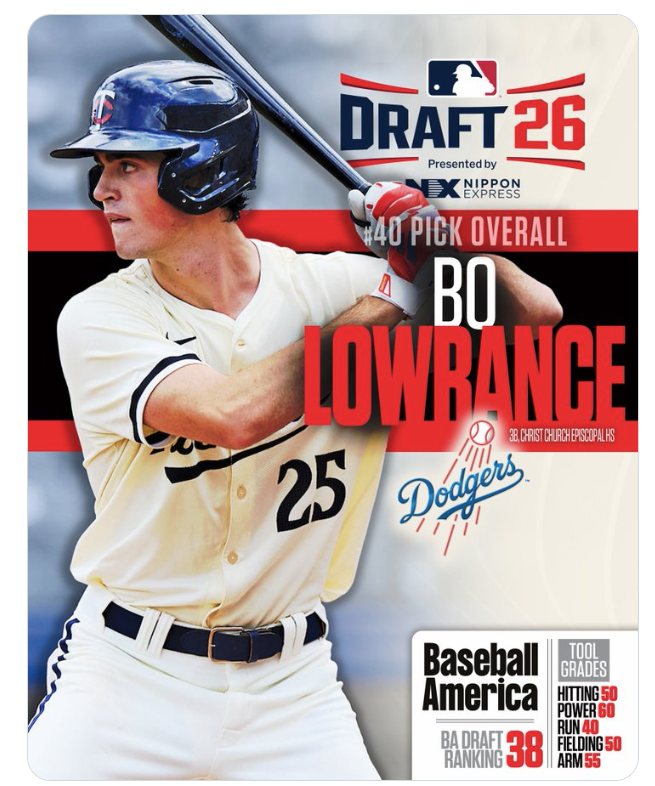
Meet LAD 2026 Draft Picks 1-12
3 picks were High School players (2 SS and 1 OF). There was a college OF, college catcher, college SS, and 10 college pitchers. Of all the talk for a need for a catcher, the only catcher the Dodgers selected was Luke Bard, son of LAD bullpen coach Josh Bard. Bard was a 4th year senior from Houston Christian University. He is not a prospect, so the Dodgers are still…

Interview with Paul Beachy – Team Bus Driver For The Great Lakes Loons (LA Dodgers Minor League Team)
It’s been a few days since I did this interview. We have evidently been working my son-in-law (the video guy) like a rented mule at US Water Systems. However, I am taking him to London with me in a few days, so maybe Watford will buy him a pint as a tip, but he’s a dang Red Sox fan, so there is that! I thought that it would be interesting…
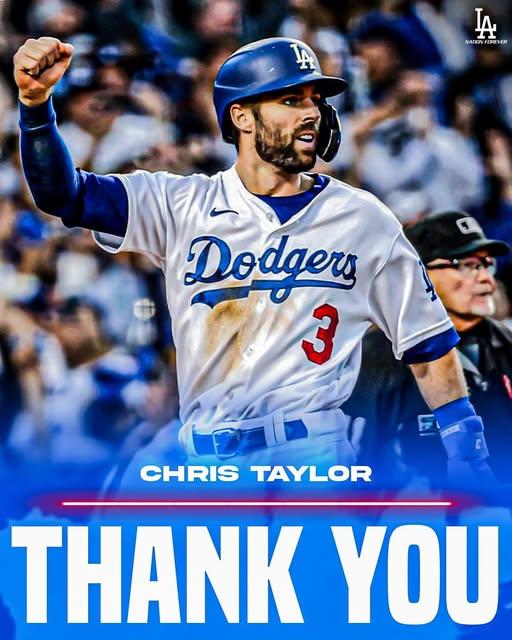
Thanks for Your Service: Chris Taylor
I was going to do this post when Chris announced he was retiring, then he changed his mind, but since the chances of him ever playing for the Dodgers again are slim and non-existent, I will go ahead with this post. He unretired, went on the IL, then decided to call it quits on May 24th. Taylor was born in Virginia Beach VA on August 29th, 1990. He attended Great…
Discussion (45)
Disagree, not disagreeable
A great clutch pitcher, a brilliant pitching coach, and a compassionate human being. He was poetry in motion on the mound. If you love baseball watch a video of Johnny pitching. I do not think there was a better big three than Koufax Drysdale, and Podres.
In 1951, a young John Podres drove from His Home in Witherbee to My hometown in Mechanicville, N.Y. to play basketball in St. Paul’s Gym. Bill Thomas, a local milkman was Johnny’s best friend. Bill would call Ray Waldron, ‘Red’ Brewster, Al Varone, Myself, plus other guys Our age. I was born Jan. 30th, 1932, Johnny was born September 30, 1932. A few of us worked shift work at the local West Virginia Paper Mill and were available When Johnny drove down to work out. Even than He was a true gentleman. I was President of the Muscular Dy strophy, Capital District Chapter when Johnny was pitching Coach for the Boston Red Sox. They were playing The Yankees at Yankee Stadium. I hired a bus to take the patients, parents and Friends to the game. Johnny Podres paid for the entire days expenses and we were invited to the dugout to meet Him. We had front row, 3rd base (protected seats.). I go to the Hall Of Fame (as an Old DODGER FAN), just to see the Precious statues Of Johnny Pitching to the immortal Roy Campanella!!!–God Bless You Johnny and Thanks For The Memories!!!
That was fun
Edwin Rios: Remember what I said about him!
I am in heaven!
Watching this intrasquad game, and, for a moment at least, things finally have somewhat of a normal feel!
Ok. That makes sense STB.
Do you think wearing a mask has anything to do with hindered eyesight? Not trying to be political here.
Sorry to be monopolizing the last few comments but we have a problem.
Muncy was hit on the finger and he “thinks he’ll be ready for opening day”. That’s a slight problem.
He says he was hit because he had a hard time picking up the ball off the new batter’s eye in center field (I guess things have been changed because of the new construction they did). That’s a bigger problem.
Other players have also commented that they are having a problem picking up the ball. That’s a major problem.
Cubs have just released Brandon Morrow. He expects to pitch this year and is presently recovering from “a minor nerve procedure”.
I think AF needs to sign him. A potentially hard throwing, effective pitcher with a long history of injury and a former Dodger to boot. How can we resist?
Here’s hoping tonight all the Dodgers hit home runs and all the pitchers strike out the side!
Is the game televised tonight?
Johnny Podres, one of my favorite Dodger pitchers, good article 2D2, thank you. Well-deserved HOFamer. His obit in the Press Republican, stated that he watched, with pride, his son, John, race their horses at the harness track and that he will be cheering him on from above. A nice tribute to him as a family man.
I am as giddy as a kid in a candy store about tonight’s game!
I’m not sure if the Panda has changed his diet but announcers used to make a big deal that he was a vegetarian. So is an elephant.
Former Dodger pitcher Jacob Rhame claimed off waivers by the Angels from the Mets today. Angel pitching has taken a hit lately. Ohtani looked really bad the other day walking 6 in three innings. Max Muncy got hit in the finger by a pitch and missed yesterday. Tonight’s intrasquad game on Twitter and Facebook. Alana and Nomah! LOL doing the play by play.
I believe it was Dave Letterman who coined the nickname for Terry Forster as a “tub of goo.” I think Pedro Sandoval can now be named the same.
Ahhh. MT, became a fan in 63. Mere pup. But Podres shut down the Yanks in game 2 of the series in 63. Big D and Sandy were the stars, but Johnny worked his magic at Yankee Stadium again. He went 8.1 innings in a 4-1 win. Gave up 6 hits, walked one and struck out 4. Ron Perranoski saw his only action of the series pitching 2/3rds of an inning and getting the save. Dodgers swept the series using 4 pitchers. Koufax and Drysdale pitched complete games in their starts. Like Claude Osteen 2 years later in the 65 series he was a big part of the win. The Yanks used 7 pitchers in the 4 game loss. Downing and Bouton each took a loss, and Ford was bested by Sandy twice. Koufax gave up the only 2 homers the Yanks hit to Tresh in game 1, and Mantle in game 4. Stan Williams, pitched 3 innings for the Yanks. Giving up no runs and striking out 5. Kinda wish he had done that in 62 against the Giants.
The Giants (especially Pablo Sandovol) look good this year:
Open on awfulannouncing.comhttps://awfulannouncing.com/mlb/andrew-baggarly-regrets-tweeting-photo-overweight-pablo-sandoval.htmlI barely remember Johnny Podres as I became a Dodger fan in 1963 and was enchanted with a couple of other pitchers that were pretty good: Koudale and Dryfax, I think!
Great article, Rob, I remember some of it, but I’m just a young whippersnapper.
Here’s my other blog that I wrote today (non-political) that is related to preset day virus issues:
Open on www.uswatersystems.comhttps://www.uswatersystems.com/blog/re-thinking-air-purification-in-a-pandemic-and-beyond-We all know about the two heroes of Game#7 in the WS( Podres and Amoros) but who remembers there was a 3rd hero? He drove in the only 2 runs of the game. His name was Gil Hodges.