

A long time ago when the earth was young – well maybe not that long ago – I visited the Cape Cod region of Massachusetts. It was almost 45 years ago and it was a whirlwind visit as a day trip from East Bridgewater, a small community about 30 miles south of Boston. My wife and I were visiting relatives in the East Bridgewater area and they took us on a tour of the Cape Cod Region. Needless to say we were impressed with what appeared to be a tourist/recreation Mecca. I remember communities such as Falmouth, Truro and Yarmouth, as there are towns in my home Province of Nova Scotia which share these same names. I also remember Sandwich and Barnstable as they are unusual names and I recall passing close to Hyannis Port, the home of the Kennedy compound.
I certainly learned something about Cape Cod on that visit, but missed what would have interested me the most of all. In fact, While reading about minor league players in the Dodgers farm system back then I noticed that Kyle Farmer, Tyler Ogle and Tom Windle had all played in the Cape Cod Baseball League. That was enough to peak my interest and sent me scrambling to find out what the Cape Cod League is and why it would attract young college players.
I was amazed to discover the Cape Cod League is the oldest and undoubtedly the most successful amateur baseball league in the United States and no doubt in the world. The league dates back to the fourth of July in 1885 and has seen literally hundreds of its alumni play at the MLB level. The league itself is older than all but eight present MLB franchises.
The ten-team league with an Eastern and Western Division plays a 44 game schedule. The league joined with the NCAA in 1964 and the players are young college players – freshmen, sophomore and junior players – from institutions with four year programs. High school players, college seniors and players with no NCAA eligibility are not eligible to play in the Cape Cod League. The teams are independent teams and not minor league affiliates for MLB teams. Players are recruited by the individual teams and not by the league.
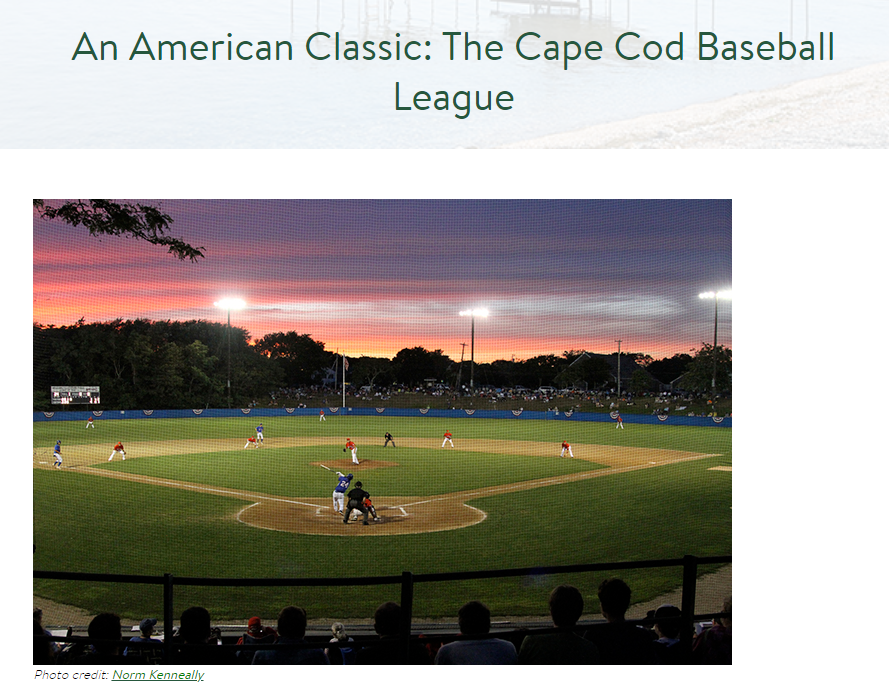
The unique aspect of the Cape Cod League is not that it hosts many of the best college players in the United States, it is the conditions, the atmosphere that surrounds the league that make it so inviting: wooden bats are used, the entire Cape Cod League program is run by volunteers, admission to the games is free and players live with host families during the season. Matt Wieters among others had a morning job when he played in the league. Families attend in an informal atmosphere often sitting on lawn chairs. All of the ten ballparks are within an hour’s drive of each other. Three parks have no lights and only play afternoon games, thus making a double header possible for fans hungry for baseball and willing to drive to another Cape Cod League ballpark with lights.
Players come to play at a high level and to be seen. MLB scouts frequent the games in the Cape Cod League as it is recognized as the best amateur summer leagues in the country by college coaches and professional baseball scouts. That recognition extends all the way to Baseball America who releases a top 30 Prospect List for the league.
As of October 2019, 1400 players have played at least one game in the CCBL and one game at the MLB level.
The Cape Cod Baseball League Hall of Fame is located on Main Street in Hyannis in the basement of the JFK Museum. The inaugural induction ceremony was held in 2001. The initial group of inductees included: Thurman Munson, Mike Flanagan, Jeff Reardon, Mo Vaughn and Frank Thomas. Besides players who play for a season or two, umpires, coaches, scouts, league personnel and friends of the league who have completed 10 years of service to the league are eligible for induction into the Hall of Fame. Mark Sweeney who had a brief time with the Dodgers is the only Dodger member of the CCBL Hall of Fame.
The league has featured major league stars and a handful of Hall of Famers. Some current CCBL alumni include stars such as Kris Bryant, Aaron Judge, Buster Posey, and Chris Sale. The CCBL also boasts several Hall of Famers including Craig Biggio, Carlton Fisk, and Frank Thomas. Biggio’s son Cavan is also an alumnus of the CCBL as is present Dodger Director of Player Development, Brandon Gomes.
Of interest Peter Gammons was inducted in the CCBL Hall of Fame in 2018. He has been a contributor, supporter and friend of the Cape Cod Baseball League for five decades. He began a career with the Boston Globe, covering the Boston Red Sox in 1969. He has been a columnist for Sports Illustrated, the Sporting News and has been an in-studio analyst for ESPN’s Baseball Tonight. He also won the J.G. Taylor Spink Award from the Baseball Hall of Fame in 2004.
In 2004 Jim Collins published his book The Last Best League: One Summer, One Season, One Dream in which he “…chronicles a season in the life of one team – the Chatham A’s, perhaps the most celebrated team in the league.” In one of my favorite country songs (Last Cowboy Song) Ed Bruce closes with this line: “…another piece of America’s lost.” In reading about the Cape Cod Baseball League it took me back to the time I watched baseball in Liverpool, Nova Scotia with young college players from New England making up most of the rosters. The Cape Cod Baseball League has insured this wonderful part of America won’t be lost although the 2020 season has been lost to Covid-19.
Excellent story! I have known about the league as long as I have been a fan and knew of some of the alumni that played in the bigs. But this kind of story drums up memories of Field of Dreams and the fact that at one time almost every town in the US had a team of some sort. I still think Moonlight Graham is one of the best nicknames ever. Which is enhanced by the fact that Moonlight Graham was a real ballplayer. As a kid in LA before the Dodgers came, we went to some LA Angels and Hollywood Stars games. I recall seeing Steve Bilko hit a towering shot out of Wrigley Field in LA. Great times. Wish they were still here.
Great post Harold. I had certainly heard of the Cape Cod League but you filled in a lot of details for me.
It sure seems like a great way to spend a summer night. Always fun to “discover” a young player and be able to say “I knew he’d be a great one when I saw him in the CCBL. ”
Because of the fact that they use wooden bats and because of the talent they draw, this is a very important league for major league scouts. Doing well there can really raise the stock of a young player.
Nice article Harold!
College summer leagues are some of the most enjoyable baseball to watch. My sons played summer ball in 2001 for Athletes in Action. AIA fielded a team in the M.I.N.K league, and was based out of Lees Summit, MO. My 13 year old daughter, her best friend and I (travelling with 2 13 year old young girls is an experience in and of itself) took a road trip to Missouri to watch them play. The old adage that there is nothing more American than “baseball, hot dogs and apple pie” truly comes to life when you travel to Chillicothe, MO (the home of sliced bread) or Clarinda, Iowa to watch a game. The atmosphere in these small towns was amazing, the people were memorable and the experience was so wonderfully unique. It was a great experience for me and definitely was one of the better baseball experiences that my sons had.
Well over 200 minor leaguers now on the loose. You could man an entire league with those kids. One of the more interesting players now a free agent is Vlad Guerrero’s nephew..
DC, I loved this story and I also love Cape Cod. I visited there some years ago and yes, the names of the towns were familiar and a surprise to me at the time as my dad’s roots are in Nova Scotia. However, my maternal great grandparents were born in Rhode Island and Mass. their parents coming down from Canada, so I also have a NewEngland dna so to speak. Speaking of names, did you visit Buzzard Bay?
I found Cape Cod lovely. Unfortunately was not able to see any baseball games. The league indeed sounds like an American classic with all those future MLB players and college stars playing in it. What a thrill it would have been to see them play.
Did not visit Buzzard Bay.
In March, MLB teams agreed to a $400/week stipend for each minor leaguer under contract through the end of May. May 31 is quickly approaching, and decisions are now being made as to how to proceed.
The Twins and Royals will be paying their MiLB players through August 31, will not cut any of them, and will continue their full benefits.
The Astros, Cubs, Red Sox, Marlins, Padres, Mets, Rays, Brewers, Cardinals, Giants, Indians, and Mariners will pay their minor leaguers through the end of August. The Reds will pay through September 7. However, those teams are not making a commitment of not releasing any players. Many teams have already released the names of players who have been released. The Mariners have released 50, Boston 22, Mets 39, and Cubs 30. I do not know what commitments the DBacks have made, but they released 64 players.
Not surprising, the A’s have told their minor leaguers that their $400/week stipend will be cutoff at the end of the month. They believe that their savings will amount to a little more than $1MM. This appears to be extremely shortsighted. How many undrafted amateur players will want to sign with Oakland for $20,000 knowing how quickly they will fold when the going gets tough.
“It’s very hard to preach family and then not act like it when times are difficult,” Class-A pitcher Aiden McIntyre tells Slusser. Triple-A outfielder Jason Krizan added: “…[I]t hurts to see the Marlins continue to pay their players when they made the least in baseball last year.”
Compare that to a player in the Rays organization who will continue to pay their minor leaguers; “This money right now, especially for guys who aren’t as well off, this is a huge deal,” Rays minor league catcher Chris Betts tells Topkin. “…I’m beyond excited about it, and I’m honestly just more stoked and proud that the organization I play for took this route more than anything.”
These MiLB players are already taking the short straw with their compensation, but to add insult to injury it is unclear as to whether these MiLB players will be able to file for unemployment after their pay is stopped. There are some who say because they are still under contract that they are not eligible. Some say that the CARES Act allows for states to expand their unemployment for contractors or seasonal workers. This is something that we will find an answer to in short order.
The Dodgers have agreed to continue the MiLB player stipend through June. I think they are going month to month with this. There are about 9 weeks after June 30. Approximately 220 MiLB players times $400 per week stipend for 9 weeks is approximately $792,000 further obligation. Hardly seems like something this ownership group would back away from. In addition, David Price has committed $1,000 for each non 40 man roster player in the organization. It is projected that the number of players approximates 220. Thus Price has committed $220K to the minor leaguers. Shin-Shoo Choo made the same arrangement for the Ranger minor leaguers back in April.
Will other multi-year high salary players make similar gestures for the Dodgers? Any other team?
Per Jeff Passan, when all has settled, upward of 1,000 minor leaguers could be released.
Really nice article, Harold! Brought me back to the days I used spent summers on Cape Cod. Never knew about the league! Shame I missed it. Regarding minor league players, I think we all have an obligation to support those we can in these times. Interesting how some clubs seem to be honoring these commitments, and some not. Given how most MLB club owners are billionaires, how much would it hurt their bottom-lines to pony up for the MiLB players?
Being a west coast guy, I knew about the league, but never close enough to go there. Kind of like Cooperstown. My dream road trip. I drove by the exit a few times when I was driving long haul, but in a rig with a load, and could not make that detour. I am closing in on 72. And it is the one place I wish I had the finances to visit.