
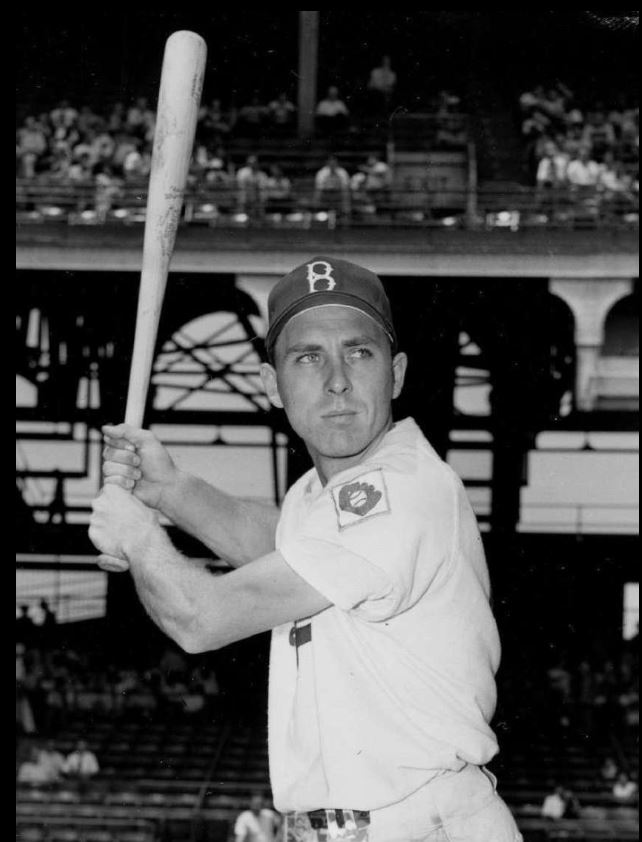
GIL HODGES A HALL OF FAME PLAYER AND HALL OF FAME MAN
I’m going to come right out and say that I believe that Gil Hodges should be in the Hall of Fame. Much has been written about the subject and nothing that I offer here is unique or original to me. I will just say this, if a player can be voted in for being a tremendous person, then Gill Hodges would be a unanimous first ballot selection. I was too

I’m going to come right out and say that I believe that Gil Hodges should be in the Hall of Fame. Much has been written about the subject and nothing that I offer here is unique or original to me. I will just say this, if a player can be voted in for being a tremendous person, then Gill Hodges would be a unanimous first ballot selection. I was too young to know much about his character when I watched him play. I just observed that he was as steady as the Rock of Gibraltar, a quiet and humble man that was incredibly strong and plied his trade in a very workmanlike manner. I did, however, learn a lot about his character In doing this research through what his fellow players said about him.
“Not getting booed at Ebbets Field was an amazing thing. Those fans knew their baseball, and Gil was the only player I can remember whom the fans never, I mean never, booed.” Clem Labine “… epitomizes the courage, sportsmanship and integrity of America’s favorite pastime.” back of his 1966 Topps baseball card
“Gil Hodges is a Hall of Fame man.” Roy Campanella
“If you had a son, it would be a great thing to have him grow up to be just like Gil Hodges.” Pee Wee Reese
“He was a great player but an even greater man. Gil Hodges is a Hall of Famer; he deserves it and it’s a shame his family and friends have had to wait so long.” Duke Snider
“He [Hodges] was such a noble character in so many respects that I believe Gil to have been one of the finest men I met in sports or out if it.” Arthur Daley, New York Times
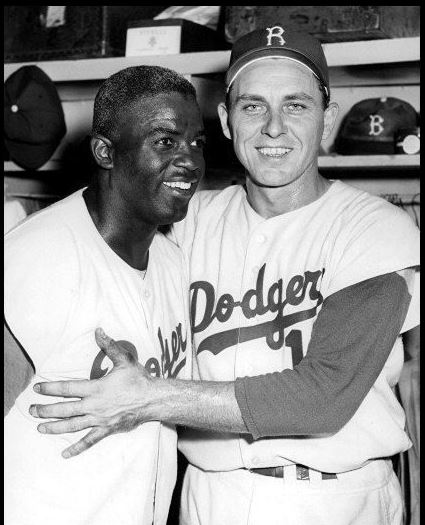
“Gil was the heart and soul of the Brooklyn Dodgers.” Jackie Robinson
“I’ve never met a finer man.” Johnny Podres
“If I had sold or traded Hodges, the Brooklyn fans would hang me, burn me, and tear me to pieces.” Walter O’ Malley
Gil Hodges was born on April 4, 1924(It’s a known fact that April babies are superior!! That topic is not open for discussion), in Princeton, Indiana. When born his last name was Hodge but apparently became Hodges by 1930. Gil’s parents were Charles and Irene Hodges. When Gil was 7 years old, the family, including older brother, Robert, and younger sister, Marjorie, moved to Petersburg, Indiana. Apparently his father, who was known as “Big Charlie” did not want his sons to work in the coal mines as he did. Gil’s father had lost an eye and some toes in various mining accidents and died of a heart embolism in 1957.
Big Charlie taught his sons how to play sports at an early age. Gil Hodges was a four-sport athlete at Petersburg High School. He ran track and played baseball, basketball, and football, earning a combined seven varsity letters. In 1941, like his brother before him, Hodges was offered a Class-D contract by the Detroit Tigers, but he declined it and instead enrolled at St. Joseph’s College on an athletic scholarship. St. Joseph’s had a well-regarded physical education program, and Hodges had thought about pursuing a career as a college coach. He played baseball and basketball for St. Joseph’s College and was a member of the Marines ROTC.
After his sophomore year, Hodges was offered a contract by a local sporting-goods store owner and part-time Dodgers scout, Stanley Feezle. By this time, the thought of playing in the major leagues was too exciting for Hodges and so he signed with the Brooklyn Dodgers. Without playing a single game in the minors, Brooklyn called up the 19-year-old Hodges late in the 1943 season. On October 3, 1943, in the Dodgers last game of the year, Hodges made his debut against the Cincinnati Reds facing Johnny Vander Meer (he of the successive no-hitter fame). Hodges went 0-for-2 and made two errors while playing third base. Eleven days later, he entered the Marine Corps and was sent to Hawaii, first to Pearl Harbor and later Kauai. Hodges served as a gunner in the 16th Anti-Aircraft Battalion. From Hawaii he went to Tinian, in the South Pacific. In April 1945, Sergeant Hodges, now assigned to his battalion’s operations and intelligence section, landed on Okinawa with the assault troops. He would earn the Bronze Star with combat “V” for heroism under fire in Okinawa. Don Hoak, a future Dodgers teammate, said, “We kept hearing stories about this big guy from Indiana who killed Japanese soldiers with his bare hands.” Hodges was discharged in February 1946, and went straight to spring training with Brooklyn.
Hodges was solidly built at 6′ 1½”, and weighing 200 pounds. He was considered big for players of that era. However, Hodges was a gentle giant, often playing the role of peacemaker during on-field brawls. His hands were so large that teammate Pee Wee Reese once remarked that
“[Hodges] could have played first base barehanded but wore a mitt because it was fashionable.”
After spring training, Hodges was sent to the Newport News Dodgers, who were in the Class-B Piedmont League. Hodges was converted from infielder to catcher. Hodges played in 129 games, hitting .278 with 8 home runs and was voted to the All-star team.
In 1947, Hodges broke camp with the Dodgers, as the second string catcher, behind Bruce Edwards. He only played in 24 games, hitting a sorry .156. It was clear that Hodges was not going to have a future behind the plate. Plus, with Roy Campanella on the way, it didn’t look good for Hodges’ future playing time.
During the spring in 1948, Hodges was switched to first base. As manager Leo Durocher said
“I put a first baseman’s glove on our other rookie catcher, Gil Hodges. … Three days later, I’m looking at the best first baseman I’d seen since Dolph Camilli.”
In 1948 Hodges played 96 games at first base, and he also caught in 38 games. Committing 13 errors at first, he had a fielding percentage of .986. That would be the only year he played regularly that he fielded under .990! Hodges also hit 11 home runs, with 70 RBI for the third-place Dodgers. He would not drive in fewer than 100 runs over the next seven seasons, nor would the Dodgers finish lower than second place over the next eight campaigns.
On December 26, 1948, Hodges married Joan Lombardi. The couple made a permanent home in Brooklyn, one of the few Dodgers to do so, and raised four children, Gil Jr. (who would spend some time as a player in the New York Mets minor-league system), Irene, Cynthia, and Barbara. (As of 2019, Joan Hodges still lived in that house in Brooklyn.)
In 1949, Hodges became a regular contributor to the Dodgers’ lineup. That season he hit .285, and tied with Duke Snider for the team lead in home runs with 23, and his 115 RBI were second on the team to Robinson’ 124. He was an All-Star and finished 11th in the MVP voting. The Dodgers would win the pennant, but they lost the World Series to the New York Yankees in five games. Hodges drove in four of the team’s 14 runs in the Series.
The next two years, 1950 and 1951, brought consecutive second-place finishes. Hodges’ power numbers continued to improve: He averaged 36 home runs and 108 RBI for those seasons. He established his career high in runs scored in 1951 with 118, one of three seasons in which he topped 100. On August 31, 1950, Hodges had his biggest day, when he became the fourth major leaguer to hit four home runs in a nine-inning game. He went 5-for-6, with 9 RBI, hitting the home runs off four different Braves pitchers. His 17 total bases tied a major-league record.
The Dodgers won pennants in 1952 and 1953, only to fall again each time to the Yankees in the Series. In 1952, Hodges hit 32 home runs and drove in 102, while in 1953 he had 31 home runs and 122 RBI, despite hitting just .181 through May 23. The slump with which he started the 1953 season was actually a carryover from the previous year. In the seven-game Series, Hodges went 0-for-21 with five walks. However, instead of booing Hodges, the Dodger fans embraced him, cheered him warmly, sometimes with standing ovations, before each at-bat. In his classic, “The Boys of Summer”, Roger Kahn wrote,
“The fans of Brooklyn warmed to the first baseman as he suffered his slump. A movement to save him rose from cement sidewalks and the roots of trampled Flatbush grass. More than thirty people a day wrote to Hodges. Packages arrived with rosary beads, rabbits’ feet, mezuzahs, scapulars.”
In his book, “The Game of Baseball”, Hodges recalled that slump in his typical humble fashion:
“The thing that most people hear about that one is that a priest [Father Herbert Redmond of St. Francis Roman Catholic Church] stood in a Brooklyn pulpit that Sunday and said, ‘It’s too hot for a sermon. Just go home and say a prayer for Gil Hodges.’ Well, I know that I’ll never forget that, but also I won’t forget the hundreds of people who sent me letters, telegrams, and postcards during that World Series. There wasn’t a single nasty message. Everybody tried to say something nice. It had a tremendous effect on my morale, if not my batting average. Remember that in 1952, the Dodgers had never won a World Series. A couple of base hits by me in the right spot might have changed all that.”
The 1954 season saw the Dodgers finish in second place. Hodges posted career highs in batting average (.304), home runs (42), RBI (130), and slugging (.579). It was his second consecutive year over the .300 mark. His 42 homers and 130 RBI were both second in the National League. It was the closest he would come to winning a home-run or RBI title.
In 1955 the Brooklyn Dodgers won their first and only World Series. Hodges hit .289, with 27 homers, 102 RBI, with a .500 slugging percentage to help the Dodgers to their first-place finish. Hodges hit .292 (7-for-24) with a homer, three walks and five RBI in the series. Hodges drove in the only two runs scored in the seventh game of the Series, and he recorded the final putout on a throw from Pee Wee Reese.
Hodges would appear in two more World Series, 1956 and 1959. He continued to play as a regular over the span of those years, averaging 26 home runs and 82 RBI. Hodges homered once in each Series; in the 1956 seven-game loss to the Yankees, he had a hand in 12 of the Dodgers’ 25 runs, and he batted .391 in the 1959 Los Angeles Dodgers Series win over the Chicago White Sox. In that Series, he won Game Four with a solo homer in the bottom of the eighth that snapped a 4-4 tie. In all, Hodges played in 39 World Series games, compiling a .267 average (35-for-131) with 5 homers, 21 RBI, and 15 runs scored.
After the 1961 season, the New York Mets selected Hodges in the first National League expansion draft. On April 11, 1962, he hit the first home run in Mets history,. Overall, he appeared in 54 games for the woeful ’62 Mets, hitting .252.
Hodges began 1963 as an active player, but retired when the two-year-old Washington Senators asked him to be their manager. After clearing waivers, he was traded to Washington for outfielder Jimmy Piersall on May 23, ending his playing career. Fittingly, Hodges’s last major-league hit was an RBI single against the San Francisco Giants. He had hit his 370th and final home run on July 6, 1962. Until April 19th of the next season, when Willie Mays hit career home run 371, Hodges had the most home runs by a right-handed batter in National League history.
Hodges would manage the Washington Senators from 1963 to 1967. Their record improved each year with him at the helm. In 1968, after the Mets paid the Senators $100,000.00 and traded them pitcher Bill Denehy, Hodges signed a 3 year contract to be the manager of the New York Mets. He managed the Mets from 1968 to 1971. The highlight, of course, being 1969 when he led the “Miracle Mets” to a World Series victory. In that World Series, Hodges and the Mets defeated the heavily favored Baltimore Orioles (who had four future Hall of Famers, including manager Earl Weaver) in five games, making the Mets the first expansion team to win a World Series.
Over his career, Hodges hit .273, with 370 home runs, 1274 RBI, 1105 runs, 1921 hits, .359 on-base percentage, .487 slugging average, 44.9 WAR, .846 OPS and 120 OPS+. At the time he retired, Hodges’ 370 home runs ranked 11th in history (3rd for right-handed batters and 3rd for first basemen). It’s without question, that Hodges’ statistical totals were affected by the fact that he lost three prime years to his time in the military during World War II. He was an eight-time All-Star; he drove in 100-or-more runs in seven straight seasons; he had 11 straight seasons with at least 20 home runs. In one span from 1949-’59, he averaged 30 home runs and 101 RBI. His 361 home runs with the Dodgers remain second in team history to Duke Snider’s 389. He set a National League record for career grand slams, with 14, breaking the mark of 12 shared by Rogers Hornsby and Ralph Kiner. On August 31, 1950, he joined Lou Gehrig as the second player to hit four home runs in a nine inning game, and he is one of only 18 players in major league history to accomplish the feat.
In important defensive categories for first basemen (putouts, assists, double plays, and fielding percentage), Hodges excelled. He led the National league three times in putouts with 10 top-10 finishes; led the league three times in assists with 10 top-ten finishes; led the league four times in double plays with 12 top-10 finishes; and led the league three times in fielding percentage with 11 top-ten finishes. He also did well in numerous range factor categories; and he won three Gold Glove awards (the award wasn’t created until the last years of Gil’s career. Had it existed earlier, he would have won many more). His 1,614 career double plays places him behind only Charlie Grimm (1733) in National League history. His 1,281 career assists rank second in National League history to Fred Tenney’s 1,363, and trail only Ed Konetchy’s 1,292 among all right-handed first basemen. Only a handful of the first basemen already in the Hall of Fame have a higher career fielding average than Gil’s .9925.
Over his career, Gil Hodges played on seven pennant winners and managed another. He was a member of three World Series championships, two as a player and one as a manger.
So why isn’t he in the Hall of Fame? Here are some of the arguments against him being enshrined:
1. He never led the National League in any important offensive category.
While certainly true, Tony Perez, Barry Larkin, Alan Trammell, and Harold Baines, among others never did either. But I ask myself, why does that even matter? In the 1950s, Gil Hodges was unquestionably the most dominant first basemen, both offensively and defensively. The fact that you are the best at your trade for a decade has to account for something.
2. He never won an MVP award.
Also true. But neither did Eddie Mathews, Al Kaline, Billy Williams, Eddie Murray, Tony Perez, and Harold Baines among many others. Hodges did receive MVP votes in nine different seasons. One of the reasons he did not win an MVP is that he had some of his best seasons in years the Dodgers didn’t win the pennant. Also, he can’t be blamed for losing in MVP votes to the likes of Willie Mays, Jackie Robinson, Roy Campanella (twice), Hank Aaron and Stan Musial. Those are some outstanding ball players!!
3. He went 0-21 in the 1952 World Series
True, but numerous other Hall of Famers endured severe batting slumps in World Series play, including Ty Cobb, Babe Ruth, Stan Musial, and Ted Williams. Despite the one slump Hodges would redeem himself with several good and clutch performances in other World Series.
4. His home run total is not high enough
He hit 370 home runs. That would place him 12th among the 24 primarily first basemen already in the Hall of Fame. But one has to ask, how many current Hall-of-Famers can match his 11-year span of averaging 30 homers and 101 RBI? Moreover, he remains the only one of the 21 players who had 300 or more home runs by the time of retirement who has not yet been elected. Gil Hodges’ 370 home runs is currently 80th all-time in major league history. Were he elected to the Hall of Fame, his 370 home runs would rank a very respectable 39th among elected members, behind Carlton Fisk in 38th place with 376, and ahead of Ralph Kiner in 40th place with 369.
Also, his career home runs-to-at-bats ratio (19) is virtually the same as Joe DiMaggio’s (18.97); and higher than Hall-of-Fame sluggers such as Stan Musial, Carl Yastrzemski, Al Kaline, Billy Williams, Johnny Bench, Orlando Cepeda, Yogi Berra, Tony Perez, Chuck Klein, Rogers Hornsby, Hack Wilson, Al Simmons, Dave Winfield, Frank Thomas, Chipper Jones, and Harold Baines.
5. His career batting average of .273 is low by Hall-of-Fame standards.
True, but again, he was not just an outstanding offensive player. He was also an excellent defensive player, as was Brooks Robinson whose average was lower than Hodges’ average. Another defensive player, Rabbit Maranville also had a career average lower than Hodges; and there are many others, including such notables as Luis Aparicio, Bill Mazeroski, Mike Schmidt, Gary Carter, Reggie Jackson, Pee Wee Reese, Joe Morgan, and Johnny Bench. There are at least 20 players in the Hall with averages below Gil Hodges’ .273. Batting average alone should not be the only qualification for entry into the Hall. If it’s true for the likes of Robinson and Mazeroski, it should also be true for Hodges.
6. His managerial record is below .500.
That it was. However, Hodges was willing to manage two expansion teams. First, the Washington Senators improved each season with Hodges as manager. Then there was the Mets. Even the legendary Casey Stengel had little to no success managing them. What did Hodges do? He led them to an amazing 100-62 record and one of the most dramatic World Series upsets ever. The Mets under Gil Hodges’ became the first World Series winner to have finished 15 games under .500 the previous year. He never won an MVP, but Hodges was named the Sporting News Manager of the Year for 1969.
7. There are too many Dodgers from that team already in the Hall of Fame
So what? Should Gil Hodges be punished just because he was on a good team with a lot of stars? When you look at the 1955 Dodger roster, four regulars were later enshrined in the Hall of Fame: Pee Wee Reese, Duke Snider, Roy Campanella, and Jackie Robinson. Sandy Koufax didn’t become the Sandy Koufax until a few years later and Don Drysdale didn’t start contributing until 1957. Two others, Tom Lasorda and Walter Alston, gained entry as managers. Hodges’ Dodgers won five pennants and two World championships during the Fifties. If you go back three years in the 1940s, you can add in another two. If elected, Gil Hodges would be the fifth regular selected from the Dodgers of this era. By comparison, the Chicago Cubs of the Leo Durocher era never won anything. Nevertheless, they have four regulars in the Hall: Ron Santo, Ernie, Banks, Billy Williams, and Fergie Jenkins. Certainly a team as good as that era’s Dodgers could stand to have a player as good as Hodges was for them voted into the Hall.
Here’s some other things to consider: Gil Hodges has received more votes for the Hall of Fame than any other player not selected. He appeared on the Hall of Fame ballot the maximum 15 times, getting 63.4% of the vote in 1983, his highest total in his final year of eligibility. Ironically, seven players who finished behind him in voting that season would later be voted into the Hall of Fame: Nellie Fox, Billy Williams, Red Schoendienst, Jim Bunning, Orlando Cepeda, Bill Mazeroski and Joe Torre. There’s also this tidbit, during his 15 years of eligibility, Hodges appeared on the same ballot numerous times with 13 players who were later enshrined. In head-to-head voting, Gil almost always received more votes than these 13 players. Mark Moreno, elaborated upon this point:
“What if I told you that 13 future Hall of Fame members regularly received less support from the baseball writers than Gil Hodges. Yes, the actual writers – the ones who saw them all play every day – each year routinely voted Gil ahead of all 13.” (The numbers below indicate how many times Gil was on the same ballot with the named player – and how many times Gil received more votes):
“Gil was 3 for 3 vs. Bobby Doerr; 4 for 4 vs. Orlando Cepeda; 4 for 5 vs. Johnny Mize; 6 for 6 vs. Bill Mazeroski; 6 for 6 (plus 1 tie) vs. Hal Newhouser; 7 for 7 vs. Jim Bunning; 8 for 8 vs. Phil Rizzuto; 8 for 11 vs. Enos Slaughter; 9 for 9 vs. George Kell; 9 for 10 vs. Pee Wee Reese; 13 for 13 vs. Nellie Fox; 14 for 14 vs. Richie Ashburn; 15 for 15 vs. Red Schoendienst. Eventually, all these players were elected into the Hall of Fame. Gil Hodges, who out-voted every one of them, has not.”
For some reason the 3 years that Hodges lost to military service is not given the same consideration that other star players (DiMaggio, Williams, Musial come to mind) received. I’m not sure why Hodges is slighted in that regard.
The final argument for his inclusion has to be the intangibles like character, leadership, and integrity, there were few better than Gil Hodges. A deeply religious man, he was devoted to his family and played an active role in his community, especially with youth sports. And how was he viewed by his teammates? To say he was admired and respected would be a gross understatement. You need only reread the quotes I added above.
On April 2, 1972, Hodges was golfing with coaches Joe Pignatano, Rube Walker, and Eddie Yost in Palm Beach, Florida. As they walked off the final hole of their 27-hole day, Pignatano asked Hodges what time they were to meet for dinner. Hodges answered him, “7:30,” and then he fell to the pavement. He was pronounced dead 20 minutes later when he got to the hospital. Hodges, a life long smoker, died of a heart attack. Hodges was just 47 years old. As Billy Joel sang “Only the Good Die Young”. Who knows what Hodges could have done if he manage another 20 years.
When I think of all of the statements made about Hodges, one shared by his son while at the his father’s funeral, Jackie Robinson then held Hodges Jr. and said, “Next to my son’s death, this is the worst day of my life.” Robinson himself would die of a heart attack six months later. Hodges was a very good player and a very good man!
If you ask me, Gil Hodges deserves to be in the Hall of Fame! What say you all?
More from Dodger Talk

Clayton Kershaw, Sandy Koufax… and Pete Rose
Yesterday, it was mentioned that Clayton Kershaw has never had Tommy John Surgery after seventeen years in the league. It was my opinion that this occurred because Clayton made a conscious decision not to throw with maximum effort on each pitch. There was a time early in his…

A Great Time to be a Dodger Fan… A Better Time to be a Dodger!
Padre Fans, Giant Fans, Ranger Fans, Braves Fans, Blue Jays Fans, and every other baseball fan on the face of this earth are bitching up a storm about how the Dodgers are “ruining baseball.” They would be fine if their team was doing what the Dodgers are doing, but no one else…

Dodgertown Still Whispers in my Ear!
NOTE: This is an update of a blog I published in 2017. Evan B wrote about Vero Beach and said there was no place like it. I totally agree. I have been to Vero Beach over a dozen times maybe 20, I really can t say. The year before the Dodgers moved to Arizona, we were looking at condos in that area. Fortunately, we could not afford it at the time .

The Dodgers Player Development Machine
Under Andrew Friedman’s leadership since 2015, the Dodgers have a winning percentage of . 623 (845-512) , including a franchise record 111 wins in the 2022 season as well as a club-best . 717 winning percentage during the shortened 2020 season (43-17).There is a lot more to the…
Discussion (142)
Disagree, not disagreeable
The latest on Andrew Toles:
Open on www.usatoday.comhttps://www.usatoday.com/story/sports/mlb/columnist/bob-nightengale/2020/06/30/andrew-toles-dodgers-homeless-mental-illness/3285031001/Andrew Toles has been in at least 20 mental health facilities since 2019, his sister says, but he never stays long enough to get the help he needs. He usually stays a week, and then vanishes, moving onto the next city.
The family was hoping with the latest arrest he would be kept in jail, perhaps as long as six weeks, providing enough time to get help. The family seeks legal guardianship, but are powerless to obtain it without his consent. Instead, an anonymous person posted the $500 bail, believing they were helping, but let him loose on the streets again.
I have been away from baseball news since Friday noon, until late Monday afternoon. I had no internet access, but I was able to get headline notifications and saw something on Andrew Toles. This AM I started to read everything I could get my hands on about Toles. The best article I could find was by Bob Nightengale at USA Today:
Open on www.usatoday.comhttps://www.usatoday.com/story/sports/mlb/columnist/bob-nightengale/2020/06/30/andrew-toles-dodgers-homeless-mental-illness/3285031001/Being diagnosed with severe depression, I know quite a bit about depression and schizophrenia. I am not bi-polar and I am not diagnosed schizophrenic, but I am well aware of the power of paranoia. I am not sure how many of you know any severely depressed people, but without treatment it is a monster. I am literally writing this with tears in my eyes because I know what he must be going through. I agree with his sister, Morgan, who says the family does not care if he is ever able to play baseball again. Their sole hope is that he can “be a functioning human being in society”.
Andrew is going down a rabbit hole. The more people try to help him, the more he fights it, and the more paranoia kicks in. I only pray that he is retained in the hospital until his court date, and the laws will allow that the family can apply for guardianship and get him treatment.
Me too. I hope for his sake and wellness and the family who supports him and tries to help. He is on my prayer list.
Nightengale did a nice job on that article. One thing he points out is that Toles still has some of his baseball earnings so he can hop a plane to anywhere. That makes him all the harder for his family to find when he disappears.
Needless to say, we all hope that he will be willing to accept the help that so many are willing to offer. My thoughts are with all of you who have these kinds of conditions that are hitting you close to home. It must be an impossibly hard burden to bear.
Typical of JT, he has already offered to pay Toles’ medical expenses. And that is why the front office needs to keep him around for many years to come, either as a player or as a coach. He is the heart and soul of this team.
I pray for Andrew and his family… Good therapy and maybe he can fit in, which was difficult for him… I’m glad there was no drugs mentioned…
Made me think of one of the greatest Little Lg. and HS hltters I ever saw, Sean Burroughs out of Long Beach, Ca…. Fell victim to a 3 year affair with drugs… He did scratch his way back to the bigs and some independent…
Ditto on Gary Sheffield having a vicious swing…
JT just oozes the “good guy vibe” in every interview that I have ever seen him in.
First, I would love to see JT stay with LA when his playing days are over. Many iconic Dodgers left the organization and went elsewhere. Or got out of baseball completely. Reese, Snider, Koufax, all did other things. Even Drysdale was an announcer somewhere else before he came back to LA> I feel for Toles family. That is hard to take. My son suffers from depression a lot. But he is a pretty strong kid, and fights it as best he can. His was triggered by the loss of his son. NO parent should have to do that.
First trade in the new era. Oakland sends former highly regarded middle infielder Jorge Mateo to San Diego for that proverbial player to be named later.
Many of the homeless on the streets are indeed mentally ill and their families can’t do anything about it.
Many are harmless but some are dangerous and most are public health problems.
We need to get a mental health system that works, but how do you do that without stripping them of their rights?
It is a huge problem. Due to our Weather, Indy doesn’t have the homeless problems that other cities in warmer climates do, but it still exists.
I carry Subway Gift cards and instead of money, I give them a $10 gift card, so that at least they can eat. We need to do more…
I would never trade for that guy… you know… PTBNL. He has been traded so many times that I am surprised anyone still wants him. To top it all of, he has a dumb name: PTBNL… is that Italian or maybe Russian?
Jason Schmidt?
Nah.
David Ortiz?
Maybe…
I remember reading years ago about Maury Wills’ issues in the early 80s. He suffered from depression and paranoia, he then started using cocaine. This stemmed from his stint as the Mariners manager where he didn’t last the season. He lived in seclusion in his Playa del Rey home. He was hallucinating, seeing persons outside his bedroom window. He covered them with blankets, lived in the dark. Refused to answer his door or phone. No one could reach him. Not family or friends.
Fred Claire and Don Newcombe camped out in front of his house until Maury finally appeared and they were able to talk him into going to a rehab facility for assistance. Wills said they saved his life. But it took more than one rehab stint. Relapses occurred again and again. I was thinking that perhaps the Andrew Toles situation was similar, but the Dodgers kept a lid on this situation. We really didn’t know the depths of his problem until today.
Before the Toles stories came out today, I thought that perhaps the team could provide the assistance he needed, but it appears that attempts have been made on numerous occasions. This mental illness situation is such a difficult problem to resolve. My heart aches for the family that is helpless is getting him better. I believe the Dodgers wanted to help, so did the family, but the rights of the individual take precedence, even when their mental state is not right.
Great idea Mark, to hand out Subway gift cards which can’t be used to buy alcohol.
We (the assembled multitude here) don’t seem to be able to agree on Covid or politics but it seems as though we all agree that the mental health system and how it interacts with the justice system is in dire need of some sort of overhaul.
Speaking of gift cards, I just gave out a few yesterday to my mailman and trash haulers…Through all of this, they’ve been steady as sin…
Another Dodger besides Newcombe instrumental in assisting players thru hard times was Sweet Lou Johnson…I attribute my sobriety in part to Sweet Lou…