

Now that the Bobby Thompson home run has surfaced again, perhaps I can tease you one more time with a reference to that fateful hit in an article I wrote four years ago.
I trace my birth as a Dodger fan back to the 1952 season. Vin Scully and Duke Snider were the midwives in bringing me into the world of “Dodger Blue.” Vin’s voice captivated me one evening in 1952 when I turned the dial on my radio and accidentally came across a Dodgers broadcast. It was my first-ever baseball radio broadcast. I loved baseball as an 11-year-old and instantly was glued to the broadcast and that voice. I had listened to hockey games on the radio prior to the most important baseball broadcast in my life but never had heard a voice like that, nor do I recall who the hockey commentators were. Just think about it. A mere fraction of an inch on my radio dial would have first brought me into a Yankee, Giant, Red Sox or Phillies broadcast, as I later learned. Whew!
The only reason I can trace my actual MLB birth night is that on that night all three Dodger outfielders hit a home run. In fact, left-fielder Andy Pafko hit two and Campy also hit one. It was the only time that they played together that all three outfielders homered in the same game. Knowing that I was able to trace the game back to April 19, 1952. I had to have tuned in after the fifth inning as Duke’s homer was the first I ever heard called on the radio. That is the reason I imprinted on Duke. Prior to the sixth inning, Andy Pafko had hit a home run in the fifth inning and Carl Furillo hit his in the fourth inning. Duke’s came in the seventh inning.
Andy Pafko was instrumental in helping me track that game as my first ever. Duke and Carl had homered a number of times together in their Dodger careers but only that once with Andy.

How is this for irony, I did not remember who was pitching, and at that time was unaware of the 1951 “cheat” game. In checking the box score for that April 19th game I learned Ralph Branca had pitched a complete game in an 11-6 win over the Giants at Ebbets Field. Bobby Thompson was 0-4 with a walk.
Pafko’s career is perhaps one that is as interesting as that of any player who has ever played the game. It is not dotted with leading career statistics or records that may never be broken but is punctuated with a number of baseball oddities that make Andy Pafko one of the true characters of the game.
Known for his work ethic and his unusual crouching batting stance, the right-handed-hitting outfielder made his debut with the Chicago Cubs on September 24, 1943, earning a promotion after winning the Pacific Coast League batting title and being chosen as the league MVP.
He led the Cubs to the World Series two seasons later in 1945 by batting .298 with 12 home runs and a career-high 110 RBIs, finishing fourth in the National League most valuable player balloting. Pafko played on the last Chicago Cubs team to represent the National League in the World Series. The Cubs fell to the Detroit Tigers in seven games.
In 1949 Pafko was involved in one of the most unusual plays to ever have happened in MLB. He was the victim of the only “inside the glove home run” in MLB history. Known throughout his career for his all-out effort and diving catches, he caught a blooper off the bat of St. Louis first baseman Rocky Nelson, or so he thought. Umpire Al Barlick called it a trapped ball, perhaps confused by the paper cups on the field. Pafko held the ball in the air arguing he had caught it but neglected to ask for a time out. Nelson and a lead runner continued running and scored giving the Cardinals a 4-3 victory. That same Rocky Nelson was to become Pafko’s teammate with the Dodgers in 1952. Nelson played 37 games with the Dodgers backing up first baseman Gil Hodges.
Andy Pafko did not like to strikeout. In 1950 the five-time all-star struck out only 32 times while hitting 36 home runs. He became one of very few players with a minimum of 20 home runs to have more home runs than strikeouts in a single season. He also walked 69 times. Hall of Fame Yankees catcher Yogi Berra is the leader in that department having accomplished the feat five times.
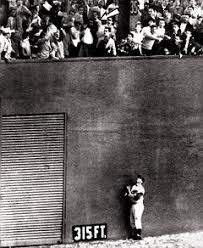
On June 15, 1951, the Cubs sent Andy Pafko, Wayne Terwilliger, Rube Walker, and Johnny Schmitz to the Dodgers for Gene Hermanski, Eddie Miksis, Joe Hatten and Bruce Edwards. Pafko was the primary target by the Dodgers and was acquired to shore up their left-field position in preparation for a World Series run. However, his season was not to end as anticipated by him or the Dodgers. On October 3 during the final game of the playoffs with the New York Giants, Pafko had a close-up view of the aforementioned Bobby Thompson home run as it crossed over his head and the left-field fence, thereby denying him and the Dodgers trip to the Fall Classic.
“[Ralph] Branca walked by me in left field. I hit him in the back. ‘Go get ’em, Ralph,’” Pafko recalled later. “But I was doubting. Branca threw a ball. Then came this shot. I started back. In Ebbets Field, I might have gotten it. In the Polo Grounds, it was gone. The moment was my biggest letdown ever.” (Note: The left-field fence at the Polo Grounds was only 315 feet from home plate).
Then in 1952 something off the field and unusual happened to Andy Pafko. Topps issued its signature baseball card set. It is truly the card set of all sets. There were many baseball heroes of the day that could have been featured as the first card in that set but Topps chose Andy Pafko as #1 in its landmark debut set. Sy Berger, then a 28-year-old veteran of World War II, designed the 1952 Topps baseball card set with Woody Gelman on the kitchen table of his apartment on Alabama Avenue in Brooklyn.

Although the reason for his number one status is not clear, other than a Brooklyn connection, Pafko’s card maxed out at much more than those of many other much more high profile stars.
“Nearly 40 years after his last major league season, Pafko was astounded to learn that one of his 1952 Topps trading cards had sold for $83,870 at an auction in Washington,” wrote Richard Goldstein in a New York Times article. “The card, found by a collector in an unopened pack for which he paid $1,000, according to Sports Collectors Digest, was in mint condition.”
Pafko lamented with a laugh that he had received boxes of cards from Topps in the 1950s but never kept any.
“I just gave the cards to the kids in the neighborhood and they put them in their bicycle spokes,” he told The Associated Press. “And there went the money — click, click, click.”
The 1952 season was to be Pafko’s last with the Dodgers and it was a good one on all counts. During that season he played 150 games in a 154-game schedule. Duke Snider played 144 and Carl Furillo 134. Pafko played primarily in left field but also appeared in center field, right field and at third base.
That had to be a dream outfield. Duke Snider climbing the wall to bring down long flies, Carl Furillo playing the right-field wall at Ebbets Field like a squash player and Andy Pafko diving for anything remotely close to him. During the 1952 season, Snider had 13 outfield assists, Furillo had 12 and Pafko had 18.
Pafko’s 1952 season with the Dodgers was also a very productive one offensively in which he hit .287 with 19 home runs along with 87 RBI. He had an OBP of .366 and OPS of .803. All of those stats ranked around twelfth best in the National League.
His first two seasons with the Braves in 1953 and 1954 were comparable to his last season with the Dodgers, although he played right field. However, during his last five years with the Braves, he was relegated to part-time duty, having been replaced in right field by a young upstart named Hank Aaron.
In yet another twist in the wonderful, unpredictable world of baseball, Bobby Thompson was traded by the Giants to the Milwaukee Braves in 1954 making him teammates with Andy Pafko for four years. As might also be predicted, they roomed together on the road.
“I had to ask him how he felt personally when he hit the home run,” Pafko once told The Journal-Sentinel of Milwaukee. “But he was such a modest guy, he didn’t want to talk about it.”
Another interesting Pafko anecdote was related to DCN Sports Editor Joel Becker in 2004 in which Pafko claims to have hit the longest ever home run.
“We were playing the Boston Braves [on the road], who became the Milwaukee Braves. … I hit a home run over the left-field wall. And at the precise time I hit it — there was a railroad track — an empty, slow freight train was coming by, pulling empty coal cars. And that ball landed in a coal car and went from Boston to New York — 320 miles.”
Andy Pafko was born in Boyceville, Wisconsin so it was only befitting that he would finish his career with the Milwaukee Braves. It may also have been the reason he was traded by the Dodgers. That is, to give the newly minted Milwaukee Braves a homegrown star. He retired after the 1959 season with a career batting average of .285 and 213 home runs.
“Handy Andy” – as he was known because of his versatility – died on October 8, 2013, at the age of 92.
I love these stories – thank you.
I also loved the story about “Handy Andy”. Thank you for writing on the great 1952 year he had with the Dodgers and his comments on that epic game with the Giants, How ironic was it that he ended up being Thompson’s roommate. I also began my love for the Dodgers due to that golden voice of Vince Scully just as I fell in love with my favorite hockey team with the calls of Foster Hewitt…..”he shoots, he scores!”
Wonderful story DC, as usual!
On April 19, 1952 I was celebrating my 1st birthday.
Now that is more than a coincidence.
I think it is more than amazing that Andy’s was the No. 1 card in the first Topps set ever.
Great post.
Hi Badger.
For those who may be interested, here you can see the salaries of each player of each team of each league and each sport!
https://www.spotrac.com/mlb/los-angeles-dodgers//payroll
Morning guys – yet another interesting post. Coming here has become a daily Dodger education for me, be it historical stuff, or news about our Farm System.
This site has really taken off IMO, and goes from strength to strength.
Mark has always been a good Front Man, but the introduction of AC, and then DC followed by 2D2 has undoubtedly made this the best Dodgers site out there.
It takes a strong personality to share something they created, and although I’m aware Mark needed some assistance, allowing these great writers to come on board has proven to be a master stroke.
The fact that the boys obviously enjoyed the site, and wanted to get involved is the key.
I really do enjoy coming here a couple of times a day, and has made my whole enjoyment of following the Dodgers that bit more enjoyable.
I first posted in 2012 – where has that 8 years gone? This place has a feeling of family about it. I’d never ever considered being on a Blog, and over the years I’ve read some excellent contributions from many talented and funny people, some who are no longer with us, and some that have left.
So, it pleases me greatly when I read this morning your Olive Branch to Badger, who, for me was undoubtedly the most interesting and amusing commentator that we have had here.
To me, it feels like he should be here, and LADT is not complete without him.
I remember well the pictures you posted of him, yourself and Roger at Spring Training together. You were friends.
Like all friends you have your ups and downs, but unfortunately you began to deliberately press each other’s buttons.
Some of it was amusing, some uncomfortable, especially the personal stuff.
I have always hoped that one day the pair of you could reconcile.
Many posters here know Badger. He would make this place even better.
I hope you two can make it work, and well done Mark for getting things moving.
I would like to add that if you could persuade Michael (Bear) to contribute here, he would be a great addition. I know that you have a bit of history, but he has mellowed from the early days of LA Dodgereport, and has probably learned a bit, like we all have. I stupidly got into it once with AC a while back, but we buried the hatchet, and I respect him greatly.
I read there every day as well, and Michael has an unbelievable knowledge. He would also make this place better.
Sorry to drone on, but I just wanted to say how much I miss MJ, and her upbeat enthusiasm and caring nature.
She too was a great contributor and a massive loss on here.
Cheers everyone.
If Badger wanted to know the truth and accept it he could be here. He was mad at me so he accepted what was easy, but not factual.
Michael made a comment in the beginning that essentially said that anyone who liked Grandal was an idiot… and you well know I don’t back down and will give it right back.
Michael and Badger are the voices of reason over there. It would take a conversation first. I am easy to get ahold of.
Watford – thank you for the kind words. Evan Bladh was recently added as a writer. He has a tremendous knowledge and practical experience regarding Dodger “stuff” and could function as a clean up hitter on this site.
DC – my bad – totally forgot our new signing Evan. I enjoyed both of his articles so far.
Apologies Mr Blade (see,-i do read it all-)
If you want a great read of Dodger memories from the 40’s and 50’s, I would highly recommend Carl Erskine’s book “Tales From the Dodger Dugout” for an very interesting and informative series of short memories of his time with the Dodgers. Note that the book not only contains great photos of the players and evocative stories, but also is loaded with his personal thoughts on his life after baseball. Vin Scully wrote a great forward which is worth reading as well.
Carl is still living in his is boyhood hometown, Anderson Indiana, and has always been a great leader in the community and a terrific husband and father. When I was nine years old, I first met Carl after he kicked of the Opening Day for the Middletown, IN Little League in 1963. I was able to speak to him for just a few moments and he told me to play the game the right way and to always exhibit good sportsmanship before he signed my glove. I wish I still had that glove to this day.
Nice and interesting, dennis. Thank you.
Carl used to be my banker. You can count on one hand men that are better in the history of the world.
This column really brought back some special memories today. My first time to visit a major league ballpark was one night in Sportsman Park in St Louis. I was a Dodger fan living a 100 miles east of St Louis, a Dodger fan in a territory where everyone rooted for the Cards. That night Jackie Robinson received a minor injury and was replaced by Wayne Terwilliger. Andy Pafko pinch hit for Bud Podbielan (remember him?). Campy hit a home run, and the Dodgers won. Those were the days before Harry Carey went to Chicago. The “free bridge” over the Mississippi cost a dime to cross. The Arch came several years later.
You have a good memory.
Wayne Terwilliger is still living. Bud Podbielan died in 1982 at age 58.
That game was on July 27, 1951. Podbielan pitched a strong 3.2 innings.
I really enjoy these blasts from the past. I feel like a youngster at a mere 68. My first memories were at the Coliseum in ’58 with my dad, which were, unfortunately, some of the only times we ever shared together. I would have loved to have visited Ebbets Field just one time, but alas… Please keep the stories coming.