

Earlier this year there was a ceremony in Georgia at the birthplace of Jackie Robinson. The plaque showing where his birthplace was had been vandalized. MLB felt it should be replaced and donated 40,000 dollars for a new plaque to be placed there, and in another location near the center of Cairo, Georgia, where he was born. I watched the ceremony on MLB.TV.
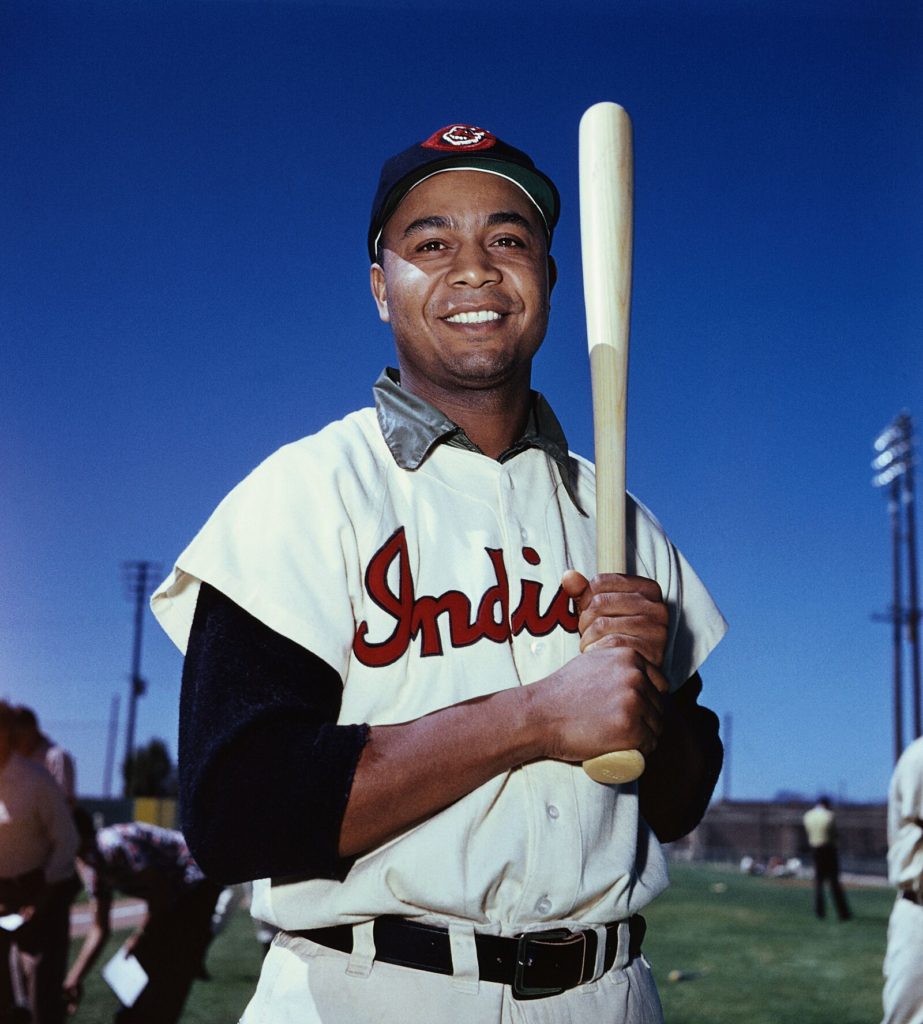
But that also got me thinking about the first Black player to play in the American League, Larry Doby. Did he face the same kind of discrimination that Jackie did? How did he handle the pressure? Lawrence Eugene Doby was born on December 13, 1923, in Camden South Carolina. His father was David Doby and his mother was Etta Brooks. His dad served in WWI. He was a horse groomer and played semi-pro baseball. But he drowned in an accident in NY state at the age of 37. His mom had divorced his dad before he died and she moved to New Jersey. Doby remained in Camden and lived with his grandmother for a while before moving in with his father’s sister until 1938.
After completing the eighth grade, he moved to Patterson N.J. to be reunited with his mom. She would visit him weekly while he lived with one of her friends. At Patterson East Side High School, he was a four-sport athlete, lettering in track, basketball, football, and baseball. After winning the state football championship the team was invited to play in Florida. The promoters would not allow Doby, the only black player on the team to play. As a result, the team decided not to go in a show of support for their player.
During summer vacation he would play with a black semi-pro team alongside Hall of Famer, Monte Irvin, who was a SS at the time. He also had a short stint with the Harlem Renaissance basketball team, as an unpaid sub. Upon completing HS he accepted a scholarship to Long Island University as a basketball player. But in the summer before he enrolled at LIU, he accepted an offer to play for the Newark Eagles of the Negro National League. As a result, he transferred to Virginia Union University. He played for the Eagles at age 17 for 300.00. It was understood he would play until September when classes started. To protect his amateur status he signed under the name, Larry Walker and it was said he was from Los Angeles. He played his first professional game at Yankee Stadium.
His career with the Eagles was interrupted when he went into the US Navy. He spent most of 43 and part of 44 in the states before being sent to the Pacific. While stationed on Ulithi in the Pacific, he heard the news of Robinson signing a pro contract with the Montreal Royals on AFRN, ( Armed Forces Radio Network), and began to believe he could have a career in major league baseball.
Upon his discharge, he married his long-time girlfriend, Helyn Curvy in the summer of 1946. He returned to the Eagles and helped them win the Negro World Series Championship over Satchel Paige and the K.C. Monarchs. Most Negro League players believed that Doby or Irvin would be the first to break the color barrier, not Robinson. Doby was not thinking that far ahead, having lived in the south, he knew blacks would not be universally accepted in the game.
Bill Veech, who owned the Indians, had proposed integrating baseball back in 1942. Of course, that was shot down quickly. He set out to find a player he felt had the skills to play, and the temperament to withstand the taunts and pressure of being the first black player in the AL. Several people suggested Doby. Doby was highly rated by the Dodgers. But unlike Rickey, who signed Robinson one full year before he came to the majors, Veeck left Doby with the Eagles. His reasoning was that one day, the players would step on the field and there would be a black player there with them.

Unlike Rickey, who refused to pay the Monarch’s for Robinson, Veeck was determined to purchase Doby from the Eagles. He finally got it done for 15,000$. Doby at the time was a second baseman. But the Indians had Joe Gordon at second, and Lou Boudreau at SS. On July 5th at Comiskey Park in Chicago, 3 months after Robinson’s debut in Brooklyn, Doby made his first appearance as a pro. He struck out pinch-hitting for the pitcher. Needless to say, he was not welcomed warmly in the clubhouse or on the field. Several teammates refused his hand when he offered it. And for several minutes when he went out on the field for warmups, he was ignored by his teammates. Joe Gordon came over and started playing catch with him. Gordon would become his best friend on the team.
On that day, Doby became the first player to go from the Negro Leagues directly to the majors. After the game, Doby showered and left with his escort, Louis Jones, who took him not to the Indians hotel, but to the black hotel, DuSable, near Comisky Park. It started a pattern of segregation from the team that would continue for his entire career. Of course, there were some city’s where he stayed with the team, but in spring training and most of the season, he stayed in black hotels.

Doby only appeared in 29 games his rookie season. He hit a paltry .156. In the off-season he signed to play with the Patterson Crescents of the American Basketball League. He was the first black player to join the league. Although his performance during the season in no way matched what Robinson achieved in his first season in Brooklyn, being named the first Rookie of the Year and helping the Dodgers to the World Series against the Yankees, the best was yet to come for the young man from Georgia. It would take a lot of hard work, a position change, and the team believing in his skills.
The Indians trained in Tucson Arizona in 1948. And again, not allowed to stay with the team, Doby and Paige, and Minnie Minoso stayed with a black family during spring training and used a rental car provided by the Indians to get to the training center. For Doby, spring was all about learning how to play the outfield. And he had two very good coaches. Hall of Famers, Tris Speaker and Hank Greenburg. He also credited Indians coach, Bill McKecknie, with helping him adjust to the majors and learning the outfield.
He solidified his roster spot in spring training when he hit a homer against the Giants in a game in Houston that most who were there said traveled over 500 feet. It landed well beyond the CF fence. In his rookie season, he hit .301 in 121 games with 14 HRs and 66 RBI’s. He also went through the same verbal abuse and harassment that Jackie faced in 47. So much so that Veeck appealed to AL president Will Harridge for support in reining in the players’ animosity towards Doby.
The Indians were in the Series against the Braves in 1948. Doby did his part contributing to the Championship by hitting .318 with a homer and 2 RBI’s. His HR was the first by a black player in the World Series. There was a photo in the paper the day after game four showing Doby and Steve Gromek, the pitcher, embracing after the game.
With the extra income from the series, and appearing in the movie, “The Kid From Cleveland”, Doby and his wife attempted to buy a house in Patterson in an all-white neighborhood.
They were kept out by a petition from members of the community. But Patterson’s city mayor intervened on their behalf and they got their house.


In 1949 Doby was selected to his first all-star team. He joined Robinson, Campanella, and Newcombe as the first black all-stars. He hit .280 with 24 HRs and 85 RBI’s. In 1950, he increased his HR and RBI totals to 25 and 102 and hit .326. His career-high. And he was considered the best CF in the game by The Sporting News.
Injuries started to take their toll in 1951. His BA shrunk to .295 and he had 20 HRs and 65 RBI’s. Greenburg reduced his salary due to the lack of production. Doby refused the reduction in pay saying his injuries played a part in his performance. This assertion was verified by his manager, Al Lopez. But back in those days, a player had no recourse because of the reserve clause and they could be renewed without their signature.
Doby was taking heat in the press at this time also. He was blamed by sportswriter, Gordon Cobbledick, of the Cleveland Plain Dealer for being a loner and a messed up guy. Doby shot back about black players being thrown at more than white players. An assertion that was confirmed by Sam Lacy, who wrote in the Baltimore Afro-American that statistics showed that 8 players in both the American and National leagues were hit a total of 68 times. An average of 8.5 times per man. No other player in either league was hit as many as 8 times.
To help get his legs in shape one month before the 1952 season, Doby employed former Olympic track and field athlete Harrison Dillard to come to his home and help him prepare his legs in hopes of reducing injuries. He started doing a lot of lower leg work. Leg injuries continued to bother him early in the season. But on June 4th, he hit for the cycle and by the end of the season, he was second in the league in RBI’s to teammate Al Rosen. He also finished with 104.
In 1953 He got a raise from 22 to 28,000 dollars. His average dropped to .263 and he led the league in strikeouts with 121. But he had over 100 RBI’s again. In 1954 the Indians would win the AL pennant again. He was made an all-star for the sixth time, and he hit a PH homer in the all-star game. The first HR by a black player in the all-star game. As the season progressed, he helped the Indians win 111 games with 32HR’s and 126 RBI’s. The Indians were swept in the series, and Doby hit .125.
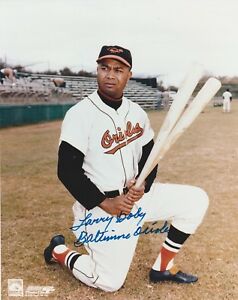
His stats dipped a little in 1955 and the Indians traded him after the season to the Chicago White Sox for Jim Busby and Chico Carrasquel. He played two seasons for the Sox, but after knocking in over 100 runs in 56, his total dipped to 79. After the season he was part of a package deal to the Orioles for Tito Francona, Billy Goodman, and Ray Moore.
He never played a regular-season game for the Orioles as he was traded on April 1st with Don Ferrarese to the Indians for Bud Daley, Dick Williams, and Gene Woodling. He had a decent year with the Indians, but he clearly was not the player he once was. Leg injuries had robbed him of range and power. He was traded to the Tigers for Tito Francona. But in May of 1959, he was sold to the White Sox for 30,000 dollars.
He was found to have a degenerative bone condition before the 1960 season, and his MLB career was over. Doby finished with a .287 BA 273 HRs and 1094 RBI’s. He did play one season in Japanese pro ball along with Don Newcombe in 1962 with the Chunichi Dragons. He and Newk were two of the first Americans to play there.
He then returned to the US and his work as a liquor retailer. In 1969 Doby became a scout for the Expos and was their batting instructor under Gene Mauch for their minor leaguers. He became the Expos batting coach in 1971 and served in that capacity until 1973 when Mauch was fired. He went back to the Indians as a coach but was let go when Ken Aspromonte was fired and Frank Robinson hired as MLB’s first black manager.
Doby was managing in the Venezuelan winter league for several seasons during this time. In 1976 Veeck bought the White Sox and hired Doby as the team’s hitting coach. In 1968 with the team floundering, Veech fired Bob Lemon and made Doby the manager. He was thus the second black manager in MLB. He finished the season, but Veeck hired Don Kessinger and returned Doby to the batting coach role. Doby retired from baseball and became the Director of Communications for the New Jersey Nets. He would stay in that capacity until 1990.
He would be named special assistant to the AL’s last president, Gene Budig in 1995. Doby suffered through the same situations as Jackie Robinson did. He handled them with the same kind of grace. Nobody ever said they were going to treat the second black any better than they did the first. Doby was one of the pallbearers at Jackie’s funeral.
In 1998, Doby was elected to the Hall by the veteran’s committee. He was notified of his election by Hall of Famer Ted Williams. He said it was as if a bale of cotton had been lifted off of his shoulders. Doby and his wife had five children, six grandkids, and four great-grandchildren. They moved to Montclair New Jersey and one of their neighbors was Yogi Berra.
Doby had a kidney removed in 1997. His wife Helen, died in 2001 after a six-month battle with cancer. Doby himself passed away on June 18th, 2003 of cancer. President Bush and Bud Selig both made statements about his contributions to the game and his character. Larry Doby was every bit the pioneer in the game of baseball as Jackie Robinson was.
Excellent article.
Thanks. I really appreciate it.
Great job Bear. Does the “needle” move in the ongoing lockout saga during today’s meeting between MLB and the MLBPA? The owners are set to make an economic proposal so we’ll see if there is any optimism that an agreement can be reached and a start to ST and a regular season can be assured.
I have my doubts an agreement can be reached despite Manfred’s assertion that a loss of games played would be disastrous for baseball. Hope I’m wrong and we will read that some substantial progress is being made, an agreement will be reached quickly and the lockout ends. I do see the Dodgers as serious contenders for Freddie Freeman and I’m hoping CK retires and doesn’t sign with the Rangers.
KJ will not be back and when you examine the Dodgers BP they’re loaded and don’t really need KJ and the $15-20 million AAV it will cost them. A healthy Gonzalez, Kahnle and Ferguson along with Graterol, Hudson, Vesia, Phillips, White, Treinen, Bickford and Bruhil and some young kids on the farm make the BP options look very promising.
Go Rams!
I have my doubts that the needle will move at all. The Dodgers relief corp’s has two pitchers who have closer experience, Trienen and Hudson. If Kahnle is healthy, he has the kind of stuff you need to close. Graterol needs another pitch to go along with his fastball. If anything, they are a wee bit thin in experience from the left side. Bruihl did a nice job last season as did Vesia. But they really missed the work they got from Gonzalez in 2020. Gonzalez has been on a serious diet and has dropped a lot of weight. We will see how that will affect his stuff. Hopefully Fergie is healthy and can contribute also. He did a fine job before his arm surgery.
Great article today Bear. I wonder how much that first WS home run ball by a black player would be worth today. I’d bet quite a bit.
Ditto Norcal, Go Rams!
I put my money where my mouth (fingers?) are, Jr
Just put $200 on LA to cover here at the Pallazo.
Good morning guys just curious why the owners were pushing for a mediator ? Would he have been impartial or sway things owners way. Could mediator sped this process up ?
Thanks have blessed day !!
Lots of reasons:
1. The union felt the last mediator wasn’t receptive to their POV
2. The union felt that to the point we are at now, they had made all the concessions. This could lead to a mediation where the middle point was not equitable. As per Old friend Alex wood: “How can MLB request for there to be a mediator from the federal government to help with negotiations when they literally haven’t even done any negotiating up to this point? Asking for a friend,”
3. The union, as evidenced in the following quote, felt the owners were using the mediation as a time suck. “Two months after implementing their lockout, and just two days after committing to Players that a counterproposal would be made, the owners refused to make a counter, and instead requested mediation,”
Great article, Bear!
Doby is under appreciated for his contributions to the MLB.
Thanks for educating us on his great career and his path to the major leagues.
Great write up Bear. It’s kind of sad how Larry Doby was forgotten by the media and the fans over the years. I remember him when I was a kid, but had no idea he was the first black player in the AL. I’m sure he went through the same terrible situations as Jackie because of him playing in the AL where those cities hadn’t been exposed to a black man playing in the major leagues.
Thanks Bear, for another great article. I certainly remember Larry Doby and the fact that he was the first black player in the AL, but I learned so much more about him from your article. I just love when you go back to the ’50s, my favorite era in baseball.
In your article you mentioned Chico Carrasquel being in one of the Larry Doby trades. I believe I read that he was the first AL All Star that was born in a Latin American country. Maybe an article about the first Latin American born MLers would be interesting.