
FRANK “HONDO” HOWARD THE GENTLE GIANT (Friday)
In 1999 Nike came out with a clever commercial featuring Tom Glavine, Greg Maddux, Mark McGwire and Heather Locklear. Rather than pay attention to the Cy Young award winning pitchers, Glavine and Maddux, Heather swooned over Mark McGuire and his ability to hit the ball over the fence. After a stringent work out regiment, Glavine and Maddux hit some out in batting practice and, for the first time, Heather Locklear

In 1999 Nike came out with a clever commercial featuring Tom Glavine, Greg Maddux, Mark McGwire and Heather Locklear. Rather than pay attention to the Cy Young award winning pitchers, Glavine and Maddux, Heather swooned over Mark McGuire and his ability to hit the ball over the fence. After a stringent work out regiment, Glavine and Maddux hit some out in batting practice and, for the first time, Heather Locklear noticed them, causing Maddux and Glavine to congratulate each other and say “Chicks dig the long ball.”
If the statement is true, then Heather Locklear would have gone completely gaga gaga over Frank “Hondo” Howard who, without the aid of performance enhancing drugs, could hit the ball a long, long way. Before there was a Mark McGuire, Jose Canseco, Aaron Judge or Giancarlo Stanton, before there were Belli Bombs, came one Frank “Hondo” Howard. Frank Howard, who played several years for the Dodgers, hit some of the longest homeruns on record. He hit a 500′ home run into the upper deck in the left field bleachers of RFK Stadium. He also hit one that traveled an estimated 562′ feet in Forbes Field in Pittsburgh. He once hit a home run one handed while playing for the Detroit Tigers. In the first game of the 1963 World Series, he hit a 460′ double off Whitey Ford that was the longest double in Yankee Stadium history. In the forth game, again off Whitey Ford, he hit a home run 450 feet into the upper deck in deep left field. Only four players, according to the Dodgers, ever reached the loge level (second level) with home runs: Frank Howard, Dave Kingman (twice), Dave Parker and Nick Esasky. Howard was the first to do it, and it would be another 41 years before another player duplicated that feat. In one week in 1968, Howard hit 10 homeruns in 20 at bats!! He is one of three players (along with Harmon Killebrew and Cecil Fielder) to have reached the top of the left-field roof at Tiger Stadium. Some say he is the only player ever to whack a fair ball out of Yankee Stadium (though the umpire ruled it foul, outfielder Bobby Murcer said it was fair). He hit 24 homeruns into the upper deck at Washington’s RFK Stadium. They painted the seats white where the home runs landed. During 16 big-league seasons, Howard hit 382 home runs, the most ever for a man his size. What’s even more amazing, he did it without the use of steroids or other performance enhancing drugs. His home runs came from sheer physical strength. No one ever accused Howard of cheating. As one reporter put it:
“Putting Howard on steroids would’ve been like giving Popeye an extra can of spinach
Frank Howard was a giant of a man, both literally and figuratively. At 6′ 8″ 260 lbs he was physically imposing. But, in character, he epitomized the term the “Gentle Giant”. He was one of the nicest men to play the game. “Frank is probably the most popular guy — in any sport — in the city, and he still is,” teammate Hank Allen said. “I don’t know anybody who was more humble than him.” Dusty Baker said of him, “He’s the most pleasant gentle giant of a man that I know.”
Frank Oliver Howard was born August 8, 1936, in Columbus, Ohio, to John and Erma Howard, the third of six children. Frank grew up modestly.
“There was always lots of food on the table,” Howard remembered, “but if we kids wanted money, we had to earn it.”
And that’s just what Frank would do. He shined shoes, caddied, and didn’t shy away from hard manual labor.
“When I was 14,” he recalled, “I worked a hundred-pound jackhammer in the streets for the city of Columbus, got paid maybe a dollar and a half an hour and was glad to get it.”
When he was in his sophomore year at Columbus South High School, he had grown to 6-foot-5, 195 pounds. I can relate to being tall in high school. I was 6′ 4″ entering the 7th grade. Only difference between me and Howard, albeit ever so slight, was that I weighed a whopping and muscular 135 pounds when I graduated high school.
Frank’s father played semipro baseball and encouraged his son’s interest in the game. Howard did not develop any interest in football, but he did play basketball. I was not able to find any information about his high school statistics, but I did learn that Howard was good enough to be widely recruited to play college basketball. Howard became a basketball star for the Buckeyes, earning All-American honors as a junior, and setting a Madison Square Garden record in a holiday tournament with 32 rebounds in a game, and 75 for the three games. Howard played three basketball seasons (1956-58) for Ohio State. He averaged 20.1 points and 15.3 rebounds in 1957 when he was a first team All-American. He led the Buckeyes in both scoring and rebounding in 1957 and 1958 and made All-Big Ten both seasons. He was also drafted by the Philadelphia Warriors of the NBA. He also played baseball for Ohio State, eclipsing the .300 mark in two seasons and displaying occasional glimpses of the power for which he would become known. He was named All-American once. What’s even more amazing, is that since they didn’t offer scholarships like they do now, and because he came from a family that couldn’t afford to pay his way, Howard would get jobs around campus to help pay his way. One of the jobs was working on a cement crew. The foreman told Howard’s coach Floyd Stahl,
“Frank does twice as much work as any laborer I’ve had.”
The Brooklyn Dodgers started scouting Howard when he was a sophomore at OSU. Scout Cliff Alexander filed a telling report:
“Good arm. Fielding below average. Hitting below average (good potential). Running speed slightly below average. Major league power. Definite follow.”
After his final basketball season ended, Howard let major-league scouts know that he was ready to sign. He had a lot of offers, but the Dodgers had been talking to him for a couple of years and he never seriously considered any other team. Alexander remembers Howard calling him up to tell him that Paul Richards, who was running the Baltimore Orioles at the time, had offered a $120,000 bonus. Howard asked Alexander for $108,000—$100,000 for himself, and $8,000 to be put toward a new house for his parents. Alexander agreed, and Howard was on his way.
Howard started his Dodgers career in 1958, with the Green Bay Bluejays in the Class-B Three-I League. Former Brooklyn star outfielder Pete Reiser was his manager. Howard hit .333 and led the league with 37 home runs and 119 RBI. He was named the league’s Most Valuable Player.
His debut was impressive enough that the Dodgers called Howard up to the big leagues in September. He made his debut on September 10, 1958, at Philadelphia’s Connie Mack Stadium. He would go 2-4 off Robin Roberts including a a mammoth two-run home run in his second big-league at-bat. Apparently, the homerun hit a billboard atop the left-field roof, causing left-fielder Harry Anderson to say “I was afraid the billboard was going to fall over onto my head. A few games later, in a game against Cincinnati, Howard came to bat with Duke Snider on third base. Up in the radio booth, Dodgers announcer Vin Scully commented wryly that Snider was standing way off the foul line in deference to Howard’s propensity for pulling line drives down the line. Just as Scully said this, Howard hit a vicious line drive that hit Snider in the head, knocking him briefly unconscious and ending his season. For his brief appearance in 1958, Howard hit .241 in 29 at-bats, with the one home run and 2 RBI.
In 1959 the Dodgers sent Howard to Victoria of the Texas League. Once again, he handled the league rather easily. In the first 63 games Howard had hit 27 home runs, with 79 RBI, and a .371 average. The triple crown seemed in reach. While GM Buzzie Bavasi was on a scouting trip to the team, Howard happened to hit a 520-foot home run to win a game. That was enough Howard to be brought back to Los Angeles. However, Howard only stayed a week, going just 2-for-19 before getting optioned out to Spokane (Triple-A Pacific Coast League). While there, he hit .317 with 16 more home runs. Howard would return to the Dodgers in mid-September. Because the Dodgers were in the midst of a pennant race, Howard only got two at-bats. One of which was a pinch-hit home run off the Cardinals’ Lindy McDaniel. The Dodgers did win the pennant and the World Series, without any contribution from Howard. After the season Howard was named Minor League Player of the Year by The Sporting News.
Despite having only 50 major league at-bats, by the spring of 1960, Howard was a much discussed player. Stories were being told of his 500-foot minor-league home runs, and that he hit his line drives so hard that they scared base runners and infielders. Visions of the next Babe Ruth were not uncommon. Jim Gilliam shared the opinion of many when he said of Howard, “a man that big should hit fifty homers every year—and I mean every year.”
In 1960, the Dodgers had a good combination of old and young outfielders. They included Tommy Davis, Ron Fairly, Willie Davis, and Howard. Duke Snider and Carl Furillo were still on the team but by May, Furillo retired which opened a spot on the team for Howard, who had been sent back to Spokane to start the season. Soon after his call up Howard became the regular right fielder and, despite a late-season slump, ended up hitting .268 with 23 home runs. This was good enough for him to be named the National League Rookie of the Year.
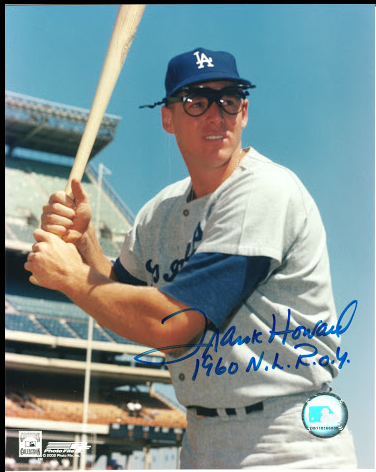
In 1961 Howard had chipped a bone in his thumb. As a result, his season started very slowly. He started just 72 games, but he did hit better than his rookie year, .296 with 15 home runs in just 267 at-bats.
After the 1961 season the Dodgers lost both of their first basemen, Gil Hodges and Norm Larker, in the expansion draft, causing them to move Ron Fairly to first base. This opened up more playing time for Howard. He started 123 games in 1962, and hit .296 with 31 home runs (seventh in the league) and 119 RBI (fifth). With the power though, came the whiffs. He struck out 108 times and only walked 39 times. The Dodgers won 102 games that year but lost to the Giants in the playoffs (it actually hurt to type that!)
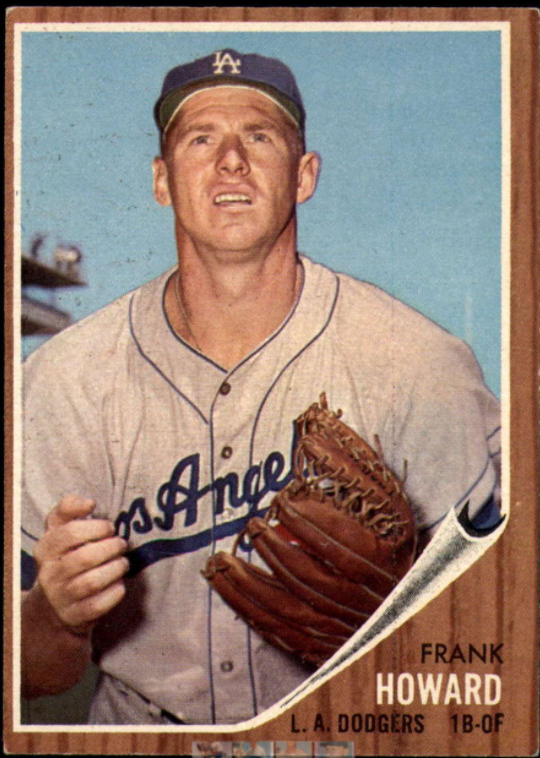
In 1963 Howard learned that his vision was screwed up (20/40 vision in his good eye and 20/60 in his left). He was fitted for some glasses and hit three home runs in four games He was fitted for some glasses and hit three home runs in four games after he started wearing them. After a hot start to the season, Howard slumped in May, which cost him his full-time job. He then platooned with Wally Moon for the rest of the season. Howard still managed 28 home runs (by far the most on the team) and a .273 batting average in 417 at-bats. But even with the glasses, he set an all-time Dodgers record with 116 strikeouts. Despite that, Howard would wear glasses for the rest of his career.
After the 1963 season Howard was 27 years old and people no longer believed he would turn into Babe Ruth. Many would come down on him because he was seen as less than their expectations. Howard, though, had a more measured view.
“I think I am a realistic guy,” he said. “I have the God-given talents of strength and leverage. I realize that I can never be a great ballplayer because a great ballplayer must be able to do five things well: run, field, throw, hit and hit with power. I am mediocre in four of those — but I can hit with power. I have a chance to be a good ballplayer. I work on my fielding all the time, but in the last two years I feel that I have gotten worse as a fielder. My greatest fear was being on the bases, and I still worry about it. I’m afraid to get picked off. I’m afraid to make a mistake on the bases, and I have made them again and again, but here I feel myself getting better.”
In 1964 both Buzzie Bavasi and Walt Alston told Howard that he would play regularly that year. Howard started the first 49 games of the 1964 season, but hit just .215 despite 14 home runs (second in the league to Willie Mays). At which point Alston began to platoon Howard again. He ended the year with 433 at-bats, 24 home runs, and a .226 average. After the season, Howard asked to be traded. Because Bavasi and Alston had come to believe that you could not win at Dodger Stadium with power, and that they needed to improve their pitching, defense, and speed, they obliged Howard. On December 4th Howard, along Ken McMullen, and pitchers Phil Ortega and Pete Richert were traded to the Washington Senators for pitcher Claude Osteen, infielder John Kennedy, and $100,000. I was heartbroken when this trade was made, as a 13 year old, I was definitely among those who thought Howard would be Babe Ruth, or at least Roger Maris. While there are arguments to be made as to who benefitted the most from the trade, Osteen stabilized the rotation and helped the Dodgers win the World Series in 1965.
Howard, on the other hand, went on to become one of the most popular players, if not the most popular player, in Washington. At the time of the trade, the Washington Senators were an expansion team that had lost at least 100 games in their first 4 years. In 1965, Howard battled injuries all year, but played 149 games and hit .289 with 21 home runs and 84 RBI, all team-leading figures. For the first time, he played mainly left field rather than right.
In 1966 his statistics were about the same (.278, 18, 71 in 146 games). Bear in mind this was in the era of the pitcher and run scoring was really depressed. Although Howard was not a star, his OPS of .790 compared favorably to the AL’s .670. Although he wasn’t tearing things up statistically, he continued to add to his legend, with his long home runs. One of note was hit against the White Sox at D.C. Stadium.
“Tommy John threw him something,” recalled teammate Fred Valentine, “and he hit a line drive back at him. John fell off the mound trying to get out of the way of the ball. Center-fielder Tommie Agee started in like he was going to catch a line drive. It was like a 2-iron, and it ended up in the upper deck in centerfield. They painted another seat.”
Before the 1967 season, manager Gil Hodges worked with Howard to retool his swing. He felt that Frank’s level swing was producing hard ground balls, and asked Frank to try a slight uppercut and to stand closer to the plate so he could pull the ball more. The results were immediate, as Howard had 24 home runs by midseason, and finished with 36 (third in the league) and a .256 average. He led the league with 155 strikeouts, and walked only 60 times, but his OPS of .849 was still eighth in the AL. It was his best season to date.
In 1968 Hodges was replaced by Jim Lemon. 1968, is historically recognized as the Year of the Pitcher, as the AL hit .230 and had shutouts in 20 percent of its games. Bucking this trend, Howard took a step forward and became the hitter people had predicted he would become a decade earlier. He hit .338 in April, but his best stretch came in early May when he collected 10 home runs and 17 RBI in a span of six games. In so doing, he set records for home runs in four games (7), five games (8), and six games (10). As late as June 9, Howard held league leads in home runs (22), runs batted in (47), and batting average (.342). As the AL had had Triple Crown winners in each of the two previous seasons (Frank Robinson and Carl Yastrzemski), Howard’s statistics were getting quite a bit of attention. As usual, the slugger himself was less impressed than the media.
“All I’m trying to do is get three good cuts each time up. I haven’t changed my swing, and I don’t kid myself — I’m a streak hitter and I’m hot.”
Howard wasn’t able to sustain the pace, and for the season, he hit .274(which was still 10th in the AL). He also led the league with 44 home runs, 330 total bases, and a .552 slugging percentage, huge numbers for 1968, and he finished second with 106 RBI. He started his first All-Star Game.
“Jim Lemon did a marvelous job with me,” Howard recalled. “He just took it a little further than Gil took it in ’67. He moved me a little closer to the plate, spread me out a little bit more, cut down on the overstride, and as a result, I was starting to get a little more selective at the plate, and probably had my first really good year in the big leagues.”
Chuck Essegian had given Howard the nickname “Hondo” when they roomed together with the Dodgers. The nickname stuck throughout his career, although in Washington he was also known as the “Washington Monument” and “Capital Punisher.”
in 1969, Ted Williams was hired to manage the Senators. Howard credits Williams with the most dramatic changes in his career as a hitter. That spring, As Howard remembers it, Ted came up to him and said:
‘How can a guy who hits 44 homers get only 48 walks? You really like that first ‘number one,’ don’t you?‘ Howard responded, “I confessed that I did, adding that all the other pitches were UFOs (unidentified flying objects) to me. Ted laughed, but then he said: ‘Ever take two strikes to get a good pitch?’ I looked at him as if he was crazy, but then he said, ‘okay, how about one strike?‘
That year, Howard increased his walk total from 54 to 102, while his strikeouts fell from 141 to 96. He took advantage of more hitter’s counts, and ended up hitting .296 with 48 home runs and 111 RBI. He led the league with 330 total bases, and finished among the leaders in on base percentage (.402) and slugging percentage (.574). A cherry on top of his cake that year was hitting a home run off Steve Carlton in the All-Star Game, held at RFK Stadium in Washington, DC.
“I did it without even trying to walk,” said Howard. “I was ready to hit, if it was my pitch, but if it was something other than I was looking for, I took it. I was laying off some bad pitches, getting more counts in my favor, and all because of Ted Williams. He’s one in a million! A marvelous, marvelous, man!”
Can you imagine what Howard’s career might have been like if Williams had got a hold of him 10 years earlier? Williams was impressed with his student.
“He still hit more home runs, some of them out of sight. I mean he crushed the ball. I think without question the biggest, strongest guy who ever played this game.”
In 1970, Howard led the AL in home runs (44), RBI (126), and walks (132). Twenty-nine of his walks were intentional. The Indians were particularly afraid of him, as they intentionally walked Howard 12 times in 18 games. Star pitcher, Sam McDowell, was particularly afraid of Howard, who hit .368 with five home runs in 68 at-bats off McDowell in his career. It might have been worse; McDowell walked Howard 25 times, including nine times intentionally. Twice in 1970 Dark moved McDowell to another position with Howard due up, then moved him back to the mound when the coast was clear.
Having finished his 3 beat seasons, by 1971, Howard turned 34. Feeling his age, he dropped back at bit, hitting .279 with 26 home runs, though his 83 walks helped him remain one of the league’s most valuable offensive forces. Part of the problem may have been the fact that he weighed 197 pounds coming into spring training. Late that season, it was decided that the Senators would be relocated to Texas. In the team’s last game in D.C., on September 30, 1971, Howard hit the final home run by a Washington Senator. After Howard hit the home run, he received a long standing ovation from the crowd.
With Texas, Howard hit just .244 with nine home runs in 95 games before being sold to the Detroit Tigers. He helped the Tigers reach the playoffs, but because he didn’t report to the team until September 1, he was ineligible to play in the AL Championship Series against Oakland, which defeated Detroit in a close five-game series.
In 1972 the AL implemented the designated hitter, which seemed tailor-made for Howard. But it was not to be. Howard, in 85 games only hit 12 home runs and batted .256. He was released in October that year. In 1974 he signed to play with the Taiheyo Lions in Japan. However, he hurt in his back in his first at-bat of Japan’s Pacific League, but he hurt his back in his very first at-bat, and never played again. Howard’s playing career was over at age 37.
After he retired as a player, Howard remained involved with baseball. He managed the Spokane Indians in 1976. The next year he returned to the majors as a coach with the Milwaukee Brewers. He remained in the majors for the next 20 years. He managed the Padres for one year and he also managed the Mets for one season. the next and remained in the majors for most of the next 20 years. He had two brief trials as manager. He led the San Diego Padres in the strike-marred 1981 season, but was let go after the team finished last in both halves of the split season. Howard was well respected as a coach, but his employers seemed to feel that he was too nice a guy to be a successful manager. Besides the Brewers and the Mets, he also served as coach with the Seattle Mariners, the New York Yankees and the Tampa Bay Devil Rays.
When the major leagues returned to Washington in 2005, with the relocation of the former Montreal Expos, Howard became the most visible link to the previous major-league teams that had played there. The Nationals initially played at RFK Stadium. The seats that had been painted for his home runs in the upper deck were still there. In 2008 the Nationals began play in the brand-new Nationals Park. In 2009, they unveiled three statues in their center field plaza, one of Walter Johnson (who pitched for the first 20th- century version of the Washington Senators), Josh Gibson (who starred in the Negro Leagues for the Homestead Grays, who played in Griffith Stadium), and Frank Howard (representing the expansion Senators). When the Nationals reached the postseason in 2012, Howard threw out the ceremonial pitch of the Division Series before Game Four.
From 1967 through 1970 Frank Howard was one of the most fearsome hitters in baseball. He hit 136 home runs between 1968 -1970. The next closest was Willie McCovey with 120. In those three years Frank “Hondo” Howard would hit 16 more home runs than anyone in baseball including the best players in the history of the game. Willie McCovey 120, Hank Aaron, 111, Harmon Killebrew 107, and Carl Yastrzemski 103. No matter how you slice it, that’s an amazing feat.
I glad that I had the pleasure of seeing Frank Howard play. He had some of the hardest hit balls that I had ever seen. If they kept statistics for exit velocity when he played, the numbers would be off the charts. In addition, het could hit the ball a long way. Even though I understood him being traded, I didn’t like it and wished he could have remained a Dodger his entire career. Moreover, if it is true that “chicks dig the long ball,” then women would absolutely have to adore Frank Howard!!
More from Dodger Talk

The Cavan Biggio Experiment is Over!
Note: I am not back, but I am not gone either. The morons have two strikes on them. Whether they stay or go is on them. I don’t know how much I will post, but the thread will be open daily. Have at it. Cavan Biggio was released by the Toronto Blue Jays after hitting .200 this…

A Fan's Biggest Mistake
It’s easy to be a fan. It takes no effort, really. You just root for your team, and if your team is winning… well, you are a fan… and you are happy. To some fans, if the team is not winning, they are no longer willing to be a fan. We call them “fair weather fans.” I have been an…

Ron Fairly Taught Me
I think it was in 1965 or 1966 that I figured out Ran Fairly was not very good against LHP. I was only 12 years old, but every time a LHP went against the Dodgers, I knew that Ron Fairly (who may have been my favorite Dodger at one time) would not do well. To the best of my…

We Don't Know What We Don't Know
We know what we know – that’s the easy part, but what about what we don’t know about what we don’t know? That’s the hard part. So, let’s just stick with what we know or maybe think we know. We know that Will Smith will be the starting catcher . That’s good. He’s likely one of…
Discussion (86)
Disagree, not disagreeable
Finally they sit Betts and put Joc in rf and lead off! Watch the offense take off now!
Thanks Phil. We are good.
To me enough already on Joc!!! Do you how many times we could have sold high or semi high we could have gotten some good pieces on him.. It pisses me off…
Muncy Not Yet, but patience is a virtue…
Take that Mookie! There’s a new sheriff in the lead off role! Now that’s some lead off juice!
Observations so far:
Buehler is having a decent outing. Seems like he’s getting a little bit more grooved every start. Should be ready for the playoffs! Beaty quietly doing real well.
If carrying only 12 position players means Beaty gets more at bats then I’m all for 12 position players.
Nice job by Corey with 2 outs.
Beuhler looking much better which is massive going forward.
Average runs per game:
No other team is over 5.0, regardless of the number of games played.
Oh, and to top it all off, the Dodgers have given up the fewest runs.
Fact: The Dodgers score the most runs per game.
Fact: The Dodgers give up the fewest runs per game.
Fact: Eric is a blowhard!
Another “decent” inning from Striker!
This from JP Hoornstra:
” Minor league pitcher Edwin Uceta is going on the restricted list after he broke the team’s COVID-19 protocol. Uceta had been training at the Dodgers’ alternate site camp at USC. The 22-year-old right-hander went 7-2 with a 3.21 ERA in 16 games (14 starts) for Double-A Tulsa last season.”
Leaving Mendoza in the rear view mirror!
Buehler today. Kersh yesterday. Now we are rolling! Who is going to fill in behind? May has shown he belongs. Urias needs to step up. Gonso (goose) has demanded he is here. Strip has to lay bear on Sunday if he wants to stay in the rotation.
Chicken Strip has 5 starts and a 5.61 ERA. He will get at least 2 more starts, but he better turn it around or he’s in danger of going to the pen.
Gonsolin has 3 starts and no ERA.
Urias has not pitched as deep in most games as is needed, but his ERA is 2.74. He has never had the opportunity to pitch every 5 days over any extended period of time. His stats are better in the pen, because that’s where he has pitched the most. as they tried to limit his innings. He’s learning. It’s a process.
Dustin May is on the clock! I listened to an interview with him today and he really interesting!
Kolarek is a lefty specialist and the 3 batter minimum is going to end his Dodger career, Another “genius” under the radar pickup by AF!
Muncy can’t square up a 2-1 90mph center cut fastball. That’s scary!
Did I miss reading or did you miss mentioning Willie Stargell’s name in this story. Vin brought it up many times that not only was the HR Dodgers Stadiums 1st HR to clear the stadium, it was also the furthest of long balls completely clearing the stadium at 506 feet.
Bluto,
I designed this product several years ago to be like the Heater Treater, NuvoH2O, and others. I would say it is equal to or better… and one thing that makes it better is that it is 100% made in the USA. The housing is made for us by a company in Valencia and the replacement cartridge (https://www.uswatersystems.com/us-water-limeblaster-2-5-x-19-replacement-cartridge-222-seal.html) is made for us by another company in Sun Valley.
Our business model is to sell direct and cut-out-the-middlemen, so that means we have a big price advantage. However, our price does not include installation. That means it is not for everyone. We have started another brand selling to Plumbers, HVAC Dealers, and the like, where all of our products are re-branded with no pricing and they can sell it for whatever they want. http://penguinwater.com/
I can be reached at mark@uswatersystems.com
Good Luck.
I enjoyed your article. Frank Howard was always a class act both on and off the field!
The 60’s may have been the best decade in baseball history when considering great ball players and performance. Frank put up numbers that were as good as anyone who played during those years. Those stats would have been significantly better if the Senators had a couple of more talented hitters in the lineup. There is no doubt he would have hit more than 500 home runs, a career batting average above .280, and many more runs batted in. Hall of Fame numbers!
Frank Howard was a fan favorite, one of baseball’s most respected, exciting and productive players when he played. He spent 50 years in baseball as a player, coach and manager. MLB and ESPN have dropped the ball. They should have done a historical documentary on his career and experiences a long time ago. Imagine the stories he could tell and share?
I was fortunate enough to grow up in the 1960’s and enjoy the game as it was played back then. Baseball has changed, and not for the better. History is important. Lets hope MLB and/or ESPN does the right thing before it is too late. Time is running out.
Maybe someone here can help me.
I was a Dodger fan, as were my parents, when Frank Howard played. I remember him saying that he never hit a ball as hard as he could because, he was afraid that he would hurt someone.
Does anyone else remember that? Or, know where it might be in print?